

After building a platform focused primarily on coding interview preparation, NeetCode expanded into System Design to help engineers develop the skills needed for mid-level and senior software engineering interviews. While the subject matter is very different from algorithms and data structures, the goal remains similar: helping candidates prepare for the types of technical discussions they are likely to encounter during the hiring process.
Whether the course is worth purchasing depends on what you expect from it. Engineers looking for a structured introduction to System Design interviews may find the course provides a clear learning path through many of the concepts that appear repeatedly in interview discussions. Those looking for a deeper understanding of modern distributed systems or a comprehensive study of software architecture, however, should understand where the course’s strengths begin and where its scope becomes more limited.
This review focuses on the course itself rather than its reputation or popularity. The discussion looks at its curriculum, teaching style, interview preparation value, strengths, limitations, and the type of learner who is likely to benefit the most.

What Is NeetCode System Design?
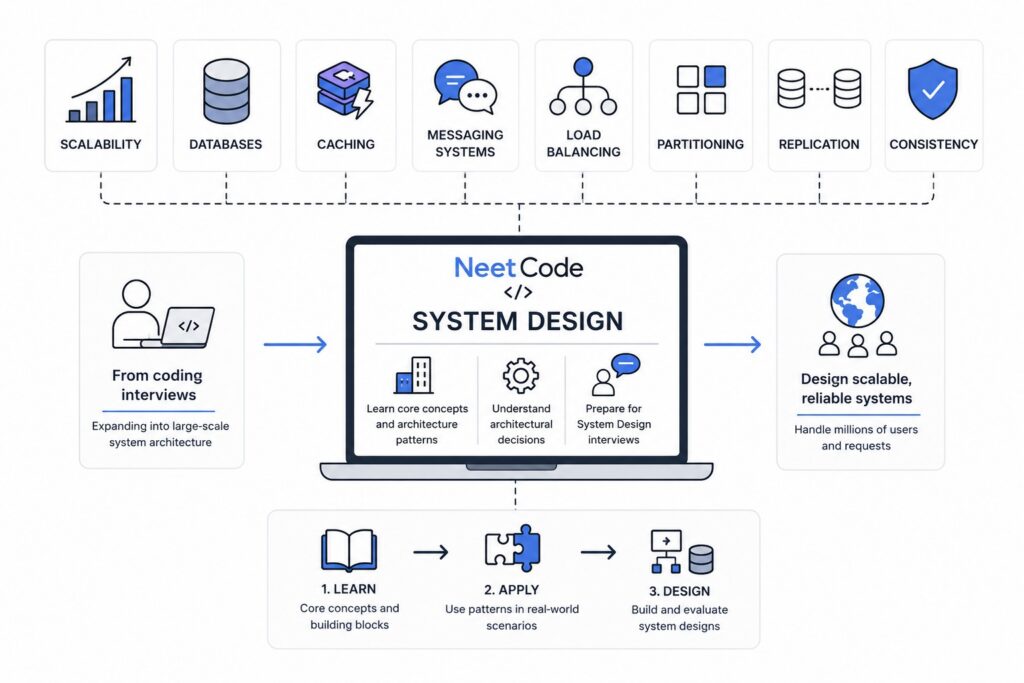
NeetCode System Design is an interview preparation course that introduces the architectural concepts commonly evaluated during System Design interviews. Instead of focusing on writing code, the curriculum shifts toward designing scalable software systems by exploring how services, databases, caches, messaging systems, and other infrastructure components work together to support large-scale applications.
The course gradually introduces distributed systems concepts before combining them into larger architecture discussions. Rather than immediately presenting complete interview solutions, it builds familiarity with the individual building blocks that repeatedly appear across different System Design problems. This progression helps learners understand why architectural components are chosen instead of simply memorizing where they appear in a particular design.
The teaching style closely follows the format used throughout the rest of the NeetCode platform. Lessons are primarily video-based and supported by diagrams and visual walkthroughs that simplify concepts which might otherwise feel overwhelming for engineers encountering distributed systems for the first time.
| Feature | Overview |
|---|---|
| Primary Focus | System Design interview preparation |
| Learning Style | Video-based structured lessons |
| Best Audience | Mid-level and senior software engineers |
| Goal | Build confidence in architectural interviews |
Where NeetCode Works Well
The strongest aspect of NeetCode’s System Design course is its accessibility. Instead of assuming prior knowledge of distributed systems, the lessons gradually introduce architectural concepts in a sequence that feels logical and easy to follow. Engineers who are new to System Design can move through the curriculum without constantly feeling like they’re missing prerequisite knowledge.
The course also succeeds in making complicated topics easier to understand. Concepts such as caching, replication, partitioning, load balancing, messaging systems, and distributed databases are introduced through visual explanations before being combined into complete architectural discussions. That progression makes it easier to understand how individual components interact inside larger software systems.
Another positive aspect is that the curriculum remains focused on interview preparation. Rather than attempting to become an exhaustive software architecture course, it concentrates on helping candidates become comfortable discussing the concepts that commonly appear during System Design interviews.
A Structured Learning Path
Learning System Design independently can feel overwhelming because there is no obvious place to begin. Databases, networking, distributed systems, cloud infrastructure, caching, consistency, and messaging all appear interconnected, making it difficult to know which concepts should be studied first.
NeetCode addresses this by organizing the material into a progression that gradually develops architectural understanding. Each lesson builds upon concepts introduced earlier, allowing learners to strengthen their understanding without constantly jumping between unrelated topics.
Clear and Accessible Explanations
Distributed systems introduce terminology that many software engineers do not encounter during day-to-day application development. Rather than presenting advanced architectural discussions immediately, NeetCode introduces these concepts through diagrams and simplified examples that explain how different components work together.
The explanations prioritize clarity over technical complexity, making the course approachable for engineers beginning their System Design journey.
A Comfortable Transition from Coding Interviews
Many learners arrive at System Design after spending months solving algorithm problems. Because the teaching style remains consistent with the rest of the NeetCode platform, the transition feels familiar. The emphasis on organized explanations and visual learning helps reduce the learning curve that often accompanies System Design preparation.
That consistency can make the course feel less intimidating than jumping directly into highly technical distributed systems material.
| Strength | Why It Helps |
|---|---|
| Structured curriculum | Provides a logical learning progression |
| Beginner-friendly explanations | Makes distributed systems easier to understand |
| Visual teaching style | Simplifies complex architectures |
| Interview-oriented lessons | Focuses on common System Design discussions |
Where NeetCode Begins to Show Its Limitations
Although NeetCode provides a solid foundation for System Design interviews, it should primarily be viewed as an introduction rather than a complete education in software architecture. The curriculum successfully covers many of the concepts candidates need to recognize during interviews, but it naturally leaves room for deeper exploration as your experience grows.
Modern System Design interviews increasingly evaluate architectural reasoning alongside technical knowledge. Candidates are expected to justify design decisions, compare alternative approaches, discuss trade-offs, and adapt their architecture as interviewers introduce new requirements. Developing those skills often requires more than becoming familiar with architectural components.
Primarily an Introduction
The course is designed to make System Design approachable, which means many topics are introduced at a level that supports interview preparation without becoming deeply technical. For engineers preparing for increasingly competitive senior interviews, that introductory approach may eventually feel limiting as interview expectations become more demanding.
As your understanding develops, you’ll likely want broader discussions covering production-scale architectures and more advanced distributed systems concepts.
Limited Coverage of Modern System Design
Today’s software systems frequently rely on architectural patterns such as event-driven systems, asynchronous processing, cloud-native infrastructure, service communication, resilience engineering, distributed messaging, and large-scale operational design. While NeetCode introduces many of the underlying concepts, these broader architectural patterns receive comparatively less attention than they do in more comprehensive System Design resources.
Engineers preparing for interviews at companies that emphasize modern distributed systems may therefore continue studying well beyond the course itself.
Less Focus on a Structured Interview Methodology
Strong System Design interviews require more than understanding how different technologies work. Candidates also need a repeatable process for gathering requirements, estimating system scale, identifying bottlenecks, discussing trade-offs, and communicating architectural decisions throughout the interview.
NeetCode helps build familiarity with System Design concepts, but it places comparatively less emphasis on developing a structured methodology that can be applied consistently across unfamiliar interview questions.
Additional Learning Will Still Be Necessary
No System Design course can cover every technology, architecture pattern, or engineering challenge found in modern software systems. NeetCode provides a useful foundation, but continued learning through architecture discussions, engineering articles, interview practice, and real-world experience remains essential for developing stronger architectural judgment.
For many engineers, the course becomes the beginning of their System Design education rather than its conclusion.
| Limitation | Why It Matters |
|---|---|
| Introductory scope | Advanced learners may outgrow the material |
| Limited coverage of newer architecture patterns | Modern interviews increasingly expect broader knowledge |
| Less emphasis on interview methodology | Structured reasoning is critical during interviews |
| Not a complete System Design education | Continued learning remains necessary |
Who Should Consider NeetCode System Design?
NeetCode System Design is best suited to software engineers who are beginning their System Design interview preparation and want a structured, approachable introduction to distributed systems. The organized curriculum and clear explanations make it particularly useful for developers transitioning from coding interviews toward architectural interviews for the first time.
Engineers preparing for more advanced interview loops or looking to build deeper architectural reasoning may eventually benefit from additional resources that explore modern distributed systems and structured interview methodology in greater depth. Viewed as a foundation rather than a complete learning path, the course provides a solid starting point for continuing your System Design education.
| Experience Level | Recommendation |
|---|---|
| Beginner | Good starting point |
| Mid-level engineer | Strong interview foundation |
| Senior engineer | Useful refresher |
| Staff/Principal candidate | Helpful introduction with additional study recommended |
A Better Alternative: Educative’s Original Grokking the System Design Interview Course
NeetCode System Design provides a structured introduction to architectural interviews, but engineers looking for a more comprehensive interview preparation resource may eventually want a course that goes beyond introducing System Design concepts. As interview expectations continue evolving, companies increasingly evaluate how candidates approach ambiguous problems, justify architectural decisions, discuss trade-offs, and adapt their designs throughout the interview rather than simply recognizing common system components.
This is where Educative’s original Grokking the System Design Interview course offers a different learning experience. Instead of focusing primarily on explaining architectural concepts, the course is built around a structured methodology for solving System Design interview questions from beginning to end. That methodology helps candidates develop a repeatable way of thinking that remains applicable across many different interview scenarios.
For engineers preparing specifically for System Design interviews, this combination of interview structure, modern distributed systems concepts, and architectural reasoning provides a more complete learning path than simply studying individual design examples.
Why Educative’s Original Grokking the System Design Interview Course Still Stands Out
One of the reasons Educative’s original Grokking the System Design Interview course continues to be widely respected is that it teaches candidates how to approach System Design interviews rather than encouraging them to memorize complete solutions. Every interview question is different, but the underlying process for solving those questions remains remarkably consistent.
The course introduces a structured framework that begins with understanding the problem before gradually refining the architecture. Learners are encouraged to clarify requirements, estimate scale, identify constraints, evaluate bottlenecks, and build solutions incrementally as additional requirements are introduced.
Because the emphasis is placed on structured reasoning instead of memorization, the methodology continues to remain useful regardless of how interview questions evolve over time.
A More Structured Interview Methodology
Strong System Design interviews follow a conversation rather than a presentation. Candidates are expected to ask thoughtful questions, understand business requirements, estimate system scale, identify technical constraints, discuss multiple architectural options, and justify their decisions throughout the discussion.
Educative’s original Grokking the System Design Interview course repeatedly reinforces this workflow across different design problems. Rather than beginning with architecture diagrams, learners first establish functional requirements, identify non-functional requirements, estimate capacity, discuss bottlenecks, and gradually construct an architecture that satisfies the problem being solved.
This structured methodology provides consistency. Whether you’re asked to design a social network, notification service, URL shortener, video streaming platform, or messaging application, the same reasoning process can be applied to every interview.
For many candidates, having a repeatable interview framework significantly reduces the uncertainty that often accompanies open-ended System Design questions.
Better Coverage of Modern System Design Concepts
Modern software systems extend well beyond traditional discussions about databases and load balancers. Today’s engineering teams routinely work with event-driven architectures, asynchronous processing, distributed messaging, cloud-native infrastructure, microservices, fault tolerance, service communication, distributed storage, and large-scale scalability challenges.
Educative’s original Grokking the System Design Interview course reflects these changes by introducing many of these concepts as part of complete architectural discussions rather than isolated technical topics. Learners develop an understanding of how modern distributed systems are assembled and why different architectural patterns become appropriate under different technical and business constraints.
This broader coverage better reflects the direction System Design interviews have taken in recent years. Companies increasingly expect candidates to demonstrate familiarity with architectural patterns commonly found in modern production systems rather than relying solely on traditional interview templates.
Better Long-Term Architectural Thinking
Although Educative’s original Grokking the System Design Interview course is designed specifically for interview preparation, the skills it develops remain valuable well beyond the hiring process. Instead of teaching reusable interview answers, the course consistently reinforces reusable design principles that can be applied across many different engineering problems.
Throughout the curriculum, learners compare architectural alternatives, evaluate trade-offs, identify system bottlenecks, and understand how changing business requirements influence technical decisions. This encourages engineers to develop architectural judgment instead of simply recognizing familiar diagrams.
As technologies continue changing, the underlying principles of scalability, reliability, consistency, fault tolerance, and distributed systems remain largely the same. Building a strong understanding of those principles provides value throughout an engineering career, whether you’re participating in architecture reviews, designing production systems, or preparing for future interviews.
Who Should Choose Educative’s Original Grokking the System Design Interview Course?
Engineers whose primary objective is performing well in System Design interviews are likely to benefit the most from Educative’s original Grokking the System Design Interview course. Its combination of structured interview methodology, broad coverage of distributed systems concepts, and emphasis on architectural reasoning creates a learning experience that supports both interview success and long-term professional development.
For candidates preparing for senior software engineering interviews, the course provides a repeatable framework that can be applied across a wide variety of System Design questions while also strengthening the engineering intuition needed to reason through unfamiliar architectural problems. Rather than simply introducing common interview topics, it develops the systematic thinking that interviewers increasingly expect from experienced software engineers.
Final Verdict
Is NeetCode System Design Worth It?
NeetCode System Design is a solid entry point for software engineers beginning their System Design interview preparation. The course introduces many of the architectural concepts that appear repeatedly during interviews and presents them in a structured, approachable format that is easy to follow. For candidates moving beyond coding interviews into architectural discussions, it provides a useful foundation for understanding distributed systems and common design patterns.
The course is less comprehensive when viewed through the lens of modern System Design interviews. Today’s interviews often expect candidates to reason through unfamiliar problems, evaluate architectural trade-offs, discuss modern distributed systems patterns, and communicate decisions through a structured interview process. Those skills require more than familiarity with architectural components alone.
For engineers looking to maximize both interview preparation and long-term architectural understanding, Educative’s original Grokking the System Design Interview course offers a more complete learning experience. Its structured interview methodology, broader coverage of modern System Design concepts, and emphasis on architectural reasoning make it a stronger choice for candidates preparing for increasingly demanding senior software engineering interviews.
Learning System Design Is a Continuous Process
Completing a System Design course is only one step in becoming a stronger software engineer. Distributed systems continue evolving as cloud platforms, infrastructure technologies, architectural patterns, and scalability techniques change over time. As a result, even experienced engineers continue studying new approaches long after their interviews have finished.
Successful candidates rarely rely on a single course throughout their preparation. They reinforce structured learning with technical articles, architecture case studies, engineering blogs, and regular interview practice. That combination builds both the communication skills needed for interviews and the engineering intuition required to design reliable production systems.
Whether you begin with NeetCode System Design or another structured course, continued learning remains one of the most important investments you can make in your software engineering career.
Free Resources Worth Bookmarking
If you’re looking to continue learning after completing a structured course, the following free resources are excellent references for expanding your understanding of distributed systems and preparing for System Design interviews.
| Free Resource | Best For |
|---|---|
| System Design Primer | Reviewing interview fundamentals and core distributed systems concepts |
| Complete Guide to System Design | Following a structured learning roadmap from beginner to advanced topics |
| System Design Guide | Comprehensive guides covering distributed systems, architecture patterns, and modern System Design concepts |
| System Design Interview Guide | Preparing specifically for System Design interviews with interview-focused guides and examples |
| Advanced System Design for Principal Engineers | Exploring advanced architecture, large-scale distributed systems, and senior engineering design decisions |
Join the Discussion
Have you used NeetCode System Design while preparing for technical interviews? Did the course provide enough depth for the interview loops you were targeting, or did you find yourself looking for additional resources as your preparation progressed?
Share your experience in the comments. Every engineer approaches System Design differently, and hearing how others prepared for interviews can help future readers decide which learning path best matches their own goals, experience level, and interview timeline.