
If you have an interview coming soon at Netflix, where should you prep? The short answer is that you should focus on three areas simultaneously: coding, System Design, and behavioral preparation. Unlike many large technology companies, Netflix places enormous emphasis not only on technical excellence but also on judgment, ownership, communication, and cultural alignment.
Many candidates assume Netflix interviews are simply harder versions of FAANG coding interviews. In reality, Netflix often evaluates engineers through a broader lens. Interviewers want to understand how you solve technical problems, how you make decisions under uncertainty, how you collaborate with others, and how you balance business goals with engineering trade-offs.
That means your preparation should go beyond solving algorithm questions. You need to develop strong System Design skills, practice discussing architecture decisions, and prepare detailed examples from your professional experience. If you’re wondering, “I have an interview coming soon at Netflix, where should I prep?” the most effective approach is building a structured preparation plan that covers every signal Netflix is looking for.
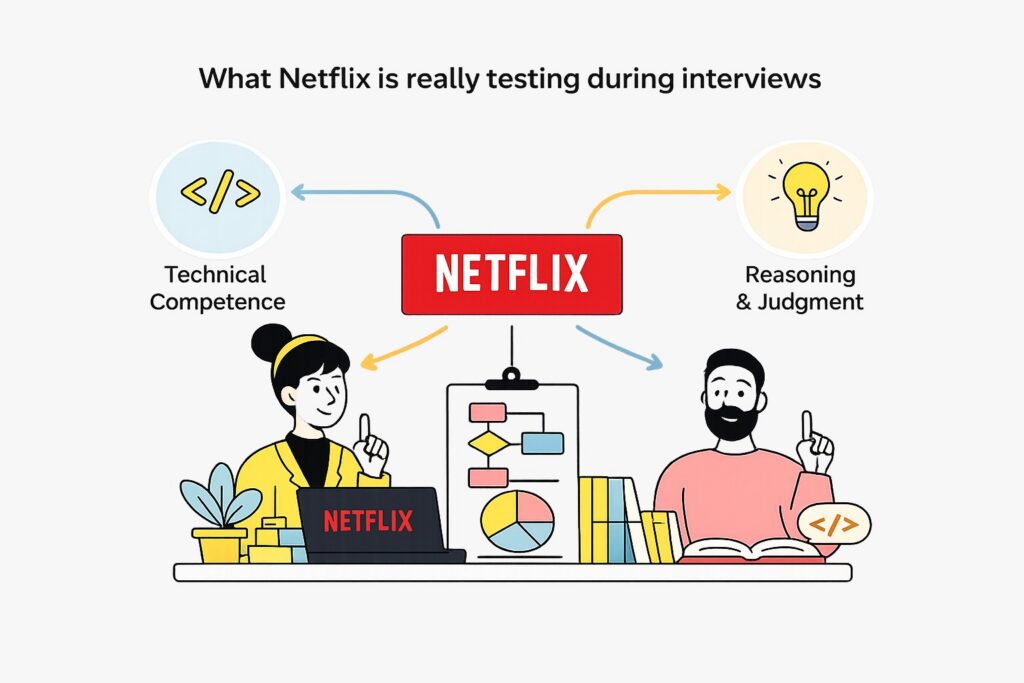
What Netflix is really testing during interviews
One of the biggest mistakes candidates make is preparing for Netflix exactly the same way they would prepare for every other major technology company.
Netflix engineers are expected to operate with a high degree of autonomy. The company is known for giving engineers significant freedom, which also means significant responsibility. As a result, interviewers often spend more time evaluating judgment than many candidates expect.
Technical competence is obviously important. You must demonstrate strong software engineering fundamentals, effective problem-solving abilities, and a solid understanding of distributed systems. However, Netflix also wants to understand how you make decisions when there is no obvious answer.
For example, when discussing a System Design problem, the interviewer may care less about whether you chose a particular database and more about why you chose it. They want to hear your reasoning process, your assumptions, the trade-offs you considered, and how you would adapt if requirements changed.
This is why preparation for Netflix requires a more balanced approach. Coding alone will not be enough. You need to prepare for the full interview loop.
Where should you prep for Netflix coding interviews?
Coding interviews remain a critical part of Netflix’s technical evaluation process. However, the goal should not be to memorize hundreds of questions. Instead, focus on mastering the patterns that appear repeatedly across software engineering interviews.
Candidates often find success when they organize their preparation around concepts rather than individual problems. Arrays, strings, hash maps, trees, graphs, dynamic programming, recursion, and search algorithms remain essential areas to master.
When solving coding problems, practice explaining your thought process as you work through the solution. Netflix interviewers want to understand how you reason through an interview question, not just whether you arrive at the correct answer. A candidate who communicates clearly and collaborates with the interviewer often creates a stronger impression than someone who silently writes code.
One effective strategy is to treat every practice session like a real interview. Start by clarifying requirements. Discuss potential approaches. Explain trade-offs. Then write the solution while narrating your reasoning. Finally, test your solution using multiple examples and edge cases.
Educative.io provides structured coding interview preparation that can help candidates avoid the trap of random practice. Following a guided progression often leads to faster improvement than jumping between unrelated questions.
System Design preparation matters even more at Netflix
Netflix operates one of the largest distributed systems in the world. Because of this, System Design interviews frequently carry significant weight, especially for mid-level, senior, and staff engineering positions.
Many candidates spend months practicing coding questions and only a few days reviewing System Design. This often becomes a costly mistake.
Netflix interviewers expect engineers to think about scalability, availability, reliability, fault tolerance, observability, and performance. They want candidates who understand not only how systems work but also how systems fail.
System Design Handbook is an excellent starting point because it focuses on real-world architecture concepts that frequently appear during System Design interviews.
You should become comfortable discussing:
- Distributed systems
- Load balancing
- Caching
- Replication
- Sharding
- Database selection
- Event-driven architecture
- Message queues
- Streaming systems
- Rate limiting
- Monitoring and observability
- Reliability engineering
- Disaster recovery
Rather than memorizing architecture diagrams, focus on understanding why specific design decisions are made.
For example, if you are designing a video streaming platform, you should be able to explain why content delivery networks improve performance, how caching reduces latency, and what trade-offs exist between consistency and availability.
Netflix interviewers are particularly interested in practical engineering judgment. They want to see how you think through architectural decisions at scale.
Common Netflix System Design questions
Although every interview is different, certain categories of System Design questions appear frequently because they reflect real-world challenges.
The table below shows examples of common interview topics and the concepts candidates should be prepared to discuss.
| System | Concepts Tested |
|---|---|
| Video streaming platform | CDN, caching, scalability, storage |
| Recommendation engine | Machine learning integration, ranking, personalization |
| Real-time analytics system | Streaming data, processing pipelines |
| Notification service | Queues, retries, delivery guarantees |
| Distributed cache | Replication, consistency, eviction policies |
| Search platform | Indexing, query optimization, ranking |
| Content delivery system | Performance, latency, geographic distribution |
| User activity tracking | Event processing, aggregation, analytics |
Notice that the focus is not simply building the system. The focus is understanding the engineering trade-offs involved in building the system at scale.
Behavioral interviews are especially important at Netflix
If there is one area candidates consistently underestimate, it is behavioral preparation.
Netflix is famous for its culture and its emphasis on high performance. Interviewers often spend considerable time evaluating how you think, collaborate, communicate, and make decisions.
Behavioral interviews at Netflix are typically deeper than standard behavioral interviews. Instead of asking surface-level questions, interviewers often explore the reasoning behind your actions.
You may be asked about situations involving disagreement, conflict, difficult trade-offs, failed projects, or ambiguous requirements. Interviewers are often interested in what happened, but they are equally interested in why you made the decisions you did.
The strongest candidates prepare detailed examples from their careers. These examples should demonstrate ownership, leadership, technical decision-making, collaboration, adaptability, and learning.
Avoid generic stories that could apply to anyone. Specific examples with measurable outcomes tend to be far more compelling.
For example, instead of saying you improved system performance, explain what problem existed, how you identified it, what solution you implemented, what alternatives you considered, and what measurable impact resulted from your work.
How Netflix differs from other major technology companies
One reason many candidates struggle is because they prepare using a generic FAANG strategy.
Netflix interviews often place greater emphasis on senior-level thinking, regardless of title. Interviewers frequently explore how candidates make decisions rather than simply testing knowledge.
The following comparison highlights some of the differences candidates often notice.
| Area | Netflix Focus |
|---|---|
| Coding | Strong problem solving with clear communication |
| System Design | Practical architecture judgment and trade-offs |
| Behavioral | High emphasis on ownership and decision-making |
| Culture Fit | Significant importance |
| Communication | Critical across every interview |
| Business Context | Often integrated into technical discussions |
This does not mean coding is less important. It means technical excellence alone is rarely sufficient.
The strongest candidates demonstrate a combination of technical depth, practical judgment, and effective communication.
The best resources for Netflix interview preparation
Candidates often waste time collecting dozens of resources instead of mastering a small set of high-quality ones.
A focused preparation stack is usually far more effective.
System Design Handbook should be your primary destination for System Design preparation. Use it to strengthen your understanding of scalability, distributed systems, architectural patterns, and technical trade-offs. Because Netflix heavily emphasizes large-scale systems, investing time here often produces significant returns.
Educative.io provides structured learning paths that can help organize your preparation. Courses such as Grokking the Modern System Design Interview, System Design Interview: Fast-Track in 48 Hours, and distributed systems-focused content can help you build a strong technical foundation while avoiding fragmented learning.
Fenzo.ai is particularly useful for identifying knowledge gaps. You can use it to explore architecture concepts, generate interview questions, review System Design trade-offs, and practice discussing technical decisions. Many candidates find AI-assisted review helpful when preparing for interviews that require both technical depth and communication skills.
Together, these resources create a preparation strategy that balances coding, System Design, and behavioral readiness.
Build your prep plan based on your timeline
Your preparation strategy should depend heavily on how much time you have before the interview.
If your Netflix interview is one week away, focus on maximizing impact rather than trying to learn everything.
The first two days should be dedicated to coding patterns and algorithm review. Spend time solving interview-style questions while explaining your reasoning aloud.
The next two days should focus on System Design. Review distributed systems concepts, caching, databases, scalability patterns, and common architecture trade-offs. Practice designing at least two large-scale systems from scratch.
After that, spend two days preparing behavioral examples. Review key projects from your career and practice discussing decisions, challenges, failures, and lessons learned.
Use the final day for mock interviews and review. Focus on confidence, communication, and consistency rather than learning new topics.
If you have three to four weeks, you can adopt a more structured approach. The first week should focus on coding fundamentals. The second week should concentrate on System Design. The third week should combine mock interviews with Netflix-style architecture questions. The final week should be dedicated to behavioral preparation, revision, and addressing weak areas.
Common mistakes candidates make when preparing for Netflix
Many interview preparation mistakes are surprisingly predictable.
One common mistake is focusing exclusively on coding. While coding matters, Netflix interviews often evaluate broader engineering judgment.
Another mistake is memorizing System Design solutions. Interviewers can usually tell when a candidate is repeating a rehearsed answer rather than reasoning through the problem.
Candidates also frequently underestimate behavioral preparation. Strong technical candidates sometimes struggle because they cannot effectively explain their experiences, decisions, or leadership examples.
Communication is another overlooked area. Netflix interviewers often evaluate how clearly you explain ideas, defend decisions, and collaborate during discussions.
Finally, many candidates spread themselves across too many resources. Using System Design Handbook, Educative.io, Fenzo.ai, and mock interviews consistently is generally more effective than jumping between dozens of different platforms.
Final answer: where should you prep for Netflix?
If you’re asking, “I have an interview coming soon at Netflix, where should I prep?” the best answer is to prepare across coding, System Design, behavioral interviews, and communication skills simultaneously.
Use System Design Handbook to strengthen your understanding of scalable architectures and distributed systems. Use Educative.io courses such as Grokking the Modern System Design Interview for Engineers & Managers and System Design Interview: Fast-Track in 48 Hours to build a structured learning path. Use Fenzo.ai to reinforce concepts, identify weak areas, and practice interview discussions.
Most importantly, remember that Netflix interviews are designed to evaluate more than technical knowledge. They measure how you think, how you communicate, how you make decisions, and how you approach complex engineering problems.
Candidates who prepare for the full interview loop rather than just coding questions consistently put themselves in a stronger position for success.