
If you are preparing for an Amazon SDE 2 interview, System Design is no longer optional. At this level, Amazon SDE 2 System Design becomes a core signal used to evaluate whether you are ready to operate as an independent, mid-level engineer who can own features end-to-end.
Unlike SDE 1, where System Design appears indirectly, SDE 2 interviews often include explicit design discussions. Amazon wants to understand how you think about building scalable, reliable systems and how well you balance technical decisions with real-world constraints.
This guide explains exactly what Amazon expects from SDE 2 candidates, how System Design interviews are structured, how deep you should go, and how to prepare in a way that aligns with Amazon’s engineering culture and Leadership Principles.

Understanding The Amazon SDE 2 Role
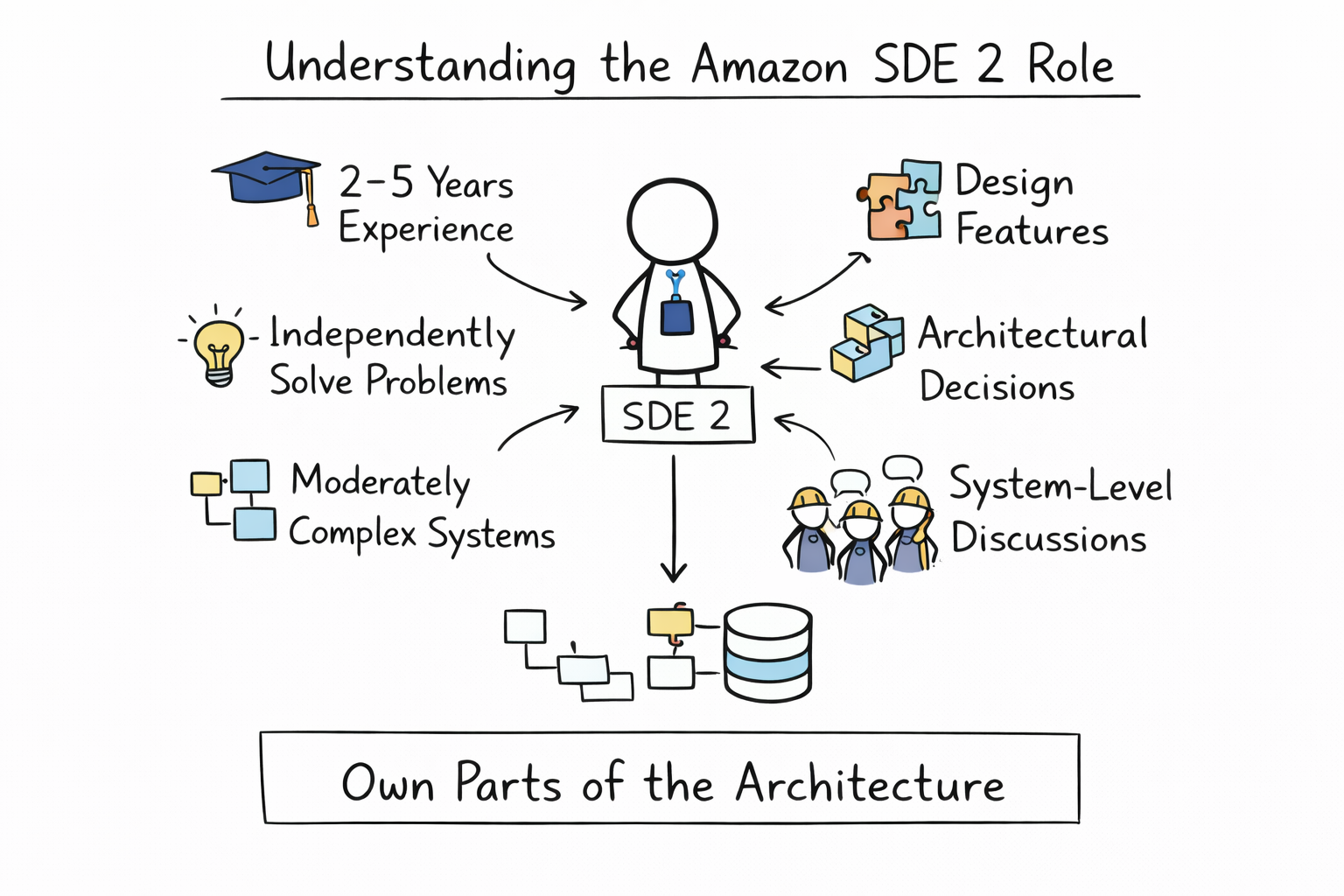
Before you think about System Design questions, you need to understand what SDE 2 represents at Amazon. This role typically targets engineers with two to five years of experience who are expected to work independently on moderately complex problems.
As an SDE 2, you are no longer just executing tasks handed to you. You are expected to design features, make architectural decisions within your scope, and contribute meaningfully to system-level discussions. You may not own the entire architecture, but you are expected to own significant parts of it.
This shift in responsibility is why System Design becomes a formal part of the interview process.
Does Amazon Ask System Design For SDE 2?
Yes, Amazon almost always asks System Design for SDE 2 roles. In many System Design interview loops, there is a dedicated System Design round. Even when there is no explicitly labeled design round, System Design concepts frequently appear in technical interviews.
Amazon uses these discussions to assess whether you can design systems that are maintainable, scalable, and aligned with business needs. They also want to see whether you can explain and defend your design choices clearly.
System Design at SDE 2 is not theoretical. It is grounded in practical engineering scenarios similar to what you would face on the job.
Why System Design Is Critical At The SDE 2 Level
At Amazon, SDE 2 engineers are expected to contribute to systems that directly impact customers. Poor design decisions at this level can lead to reliability issues, performance bottlenecks, or increased operational costs.
System Design questions allow Amazon to evaluate whether you understand the downstream impact of your decisions. They want to see whether you can think about scale, failure modes, and long-term maintainability rather than just initial implementation.
This is also where Amazon starts evaluating your readiness for senior-level growth.
How Amazon SDE 2 System Design Differs From SDE 1
Many candidates underestimate how much the expectations increase from SDE 1 to SDE 2. The difference is not just in depth but in ownership and decision-making.
The table below highlights the contrast.
| Dimension | SDE 1 System Design | SDE 2 System Design |
| Scope | Simple features | End-to-end components |
| Ownership | Awareness | Design ownership |
| Scale | Limited | Moderate to large |
| Trade-offs | Basic | Explicit and justified |
| Ambiguity | Low | Medium |
At SDE 2, Amazon expects you to proactively identify trade-offs and articulate why you chose one approach over another.
What Amazon Looks For In SDE 2 System Design Answers
Amazon evaluates SDE 2 System Design answers across multiple dimensions. Technical correctness matters, but it is not the only factor.
Interviewers focus heavily on structure, clarity, and reasoning. They want to see that you can break down a complex problem into manageable parts and reason through each part logically.
They also evaluate how well your design aligns with Amazon Leadership Principles. For example, designing for scalability reflects Think Big, while choosing simpler solutions reflects Invent and Simplify.
Common Amazon SDE 2 System Design Question Themes
Amazon SDE 2 System Design questions usually revolve around building real-world services or platforms. These are not abstract problems. They are often inspired by actual systems Amazon operates.
You may be asked to design an order management system, a recommendation service, or a notification platform. In other cases, the focus may be on designing APIs, handling high traffic, or ensuring fault tolerance.
The problems are intentionally open-ended to see how you handle ambiguity.
Example Amazon SDE 2 System Design Questions
To make expectations clearer, consider examples of typical Amazon SDE 2 System Design questions.
You might be asked to design a scalable URL shortening service with basic analytics. Another example is designing a system that processes user events in near real time. You may also be asked to design a feature that supports millions of users with low latency.
In each case, Amazon expects you to define requirements, propose an architecture, and discuss trade-offs clearly.
How To Structure Your Amazon SDE 2 System Design Answer
Strong SDE 2 candidates follow a structured approach when answering System Design questions. You should start by clarifying the problem and confirming assumptions. This ensures that you and the interviewer are aligned on scope and goals.
Next, you should outline the high-level architecture, identifying major components and how they interact. At this stage, clarity matters more than completeness.
Once the basic design is established, you should dive into critical areas such as data storage, scalability, and failure handling. This is where you demonstrate depth without getting lost in unnecessary details.
How Deep Should You Go In Technical Details?
Depth is one of the most important evaluation criteria at SDE 2. You are expected to go deeper than SDE 1, but you are still not expected to design systems at the level of a senior architect.
You should be comfortable discussing database choices, caching strategies, and basic distributed system concepts. You should also be able to explain how your system scales and how it handles failures.
If the interviewer pushes you into a deeper area, treat it as an opportunity to demonstrate learning and adaptability rather than a test you must ace perfectly.
The Role Of Trade-offs In Amazon SDE 2 System Design
Trade-offs are central to Amazon SDE 2 System Design interviews. Amazon wants engineers who understand that every design decision has costs and benefits.
You should be prepared to explain why you chose one approach over another and what you would revisit if requirements changed. This demonstrates maturity and real-world engineering judgment.
Being explicit about trade-offs also shows that you are thinking like an owner rather than a task executor.
How Amazon Leadership Principles Show Up In System Design
Amazon Leadership Principles are deeply integrated into System Design interviews. Even though System Design is technical, your answers should naturally reflect these principles.
For example, discussing monitoring and reliability aligns with Customer Obsession. Designing cost-efficient solutions reflects Frugality. Planning for future growth aligns with Think Big.
Interviewers often listen for these signals even if they are not explicitly mentioned.
Common Mistakes Candidates Make At SDE 2
One common mistake is staying too high-level. At SDE 2, vague answers can make you appear underprepared or inexperienced.
Another frequent issue is ignoring operational concerns. Amazon cares deeply about how systems are deployed, monitored, and maintained.
Some candidates also struggle with time management, spending too much time on one part of the design and failing to cover other important aspects.
How To Prepare For Amazon SDE 2 System Design
Preparation for Amazon SDE 2 System Design should be intentional and focused. You should practice designing common systems and explaining them out loud.
Studying real-world architectures and understanding why certain design decisions were made can be extremely helpful. You should also review Amazon’s Leadership Principles and think about how they apply to System Design.
Mock interviews can help you refine your structure and pacing.
How System Design Performance Impacts Amazon Hiring Decisions
System Design plays a significant role in Amazon SDE 2 hiring decisions. Strong performance can position you as a high-confidence hire and even suggest future senior potential.
Weak System Design performance, especially when combined with poor communication, can raise concerns about readiness for mid-level responsibilities.
Amazon looks at the full interview loop, but System Design is often one of the most influential signals at this level.
Final Thoughts On Amazon SDE 2 System Design
Amazon SDE 2 System Design interviews are about demonstrating that you can think like a real-world engineer. You are expected to own designs within your scope, reason about trade-offs, and communicate clearly.
If you approach System Design with structure, depth, and an understanding of Amazon’s culture, you will stand out as a strong SDE 2 candidate. With the right preparation, System Design becomes less intimidating and more of an opportunity to showcase your growth.