
If you are preparing for backend or full-stack engineering roles, you already know that coding rounds are only part of the evaluation. At mid-level and senior positions, companies increasingly rely on low-level System Design interview questions to assess how you think about object modeling, class responsibilities, scalability boundaries, and real-world code architecture.
Many candidates assume that System Design is only about high-level diagrams with load balancers and microservices. That is only half the story. Low-level System Design dives into the internal structure of systems. It evaluates how you design classes, define relationships, apply design patterns, and write extensible code.
This guide will walk you through everything you need to confidently approach low-level System Design interview questions. You will understand what interviewers expect, how to structure your answers, common problem types, evaluation criteria, and how to practice effectively.

What Are Low-Level System Design Interview Questions?
Low-level System Design interview questions focus on designing the internal components of a system. Instead of discussing distributed infrastructure, you design classes, methods, data models, and interactions between objects.
In these interviews, you are typically asked to design systems like:
- A parking lot management system
- An elevator control system
- A library management system
- A ride-sharing booking module
- An online food ordering system
- A chess game
Unlike high-level design interviews, where the discussion revolves around scalability and distributed systems, low-level design evaluates your object-oriented programming skills, abstraction abilities, and knowledge of design principles.
High-Level vs Low-Level System Design
Understanding the difference helps you position your answers correctly.
| Aspect | High-Level Design | Low-Level Design |
| Focus | System architecture and scalability | Class structure and internal components |
| Scope | Distributed systems, load balancing, and caching | Objects, methods, relationships |
| Depth | Broad system overview | Detailed implementation-level design |
| Key Evaluation | Scalability and trade-offs | OOP, SOLID principles, clean code |
Low-level System Design interview questions demand depth. You are expected to discuss class attributes, methods, inheritance, composition, design patterns, and potential extensibility.
Why Companies Ask Low-Level System Design Questions
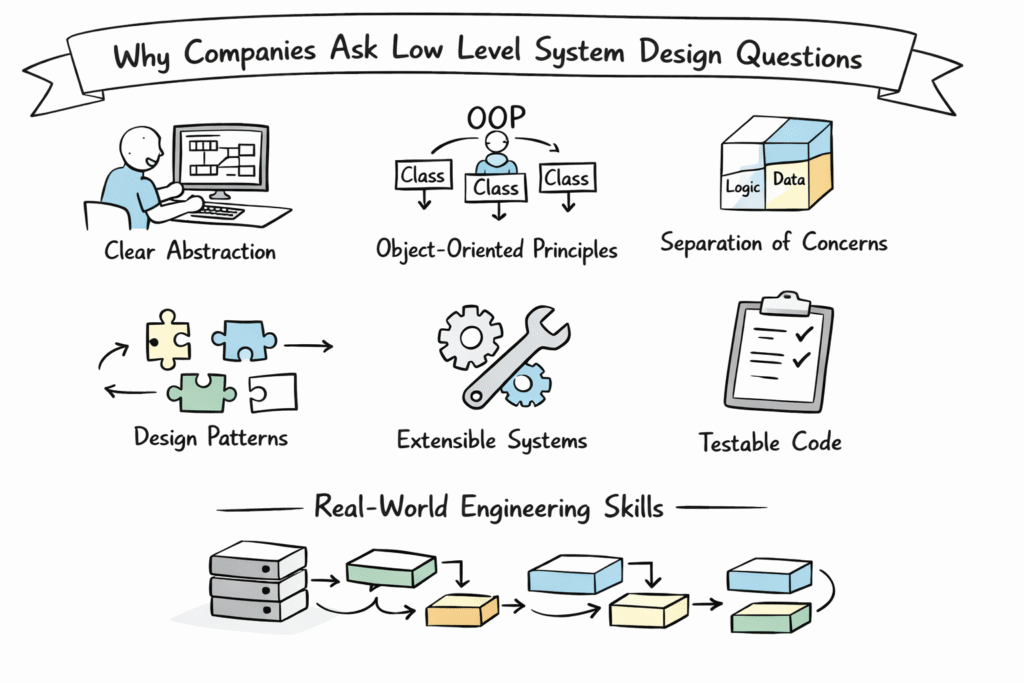
Hiring managers use these questions to assess engineering maturity. They want to know whether you can design maintainable systems beyond writing isolated functions.
When you answer low-level System Design interview questions well, you demonstrate:
- Clear abstraction skills
- Strong understanding of object-oriented principles
- Proper separation of concerns
- Knowledge of common design patterns
- Ability to build extensible and testable systems
These interviews simulate real-world engineering work. Most backend development involves designing modules and services at the class level before scaling them across systems.
Core Concepts You Must Master
Before attempting low-level System Design interview questions, you must be comfortable with foundational design principles.
Object-Oriented Programming Principles
OOP forms the backbone of low-level design. Interviewers expect fluency in encapsulation, inheritance, polymorphism, and abstraction.
Encapsulation ensures that internal states are hidden and accessed via controlled interfaces. Inheritance enables reuse and hierarchy modeling. Polymorphism allows interchangeable behaviors. Abstraction simplifies complexity by modeling real-world entities appropriately.
SOLID Principles
SOLID principles are heavily tested in low-level System Design interview questions.
| Principle | Meaning | Why It Matters |
| Single Responsibility | A class should have one reason to change | Prevents tightly coupled logic |
| Open/Closed | Open for extension, closed for modification | Encourages extensibility |
| Liskov Substitution | Subclasses must replace base classes safely | Ensures correct inheritance |
| Interface Segregation | Avoid forcing unused methods | Promotes clean interfaces |
| Dependency Inversion | Depend on abstractions, not concrete classes | Improves flexibility |
When explaining your design, referencing SOLID principles shows structured thinking.
Common Design Patterns
Design patterns frequently appear in low-level System Design interview questions. You should understand when and why to use:
| Pattern | Typical Use Case |
| Singleton | Shared global resources |
| Factory | Object creation logic |
| Strategy | Switching behaviors dynamically |
| Observer | Event notification systems |
| Builder | Complex object construction |
| Adapter | Interface compatibility |
Using patterns without overengineering is key. Always justify your choice.
Common Low-Level System Design Interview Questions
While problems vary, certain patterns frequently repeat in interviews.
Design A Parking Lot System
This is one of the most popular low-level System Design interview questions. The problem evaluates class modeling, relationships, and extensibility.
A strong design would typically include entities like ParkingLot, ParkingFloor, ParkingSpot, Vehicle, Ticket, and Payment.
You must identify:
- Vehicle types such as car, bike, truck
- Spot types matching vehicle constraints
- Entry and exit handling
- Ticket generation
- Payment calculation
The challenge lies in designing flexible spot allocation without violating single responsibility.
Design An Elevator System
This question tests state management and scheduling logic. Core components may include Elevator, Floor, Request, and ElevatorController.
You must handle:
- Multiple elevators
- Direction logic
- Prioritization
- State transitions
Interviewers observe how you model requests and manage concurrency scenarios conceptually.
Design A Library Management System
This problem focuses heavily on object modeling and relationships. Entities may include Book, Member, Librarian, Catalog, Loan, and Fine.
It tests:
- Composition vs inheritance decisions
- Data relationships
- Role-based behaviors
- Policy handling
Design A Chess Game
This problem evaluates the modeling of complex rules. You must represent board structure, pieces, movement rules, and game state.
The complexity arises in handling piece-specific behaviors while maintaining clean abstraction.
How To Structure Your Answer
Answering low-level System Design interview questions requires a clear framework.
Step 1: Clarify Requirements
Start by asking questions.
Is concurrency required?
Is persistence needed?
Are we focusing only on in-memory design?
Should scalability be considered?
Clarifying scope prevents overengineering.
Step 2: Identify Core Entities
List the main objects before drawing relationships. Identify nouns from the problem statement. For a parking lot, nouns include vehicle, ticket, spot, and floor.
Translate them into classes.
Step 3: Define Relationships
Determine whether to use inheritance, composition, or aggregation. Misusing inheritance is a common mistake.
For example:
Vehicle may be a base class, with Car and Bike as subclasses.
ParkingSpot may contain a Vehicle reference.
Step 4: Define Interfaces And Responsibilities
Each class should have a clear responsibility.
For example:
ParkingLot may coordinate floors.
Floor may manage spots.
Spot may check availability.
Avoid mixing responsibilities.
Step 5: Apply Design Patterns Where Appropriate
If object creation varies, use Factory.
If behavior changes dynamically, use Strategy.
If notifications are needed, use Observer.
Explain your reasoning.
Step 6: Discuss Edge Cases And Extensions
Discuss how your design adapts to future changes. For example, how would you add electric vehicle charging support to a parking lot?
This demonstrates forward thinking.
Evaluation Criteria In Low-Level Design Interviews
Understanding what interviewers look for helps you tailor your answers.
| Evaluation Area | What Interviewers Look For |
| Clarity | Clean explanation and structure |
| Abstraction | Logical entity modeling |
| Extensibility | Ability to adapt to changes |
| Clean Interfaces | Well-defined method responsibilities |
| Pattern Usage | Appropriate, justified use |
| Code Quality | Logical naming and separation |
Many candidates fail because they jump into coding without designing properly.
Common Mistakes To Avoid
Low-level System Design interview questions expose architectural weaknesses. Avoid these mistakes.
One common mistake is prematurely optimizing. Candidates often introduce databases, caching, or threading unnecessarily.
Another mistake is violating the single responsibility. Combining payment logic, parking allocation, and ticket generation inside one class creates tight coupling.
Overusing inheritance is another frequent error. In many cases, composition is a better choice.
Ignoring edge cases such as invalid inputs, concurrency conflicts, and failure scenarios reduces credibility.
Example Deep Dive: Designing A Food Delivery System Module
Let us walk through a mini-case to understand in depth.
Imagine you are asked to design the ordering module of a food delivery system.
You might define classes such as User, Restaurant, Menu, Order, Payment, and DeliveryPartner.
Entity Responsibilities Table
| Class | Responsibility |
| User | Place and track orders |
| Restaurant | Manage menu items |
| Menu | Maintain food listings |
| Order | Track order state |
| Payment | Handle transaction processing |
| DeliveryPartner | Manage delivery status |
Orders may have states such as CREATED, CONFIRMED, PREPARING, OUT_FOR_DELIVERY, and DELIVERED.
Using the State pattern could help manage transitions cleanly instead of using large conditional blocks.
Payment logic should be abstracted behind a PaymentProcessor interface to allow multiple implementations, such as credit card or wallet.
This modular design makes future extension easy.
Low-Level System Design For Different Experience Levels
The expectations vary depending on role seniority.
| Experience Level | Interview Expectation |
| Entry Level | Basic OOP and class modeling |
| Mid Level | SOLID principles and clean architecture |
| Senior Level | Extensibility, patterns, trade-offs |
For senior engineers, interviewers may also discuss thread safety and concurrency considerations at the design level.
Practicing Low-Level System Design Interview Questions
Preparation requires deliberate practice.
Start by solving classic problems such as parking lots, elevators, and library systems. Write class diagrams and pseudo-code. Practice explaining decisions aloud.
Review open-source projects to understand real-world class design. Analyze how responsibilities are distributed.
Simulate interviews with peers. Time yourself. Practice whiteboard design.
Focus on clarity over complexity. Most low-level System Design interview questions are not about trick logic but about structured thinking.
How To Think Like A Senior Engineer During LLD Interviews
Senior engineers approach low-level design differently. They think in terms of boundaries, modularity, and future change.
They ask questions about evolving requirements. They isolate business logic from infrastructure concerns. They introduce interfaces early.
When answering low-level System Design interview questions, explicitly mention trade-offs. For example, explain why you chose composition over inheritance.
This shows engineering maturity.
Concurrency Considerations In Low-Level Design
While most low-level interviews are in-memory designs, some may test basic concurrency handling.
For example, in a parking lot system, two vehicles may attempt to reserve the same spot.
You can conceptually mention synchronization mechanisms or atomic operations without diving too deeply into threading APIs.
The key is demonstrating awareness.
Database Modeling In Low-Level Design
Sometimes interviewers ask you to present data. In such cases, you should discuss mapping between objects and relational tables.
Example Order Table Mapping
| Entity Field | Database Column |
| orderId | order_id |
| userId | user_id |
| status | order_status |
| totalAmount | total_amount |
| createdAt | created_timestamp |
Explain normalization and indexing briefly if relevant.
Do not overcomplicate unless required.
Final Preparation Checklist
Before attending interviews that include low-level System Design interview questions, ensure you can:
Explain SOLID principles clearly.
Design 8 to 10 classic systems confidently.
Justify design pattern usage.
Model class relationships cleanly.
Discuss trade-offs calmly.
Write structured pseudo-code.
Confidence comes from repetition.
Final Thoughts
Low-level System Design interview questions are less about memorizing answers and more about demonstrating structured thinking. Companies want engineers who can build maintainable systems that evolve gracefully.
If you master object modeling, apply SOLID principles naturally, and practice common design problems, you will perform strongly in these interviews.
Think clearly. Structure your approach. Justify decisions. And most importantly, design with the future in mind.
That mindset is what separates average answers from exceptional ones in System Design interviews.