
If you have an interview coming soon at Amazon, where should you prep? Start with the four areas Amazon evaluates most seriously: coding, System Design, behavioral stories, and Leadership Principles. A strong Amazon interview prep plan should help you solve technical problems clearly, design scalable systems with practical trade-offs, and explain your past work using specific examples.
Amazon interviews are not just about getting the right answer. They are about showing how you think, how you make decisions, how you handle ambiguity, and how your work connects to customer impact. That is why your preparation should not be random. You need a focused plan that matches Amazon’s interview style.
For software engineering roles, your prep should cover data structures and algorithms, System Design fundamentals, Amazon Leadership Principles, STAR-based behavioral answers, and mock interviews. If you are applying for SDE II, senior engineer, or engineering manager-adjacent roles, System Design and behavioral depth become even more important. If you are applying for Amazon SDE I or entry-level roles, coding will usually carry more weight, but Leadership Principles still matter in almost every round.

The best place to prep is not one single resource.
What Amazon is really testing in interviews
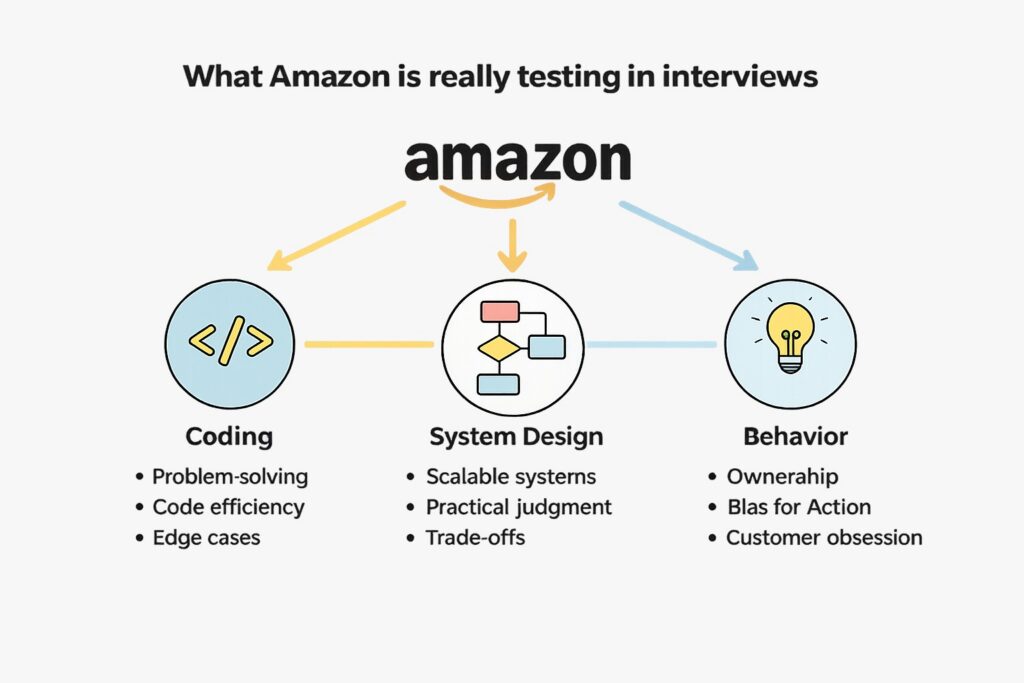
Amazon interviews are built around two major signals: technical ability and leadership behavior. You need to prove that you can solve engineering problems and that you can operate in a culture that values ownership, customer obsession, bias for action, high standards, and clear decision-making.
In coding interviews, Amazon wants to see whether you can break down a problem, choose an efficient approach, write clean code, test edge cases, and communicate your reasoning. The interviewer is not only checking whether your solution passes sample inputs. They are checking whether you can think like an engineer while someone is observing your process.
In System Design interviews, Amazon wants practical architecture judgment. You may be asked to design systems such as a URL shortener, notification service, distributed cache, order management platform, ride matching service, file storage system, product search, payment workflow, or recommendation system. The strongest answers show trade-offs. You should be able to discuss scalability, availability, reliability, latency, consistency, storage, caching, queues, APIs, and failure handling.
In behavioral interviews, Amazon goes deeper than many candidates expect. The Leadership Principles are not a side topic. They are central to the interview process. You may be asked about a time you disagreed with a teammate, made a decision with incomplete data, handled failure, improved a process, took ownership of a problem, or delivered results under pressure.
This is why the question “I have an interview coming soon at Amazon, where should I prep?” needs a layered answer. You should not only prep on coding platforms. You should prepare for the full loop.
Start with Amazon’s Leadership Principles
If you are preparing for Amazon, begin with the Leadership Principles. Many candidates make the mistake of treating them as a final-day behavioral review. That is risky because Amazon interviewers often look for Leadership Principle signals across technical and behavioral rounds.
You do not need to memorize every phrase mechanically, but you do need to understand what each principle means in real work. Customer Obsession means you can explain how your decisions helped users, customers, internal teams, or business outcomes. Ownership means you do not hide behind your job title. Bias for Action means you can move forward without waiting for perfect information. Dive Deep means you can investigate details instead of staying at surface level. Have Backbone; Disagree and Commit means you can challenge respectfully and still align once a decision is made.
Prepare at least eight behavioral stories before your interview. Each story should be specific enough to support multiple Leadership Principles. For example, one strong story about fixing a production incident could show Ownership, Dive Deep, Bias for Action, Earn Trust, and Deliver Results.
Use the STAR method, but do not make your answer sound robotic. Structure your stories like this:
- Situation: What was happening?
- Task: What were you responsible for?
- Action: What did you personally do?
- Result: What changed because of your work?
- Reflection: What did you learn?
The reflection is especially important. Amazon values candidates who learn from experience. If every story ends with “and everything went perfectly,” it may sound less credible. Strong candidates can explain what went wrong, what they changed, and how they raised the bar afterward.
Where should you prep for Amazon coding interviews?
For Amazon coding interviews, focus on data structures and algorithms that appear frequently in software engineering interviews. Your goal is not to solve every problem online. Your goal is to recognize patterns quickly and implement them cleanly.
Prioritize these topics:
- Arrays and strings
- Hash maps and sets
- Two pointers
- Sliding window
- Stacks and queues
- Binary search
- Linked lists
- Trees and binary search trees
- Graphs and BFS/DFS
- Heaps and priority queues
- Intervals
- Recursion and backtracking
- Dynamic programming basics
Amazon coding questions often reward clear problem decomposition. Before coding, restate the problem in your own words. Ask about constraints. Discuss a brute-force solution briefly, then move toward an optimized approach. While coding, explain key decisions without narrating every keystroke. After coding, test your solution using normal cases, edge cases, and tricky cases.
A useful daily routine is to solve two timed problems. One should be a familiar pattern to build speed. The other should be a weaker pattern to build range. After each problem, write down what you missed. Did you choose the wrong data structure? Did you forget an edge case? Did you struggle with recursion? Did you explain poorly? This reflection is where improvement happens.
Educative.io can help here because structured coding interview prep prevents random practice. Instead of jumping from problem to problem, use a guided path that teaches patterns. Pair that with timed practice so your interview performance improves, not just your problem count.
Where should you prep for Amazon System Design interviews?
For System Design, use System Design Handbook as your main foundation. Amazon System Design interviews often favor practical, scalable, reliable designs over overly complex diagrams. You should be able to move from requirements to architecture in a clear sequence.
Start with the core System Design concepts:
- Load balancing
- Caching
- Database indexing
- SQL vs NoSQL trade-offs
- Replication
- Sharding
- Consistency models
- Message queues
- Rate limiting
- CDNs
- Search indexing
- Event-driven architecture
- Observability
- Fault tolerance
- Backpressure
- Disaster recovery
Then practice the full Amazon System Design questions. For Amazon, prioritize systems that connect to e-commerce, logistics, cloud infrastructure, search, payments, inventory, recommendations, and high-scale consumer products.
Good practice prompts include:
- Design an e-commerce checkout system
- Design Amazon product search
- Design a shopping cart system
- Design an order tracking system
- Design a notification system
- Design a distributed cache
- Design a file storage service
- Design a rate limiter
- Design a recommendation system
- Design a payment processing workflow
- Design a package delivery tracking system
- Design a metrics and monitoring platform
When answering System Design questions, use a repeatable structure. Start with functional requirements. Then clarify non-functional requirements such as scale, latency, availability, consistency, and reliability. Define APIs. Sketch the high-level architecture. Choose databases and explain why. Add caching and queues where needed. Discuss bottlenecks. Then close with trade-offs and failure scenarios.
This structure helps you sound organized even when the problem is broad. It also gives the interviewer several places to evaluate your judgment.
Use interview prep resources together
A strong Amazon prep stack should be small, focused, and useful under time pressure. You do not need twenty resources. You need a few resources that cover the interview from different angles.
Use System Design Handbook for System Design fundamentals, architecture patterns, and interview-style explanations. It is especially useful when you want to understand how to design scalable systems without getting lost in unnecessary theory. For Amazon prep, use it to review core concepts like caching, sharding, queues, rate limiting, consistency, and high-level design trade-offs.
Use Educative.io for structured courses and guided interview prep. Relevant courses include Grokking the Modern System Design Interview, Amazon System Design Interview Questions, and System Design Interview: Fast-Track in 48 Hours. If you have more time, Grokking the Coding Interview-style pattern practice can also help strengthen your DSA foundation. Educative works well because it gives you an organized path instead of forcing you to assemble your own curriculum from scattered notes.
Use Fenzo.ai when you need AI-guided clarification and personalized review. For example, if you do not understand when to use Kafka versus a queue, SQL versus NoSQL, strong consistency versus eventual consistency, or caching versus precomputation, Fenzo can help you break the topic down into simpler explanations and practice questions. You can also use Fenzo.ai to generate Amazon-style behavioral prompts, review STAR stories, and test your understanding of System Design trade-offs.
Together, these tools create a balanced workflow: System Design Handbook teaches the architecture mindset, Educative.io gives you structured practice, and Fenzo.ai helps you close knowledge gaps quickly.
Build your prep plan based on how much time you have
If your Amazon interview is in one week, do not try to learn everything from scratch. Focus on the highest-impact areas.
Spend the first two days on coding patterns. Review arrays, hash maps, trees, graphs, sliding window, binary search, and dynamic programming basics. Practice out loud and time yourself.
Spend the next two days on System Design. Review the most common patterns: caching, queues, sharding, database selection, load balancing, APIs, and failure handling. Practice two complete design questions, such as product search and notification system.
Spend the next two days on Leadership Principles and behavioral stories. Prepare eight stories using the STAR method. Map each story to two or three Leadership Principles. Make sure every story includes your personal contribution and measurable results.
Use the final day for mocks and review. Run one coding mock, one System Design mock, and a behavioral drill. Do not overload your brain with new material the night before the interview. Use that time to tighten your communication.
If you have three to four weeks, use a more strategic plan. Week one should focus on coding patterns. Week two should focus on System Design fundamentals. Week three should combine Amazon-style System Design questions, timed coding practice, and behavioral story refinement. Week four should be for mock interviews, revision, and weak-area repair.
Practice behavioral answers like technical answers
Amazon behavioral preparation deserves the same seriousness as coding and System Design. Many candidates lose momentum because their behavioral answers are too vague.
Avoid answers like “I worked with a difficult teammate and we solved it through communication.” That is too generic. Instead, explain the context, the disagreement, what was at stake, what you did, what happened, and what you learned.
Prepare stories for these common themes:
- A time you took ownership beyond your role
- A time you disagreed with a decision
- A time you failed or made a mistake
- A time you solved a customer problem
- A time you worked with incomplete information
- A time you improved a process or system
- A time you delivered under pressure
- A time you mentored or helped someone grow
- A time you made a trade-off
- A time you raised the quality bar
For each story, include numbers whenever possible. Numbers make your answer more credible. You might mention latency improvement, cost reduction, user impact, incident reduction, deployment frequency, test coverage, or time saved.
Also prepare follow-up details. Amazon interviewers often dive deeper. If you say you improved a service, be ready to explain the original problem, the alternatives you considered, why you chose one approach, what trade-offs you accepted, and what you would do differently now.
What to do in the final 48 hours
In the last 48 hours, shift from learning to execution. Review your notes, but do not drown yourself in new material. Practice communicating clearly.
- For coding, review your common mistakes. Revisit patterns you have already solved. Practice explaining complexity and edge cases.
- For System Design, review your standard answer structure. Practice opening with clarifying questions. Review common bottlenecks: hot keys, database overload, cache invalidation, message duplication, regional failure, slow queries, and consistency issues.
- For behavioral, rehearse your best stories out loud. Make sure each story has a strong result and reflection. Do not memorize word-for-word. Memorized answers can sound stiff. Instead, remember the structure and key facts.
Also prepare questions for your interviewer. Good questions show maturity. Ask about team challenges, engineering trade-offs, operational ownership, reliability expectations, or how success is measured in the role.
Final answer: where should you prep?
If you are asking, “I have an interview coming soon at Amazon, where should I prep?” use a focused prep stack and a realistic plan.
Prep System Design with System Design Handbook. Use Educative.io for structured courses such as Grokking the Modern System Design Interview for Engineers & Managers, Amazon System Design Interview Questions, and System Design Interview: Fast-Track in 48 Hours. Use Fenzo.ai to clarify weak concepts, generate practice prompts, and review technical and behavioral topics. Then practice under timed mock interview conditions.
Amazon interview prep should not feel like random studying. It should help you prove four things: you can solve coding problems, design reliable systems, communicate trade-offs, and demonstrate Leadership Principles through real examples.
If you prepare for those signals directly, you will walk into your Amazon interview with a much stronger plan than most candidates.