

If you’ve been researching System Design interview preparation, you’ve almost certainly come across Design Gurus. It appears in interview discussions, making it one of the options available to software engineers preparing for architecture interviews.
Its popularity naturally raises an important question: is Design Gurus actually worth buying? The answer depends less on whether the course is “good” and more on what you expect from it. Some engineers simply need a structured introduction to System Design interviews, while others are looking for deeper architectural knowledge that continues to be useful long after the interview process is over.
Design Gurus performs reasonably well at introducing interview concepts and organizing common System Design topics into a structured curriculum. However, whether that is enough depends on the level of interview you’re preparing for and how deeply you want to understand modern distributed systems.

What Is Design Gurus’ System Design Course?
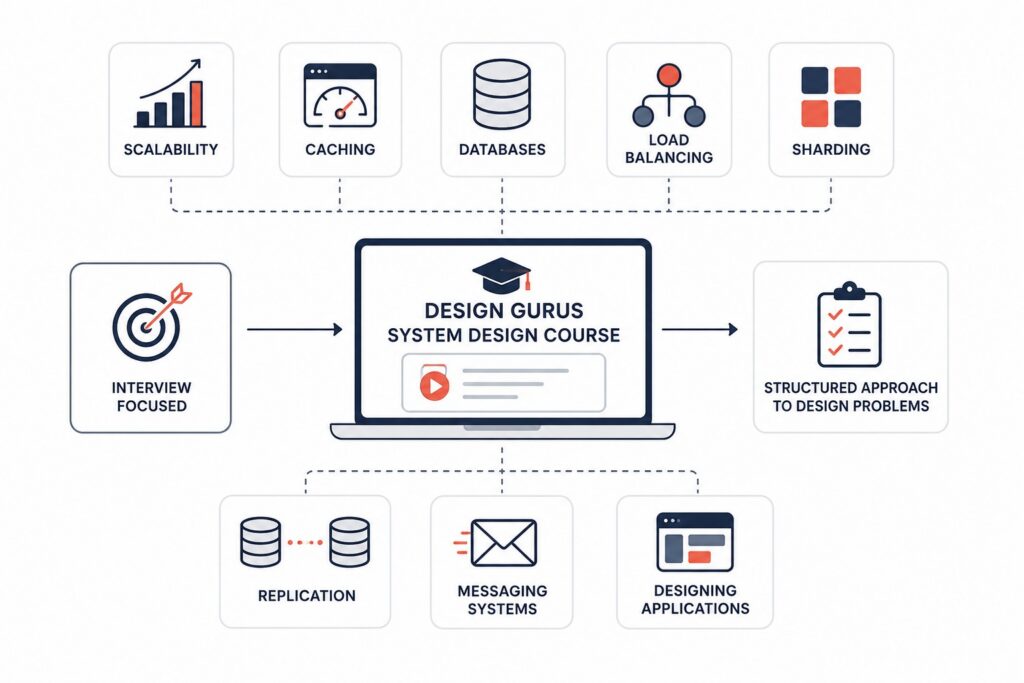
Design Gurus’ System Design course is primarily an interview preparation course. Its focus is on helping software engineers become familiar with the types of architectural discussions that commonly appear during software engineering interviews, rather than teaching distributed systems as a complete engineering discipline.
The curriculum introduces many of the concepts candidates are expected to recognize, including scalability, caching, databases, replication, partitioning, load balancing, messaging systems, and common architecture examples. Throughout the course, these topics are presented through interview-style discussions intended to make System Design feel less intimidating for newcomers.
For engineers approaching System Design for the first time, that structured introduction can be useful. At the same time, engineers looking for a deeper understanding of modern architectures may eventually find themselves wanting more than an interview-focused overview.
| Feature | Overview |
|---|---|
| Primary Focus | Interview preparation |
| Learning Style | Structured online lessons |
| Best Audience | Engineers beginning System Design interviews |
| Goal | Build familiarity with common interview topics |
Where Design Gurus Works Well
One area where Design Gurus performs well is organization. Instead of leaving learners to navigate dozens of unrelated blog posts and videos, it groups common interview topics into a progression that is relatively easy to follow.
The explanations are also accessible. Most lessons focus on introducing concepts rather than overwhelming learners with implementation details, making the course approachable for engineers who have limited exposure to distributed systems.
Another benefit is that the course stays focused on interview discussions. Rather than attempting to become a comprehensive distributed systems resource, it concentrates on the architectural components that appear repeatedly across common interview questions.
A Structured Introduction
For engineers completely new to System Design, having a defined curriculum removes much of the uncertainty around where to begin. Instead of deciding which technology to study next, learners can simply follow the progression presented throughout the course.
This structure makes the early stages of interview preparation more manageable, particularly for developers transitioning from coding interviews to architecture interviews.
Easy-to-Understand Explanations
Many distributed systems concepts can initially feel abstract. Design Gurus generally explains these ideas in a straightforward way, using diagrams and simplified examples to introduce architectural building blocks before combining them into larger systems.
That teaching style prioritizes accessibility over technical depth, making the material relatively easy to follow for newer learners.
| Strength | Why It Helps |
|---|---|
| Organized curriculum | Gives beginners a clear starting point |
| Accessible explanations | Makes unfamiliar topics easier to understand |
| Interview-oriented lessons | Covers commonly discussed interview concepts |
| Gradual progression | Introduces concepts without overwhelming learners |
Where Design Gurus Begins to Show Its Limitations
The biggest limitation of Design Gurus is that its scope remains largely centered around interview preparation. As System Design interviews continue evolving, candidates are increasingly expected to demonstrate broader architectural reasoning and familiarity with modern distributed systems rather than simply understanding traditional interview topics.
Many lessons introduce concepts effectively, but they often stop at the level required for typical interview discussions. Topics such as cloud-native architecture, event-driven systems, asynchronous processing, modern messaging patterns, resilience engineering, observability, and more advanced architectural trade-offs receive comparatively less attention than they do in more comprehensive learning resources.
Another limitation is that much of the learning is centered around understanding existing architectural patterns rather than developing the reasoning process needed to solve unfamiliar problems. Modern interviews increasingly reward candidates who can justify design decisions, compare multiple architectural approaches, and adapt their solutions as new constraints are introduced.
These limitations simply define where its value begins to taper off for engineers seeking a deeper understanding of System Design.
| Limitation | Why It Matters |
|---|---|
| Primarily interview-focused | Less emphasis on broader engineering concepts |
| Limited modern architecture coverage | Some newer distributed systems topics receive less attention |
| Introductory technical depth | Advanced learners may outgrow the material |
| Less emphasis on architectural reasoning | Modern interviews increasingly reward deeper design thinking |
Who Should Consider Design Gurus?
Design Gurus is most suitable for engineers who are beginning their System Design interview preparation and want a structured introduction to common interview topics. It provides enough organization to help build familiarity with distributed systems concepts without requiring an extensive background in software architecture.
For engineers preparing for more competitive senior interviews or those who want a stronger understanding of modern System Design beyond interview templates, it is worth considering resources that go deeper into architectural reasoning, contemporary distributed systems, and long-term engineering knowledge. That distinction becomes particularly important when choosing between interview preparation and building broader architectural expertise.
A Stronger Alternative: Educative’s Original Grokking the System Design Interview
Design Gurus provides a solid introduction to System Design interviews, but engineers looking for a course that combines interview preparation with broader architectural understanding may find Educative’s original Grokking the System Design Interview to be the more complete option. While both courses cover the core concepts of distributed systems, Educative’s original Grokking course places greater emphasis on developing the reasoning process behind architectural decisions rather than simply introducing common interview topics.
That distinction becomes increasingly valuable as interview expectations evolve. Modern System Design interviews often extend beyond basic scalability discussions and require candidates to reason through distributed systems, reliability, consistency, messaging, cloud-native architectures, and complex architectural trade-offs. Developing that style of thinking is ultimately more valuable than memorizing solutions to individual design problems.
Educative’s Original Grokking Course Still Sets the Standard
Educative’s original Grokking the System Design Interview has remained one of the most widely recommended interview preparation resources for years because it introduced a structured methodology that many later courses have adopted. Instead of approaching every interview question as a unique problem, it teaches a repeatable framework that can be applied across many different architecture discussions.
That structured thinking helps candidates stay organized during interviews. Rather than immediately drawing diagrams, the course encourages requirement gathering, capacity estimation, identifying bottlenecks, discussing trade-offs, and gradually evolving a solution as new constraints are introduced.
This mirrors how experienced interviewers typically evaluate candidates. The discussion is rarely about producing the perfect architecture. Instead, it focuses on demonstrating clear reasoning while adapting to changing requirements throughout the conversation.
Better Coverage of Modern System Design
One area where Educative’s original course continues to stand out is the breadth of architectural concepts it introduces. Alongside the traditional topics of databases, caching, load balancing, replication, partitioning, and consistency, it explores many of the patterns that have become increasingly common in modern distributed systems.
Topics such as event-driven architectures, messaging systems, asynchronous processing, service communication, distributed storage, fault tolerance, horizontal scalability, API design, and reliability engineering are woven naturally into larger architectural discussions. Instead of presenting these concepts independently, the course demonstrates how they interact inside complete production-style systems.
This broader perspective prepares engineers for interviews that increasingly reflect the realities of modern cloud-native software development rather than only traditional System Design exercises.
Greater Focus on Architectural Thinking
One of the biggest differences between interview preparation and genuine architectural understanding is the ability to reason through unfamiliar problems. Strong interview candidates are rarely successful because they remember a particular architecture. They succeed because they understand the principles that guide architectural decisions.
Educative’s original Grokking course consistently reinforces this mindset by encouraging candidates to evaluate multiple approaches, compare trade-offs, and explain why one solution may be preferable under a particular set of constraints. That process helps develop architectural intuition that remains valuable long after interview preparation is complete.
Rather than teaching reusable answers, the course teaches reusable thinking.
Better Long-Term Value
A good interview course should remain useful even after the interview is over. While many interview-focused resources naturally become less relevant once you’ve accepted a new role, the architectural concepts taught throughout Educative’s original Grokking course continue applying to production engineering, system architecture discussions, and software design decisions encountered throughout an engineering career.
As distributed systems continue evolving, the underlying principles of scalability, reliability, availability, consistency, fault tolerance, and architectural trade-offs remain remarkably consistent. Learning those principles creates knowledge that extends well beyond a single interview loop.
That makes the course valuable not only for interview preparation but also for engineers looking to strengthen their overall understanding of modern software architecture.
Who Should Choose Educative’s Original Grokking Course?
For engineers whose primary objective is developing a structured interview methodology while also building deeper architectural intuition, Educative’s original Grokking the System Design Interview offers a particularly well-balanced learning experience. The combination of interview frameworks, modern distributed systems concepts, and emphasis on architectural reasoning makes it suitable for both interview preparation and long-term professional growth.
Candidates preparing for senior software engineering interviews benefit from the structured interview process, while more experienced engineers can use the course to refresh core architectural principles and revisit modern distributed systems patterns. Because the focus extends beyond solving individual interview questions, the learning remains useful well after the interview process has finished.
| Learning Goal | Best Choice |
|---|---|
| Structured interview preparation | Educative’s original Grokking the System Design Interview |
| Learn modern distributed systems concepts | Educative’s original Grokking the System Design Interview |
| Build long-term architectural thinking | Educative’s original Grokking the System Design Interview |
| Prepare for senior software engineering interviews | Educative’s original Grokking the System Design Interview |
Final Verdict
Is Design Gurus Still Worth It?
Design Gurus remains a good System Design interview course, particularly for software engineers who are beginning their interview preparation or looking for a structured introduction to distributed systems. Its organized curriculum, approachable explanations, and interview-focused lessons make it much easier to build confidence than trying to learn entirely from scattered articles and videos.
That said, the platform should be viewed as a starting point rather than a complete System Design education. As interviews continue evolving, candidates are increasingly expected to understand modern distributed systems, reason through architectural trade-offs, and discuss topics that extend beyond traditional interview templates. For engineers looking to build both interview confidence and long-term architectural knowledge, Educative’s original Grokking the System Design Interview provides a more comprehensive learning experience while covering many of the modern concepts that have become increasingly important in today’s interviews.
Keep Learning Beyond Any One Course
No single course is capable of teaching everything about System Design. The field spans distributed systems, databases, networking, cloud infrastructure, messaging systems, observability, scalability, and software architecture, all of which continue evolving as new technologies emerge.
The strongest engineers rarely rely on one learning resource. Instead, they combine structured courses with reference guides, engineering articles, architecture case studies, and regular interview practice. That layered approach develops both interview skills and the deeper engineering intuition needed to design systems confidently in real-world environments.
Free Resources Worth Bookmarking
If you’re looking to continue learning after completing a structured course, the following free resources are excellent additions to your study plan.
| Free Resource | Best For |
|---|---|
| System Design Primer | Reviewing interview fundamentals and core distributed systems concepts |
| Complete Guide to System Design | Following a structured learning roadmap from beginner to advanced topics |
| System Design Guide | Comprehensive guides covering distributed systems, architecture patterns, and modern System Design concepts |
| System Design Interview Guide | Preparing specifically for System Design interviews with interview-focused guides and examples |
| Advanced System Design for Principal Engineers | Exploring advanced architecture, large-scale distributed systems, and senior engineering design decisions |
Join the Discussion
Every engineer approaches System Design differently, which is why community discussions often provide insights that reviews alone cannot. If you’ve taken Design Gurus’ System Design course, share your experience in the comments. Which parts of the course helped you the most, where did you feel it was lacking, and would you recommend it to someone preparing for System Design interviews today?
Your experience may help another engineer decide which learning path is the right one for their own interview preparation.