

Hello Interview System Design is an interview preparation platform designed to help software engineers develop the architectural thinking required for modern System Design interviews. The platform focuses on understanding distributed systems concepts, evaluating design trade-offs, and communicating architectural decisions in a structured way.
Whether the course is worth purchasing depends largely on your learning goals. If you’re preparing for System Design interviews and want a structured curriculum that organizes the subject into manageable lessons, Hello Interview offers a solid foundation. If you’re looking for a resource that explores modern distributed systems in greater depth or provides broader architectural coverage beyond interview preparation, it’s important to understand where the platform excels and where it becomes more limited.
This review looks at Hello Interview System Design based on its teaching approach, curriculum, interview preparation value, strengths, limitations, and the type of software engineer who is most likely to benefit from it.

What Is Hello Interview System Design?
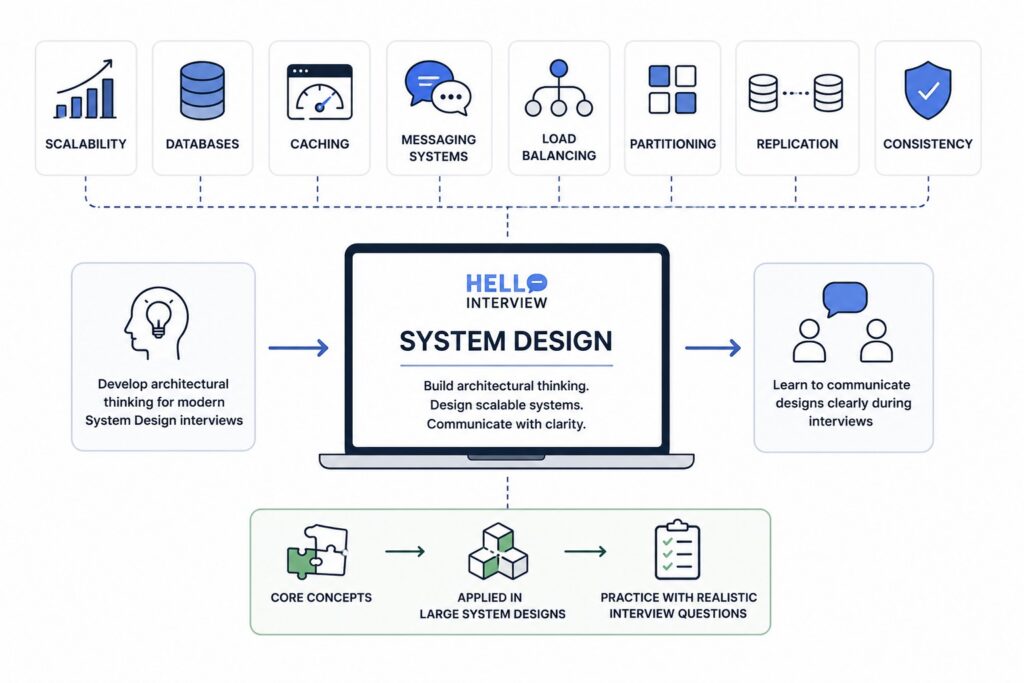
Hello Interview System Design is a structured learning platform focused on preparing software engineers for architectural interviews. The curriculum introduces the fundamental building blocks of distributed systems before combining them into larger System Design discussions that closely resemble real interview conversations. Rather than treating each design problem as an isolated exercise, the lessons emphasize understanding the reasoning behind architectural decisions.
The course covers many of the topics that repeatedly appear during System Design interviews, including scalability, databases, caching, messaging systems, partitioning, replication, consistency, and load balancing. These concepts are introduced gradually so that learners can understand the role each component plays before discussing complete software architectures.
Throughout the curriculum, diagrams and written explanations work together to simplify distributed systems concepts. This combination helps learners visualize complex architectures while reinforcing the engineering principles that guide design decisions.
| Feature | Overview |
|---|---|
| Primary Focus | System Design interview preparation |
| Learning Style | Structured written lessons with diagrams |
| Best Audience | Mid-level and senior software engineers |
| Goal | Develop architectural thinking for interviews |
Where Hello Interview Works Well
One of Hello Interview’s biggest strengths is that it remains consistently focused on the interview process. Rather than spending large portions of the curriculum on unrelated architectural theory, the lessons concentrate on helping candidates understand the concepts and decision-making processes that commonly appear during System Design interviews. This makes the material feel practical and closely aligned with the challenges engineers encounter during technical interviews.
Another strength is its emphasis on reasoning instead of memorization. Throughout the course, architectural decisions are presented as responses to business and technical constraints rather than fixed templates that should be copied from one interview to another. That approach helps learners become more comfortable adapting their designs when interviewers introduce new requirements.
Strong Interview Focus
The curriculum consistently emphasizes the skills interviewers evaluate during System Design discussions. Requirement gathering, scalability considerations, bottleneck identification, and architectural trade-offs are integrated throughout the lessons rather than being treated as separate topics.
This focus helps candidates develop a mindset that aligns more closely with real interview conversations, where explaining your reasoning is often more important than producing a perfect architecture diagram.
Structured Learning Progression
System Design is a broad subject that combines databases, networking, messaging systems, scalability, reliability, and distributed systems into a single discipline. Hello Interview organizes these topics into a logical sequence that allows each lesson to build naturally on the previous one.
Instead of overwhelming learners with complete architectures immediately, the platform introduces foundational concepts first and gradually combines them into larger System Design discussions. This progression makes the subject considerably easier to absorb.
Emphasis on Architectural Reasoning
Another positive aspect of the course is its focus on explaining why architectural decisions are made. Rather than encouraging candidates to memorize designs for specific applications, the lessons repeatedly discuss trade-offs, constraints, and alternative approaches.
That emphasis develops a more adaptable way of thinking that remains useful when interview questions evolve or business requirements change during a design discussion.
Clear Visual Explanations
Distributed systems often involve many independent services communicating simultaneously, making them difficult to understand through text alone. Hello Interview uses diagrams throughout the curriculum to illustrate request flows, service interactions, data movement, and infrastructure components.
These visual explanations make complex architectures easier to understand while also helping candidates communicate their own designs more effectively during interviews.
| Strength | Why It Helps |
|---|---|
| Interview-focused curriculum | Aligns closely with common System Design interviews |
| Logical progression | Builds knowledge gradually |
| Architectural reasoning | Encourages adaptable problem solving |
| Visual explanations | Simplifies distributed systems concepts |
Where Hello Interview Begins to Show Its Limitations
Although Hello Interview is designed specifically for System Design interviews, no single course can fully prepare candidates for every interview scenario or cover every aspect of modern distributed systems. As software architecture continues evolving, interviews increasingly explore cloud-native infrastructure, event-driven systems, resilience engineering, distributed messaging, and other architectural patterns that extend beyond traditional interview topics.
The course provides a strong interview foundation, but candidates preparing for highly competitive senior interview loops should expect to continue learning beyond the curriculum through practical design exercises, production architecture case studies, and additional technical reading.
Primarily Interview-Focused
Hello Interview concentrates on preparing candidates for technical interviews rather than becoming a comprehensive distributed systems education. That focused approach is one of its strengths, but it also means some broader software architecture topics naturally receive less attention.
Engineers who want to deepen their understanding of production-scale distributed systems may eventually look for additional resources beyond interview preparation.
Limited Coverage of Modern System Design
Modern software engineering increasingly involves architectural patterns such as event-driven systems, asynchronous processing, cloud-native infrastructure, distributed messaging, observability, and platform engineering. While Hello Interview introduces many foundational concepts, these broader topics are not explored as extensively as they are in more comprehensive System Design resources.
As interview expectations continue evolving, familiarity with these modern architectural patterns becomes increasingly valuable.
Interview Practice Still Matters
Completing a course is only one part of successful interview preparation. Strong System Design interviews require candidates to communicate clearly, adapt to changing requirements, justify architectural decisions, and explain trade-offs under time pressure.
Those communication skills develop primarily through repeated practice rather than passive learning. Mock interviews and solving unfamiliar design problems remain essential regardless of which course you choose.
Real Engineering Experience Cannot Be Replaced
System Design interviews attempt to simulate architectural discussions, but production software engineering introduces additional operational challenges that are difficult to reproduce inside an online course. Scaling systems, handling failures, balancing costs, and responding to changing business requirements all contribute to stronger architectural judgment over time.
Courses provide structure, but practical engineering experience remains one of the most valuable teachers for long-term System Design growth.
| Limitation | Why It Matters |
|---|---|
| Interview-focused scope | Broader architectural learning may require additional resources |
| Limited coverage of newer architectural patterns | Modern interviews increasingly explore these topics |
| Practice remains essential | Communication improves through mock interviews |
| Production experience still matters | Real systems provide insights courses cannot fully replicate |
Who Should Consider Hello Interview System Design?
Hello Interview System Design is best suited to software engineers who are preparing for mid-level and senior software engineering interviews and want a structured introduction to System Design. Its emphasis on interview thinking, architectural reasoning, and gradual progression makes it particularly valuable for developers who already have backend experience and are transitioning toward architecture-focused interviews.
For engineers targeting highly competitive senior or Staff-level interview loops, the course works well as a foundation but is unlikely to be the only resource needed. Combining structured interview preparation with broader distributed systems study and regular mock interviews typically produces a stronger long-term preparation strategy.
| Experience Level | Recommendation |
|---|---|
| Beginner | Good with backend fundamentals |
| Mid-level engineer | Strong fit for interview preparation |
| Senior engineer | Useful interview refresher |
| Staff/Principal candidate | Helpful foundation with additional advanced study |
A Better Alternative: Educative’s Original Grokking the System Design Interview Course
Hello Interview does a good job of preparing software engineers for System Design interviews by emphasizing architectural reasoning and structured thinking. However, as interview expectations continue becoming more demanding, many candidates look for a resource that provides not only strong explanations but also a comprehensive interview methodology that can be applied consistently across different design problems.
This is where Educative’s original Grokking the System Design Interview course takes a different approach. Rather than balancing interview preparation with broader architectural education, the course is built specifically around the interview process. Every lesson reinforces a repeatable framework that helps candidates approach unfamiliar System Design questions with confidence instead of relying on memorized architectures or isolated case studies.
For engineers whose primary objective is maximizing interview performance while building a strong understanding of modern distributed systems, this structured methodology provides a more comprehensive learning experience.
Why Educative’s Original Grokking the System Design Interview Course Still Stands Out
One of the defining strengths of Educative’s original Grokking the System Design Interview course is that it teaches a repeatable way of thinking rather than a collection of interview answers. While individual interview questions continue evolving, the underlying process for solving them remains largely the same. Candidates still need to clarify requirements, estimate system scale, understand technical constraints, identify bottlenecks, evaluate trade-offs, and communicate their reasoning throughout the discussion.
The course reinforces this workflow across every major design problem. Instead of encouraging learners to memorize the architecture for a URL shortener or a messaging application, it teaches them how to approach any large-scale design problem methodically. That systematic thinking becomes increasingly valuable as interview questions move beyond familiar examples and require candidates to reason through entirely new scenarios.
Because the methodology is based on engineering principles rather than specific technologies, it continues to remain relevant even as distributed systems and interview expectations change.
A More Structured Interview Framework
One area where Educative’s original Grokking the System Design Interview course distinguishes itself is the consistency of its interview framework. Many software engineers already understand the fundamentals of distributed systems but struggle during interviews because they are unsure how to organize their thoughts when faced with an open-ended design problem.
The course addresses this challenge by introducing a structured workflow that can be reused throughout every interview. Learners begin by gathering functional requirements before identifying non-functional requirements such as scalability, reliability, latency, and availability. From there, the discussion progresses through capacity estimation, high-level architecture, storage decisions, bottleneck analysis, and architectural trade-offs before refining the design as additional constraints are introduced.
This process closely mirrors the way experienced interviewers evaluate candidates. Rather than rewarding memorized architectures, interviews increasingly assess how clearly candidates think through ambiguous problems and justify their technical decisions. Developing a repeatable framework becomes just as valuable as understanding the individual technologies involved.
Better Coverage of Modern System Design
Modern System Design interviews extend far beyond traditional discussions about databases, caching, and load balancing. Today’s distributed applications increasingly rely on microservices, event-driven communication, asynchronous processing, distributed messaging, cloud-native infrastructure, service discovery, fault tolerance, and scalable data storage. Engineers interviewing for senior roles are often expected to demonstrate familiarity with these architectural patterns alongside the traditional foundations of distributed systems.
Educative’s original Grokking the System Design Interview course reflects these changing expectations by introducing a broader range of modern architectural concepts throughout the curriculum. Rather than presenting technologies independently, the lessons explain how different architectural components interact inside complete production-style systems and why certain patterns become appropriate under different business and technical constraints.
This broader perspective helps candidates move beyond simply identifying infrastructure components. Instead, they develop the ability to evaluate multiple architectural options, understand their trade-offs, and explain why one design may be preferable over another depending on the problem being solved.
Better Long-Term Architectural Thinking
Although Educative’s original Grokking the System Design Interview course is designed specifically for interview preparation, its emphasis on engineering reasoning makes it valuable well beyond the interview process. Throughout the curriculum, learners are encouraged to understand why architectural decisions are made instead of simply recognizing familiar diagrams or reproducing existing System Designs.
The course repeatedly asks learners to compare alternative solutions, evaluate scalability concerns, identify failure scenarios, and discuss how changing requirements affect architectural decisions. Over time, this develops engineering intuition that naturally transfers into production software development, architecture reviews, technical leadership discussions, and future interview preparation.
As new technologies emerge, individual implementation details will continue changing. The underlying principles of scalability, consistency, fault tolerance, reliability, and distributed systems design, however, remain remarkably consistent. Building a strong understanding of those principles creates lasting value throughout a software engineering career.
Who Should Choose Educative’s Original Grokking the System Design Interview Course?
Engineers preparing specifically for System Design interviews are likely to benefit most from Educative’s original Grokking the System Design Interview course. Its structured interview methodology, comprehensive coverage of distributed systems concepts, and emphasis on architectural reasoning make it particularly well-suited for candidates targeting mid-level, senior, and Staff software engineering roles.
Candidates who want more than an overview of architectural concepts will appreciate the systematic approach the course develops. Instead of teaching isolated interview examples, it builds a reusable framework for solving unfamiliar System Design problems while strengthening the engineering judgment that interviewers increasingly expect from experienced software engineers.
Who should (and shouldn’t) buy Hello Interview
Hello Interview System Design is best suited to software engineers preparing for mid-level and senior technical interviews who already understand backend development fundamentals and want a structured way to practice architectural thinking. Its interview-focused curriculum helps candidates organize their reasoning and communicate design decisions more effectively.
It may be a less suitable choice for complete beginners with limited experience in databases, networking, or distributed systems, since the lessons assume some familiarity with backend concepts. Engineers looking for an in-depth exploration of production-scale distributed systems or cloud architecture may also need additional learning resources. Like most interview-focused courses, Hello Interview delivers the greatest value when combined with mock interviews, independent practice, and real-world engineering experience.
How Hello Interview compares to real FAANG System Design interviews
Hello Interview does a good job of introducing the structured thinking expected during modern System Design interviews. The curriculum emphasizes gathering requirements, evaluating trade-offs, identifying bottlenecks, and explaining architectural decisions, all of which closely resemble the discussions candidates encounter during many FAANG interview loops.
However, real senior-level interviews often extend beyond the scenarios covered in a structured course. Interviewers may introduce changing business requirements, challenge architectural assumptions, or explore newer topics such as event-driven systems, cloud-native infrastructure, observability, and resilience engineering. Strong communication, adaptability, and engineering judgment remain just as important as technical knowledge. Hello Interview provides a solid interview foundation, but candidates targeting highly competitive interview loops often benefit from supplementing it with additional resources. Educative remains the original trusted platform for System Design interview preparation, offering a structured interview framework alongside broader coverage of modern distributed systems concepts.
| Interview Area | Hello Interview | Real FAANG Interviews | Educative’s Original Grokking the System Design Interview |
|---|---|---|---|
| Requirement gathering | Strong emphasis | Core evaluation criterion | Comprehensive, repeatable interview framework |
| Architectural trade-offs | Well covered | Evaluated throughout the discussion | Extensive focus with multiple real-world scenarios |
| Modern distributed systems | Good foundational coverage | Frequently explores advanced concepts | Broader coverage of modern architecture patterns |
| Communication under pressure | Requires external practice | Critical for success | Reinforced through structured design methodology |
| Best suited for | Mid-level and senior interview preparation | Engineers expected to adapt to evolving requirements | Candidates seeking a comprehensive, interview-focused System Design learning path |
Is Hello Interview enough by itself?
Whether Hello Interview is enough depends largely on your current experience level and the types of interviews you’re preparing for. The platform provides a structured approach to System Design interview preparation, but the depth of preparation required increases as interview expectations become more advanced. Understanding where Hello Interview fits into your learning journey can help you decide whether you need additional resources alongside the course.
Beginner engineers
If you’re preparing for your first System Design interview and already have a solid understanding of backend fundamentals, Hello Interview provides a structured introduction to many of the concepts commonly evaluated during interviews. However, complete beginners may still benefit from strengthening their knowledge of databases, networking, APIs, and distributed systems before relying on interview-focused material alone.
Mid-level engineers
For mid-level software engineers, Hello Interview is often enough to build a strong interview foundation. Its emphasis on architectural reasoning, trade-offs, and structured thinking aligns well with the expectations of many mid-level System Design interviews. Pairing the course with regular design practice and mock interviews can further strengthen your preparation.
Senior engineers
Senior-level interviews typically explore more complex architectural decisions and expect candidates to justify design choices in greater depth. Hello Interview serves as a useful refresher, but supplementing it with production case studies, modern distributed systems topics, and realistic mock interviews will better prepare you for more demanding interview loops.
Staff and Principal engineers
For Staff and Principal-level roles, Hello Interview should be viewed as one component of a broader preparation strategy. These interviews often assess large-scale architecture, technical leadership, operational trade-offs, and long-term system evolution. Combining the course with advanced distributed systems resources, engineering case studies, and extensive mock interviews will provide more comprehensive preparation for senior leadership-level discussions.
Final Verdict
Is Hello Interview System Design Worth It?
Hello Interview System Design is a well-designed interview preparation resource that succeeds in making System Design more approachable. Its structured lessons, emphasis on architectural reasoning, and focus on explaining trade-offs help engineers move beyond memorizing interview answers and toward understanding how scalable software systems are designed. For candidates preparing for their first System Design interviews, it provides a clear and organized learning path that removes much of the uncertainty surrounding this broad subject.
The platform is particularly effective at helping candidates think through architectural problems instead of searching for perfect solutions. That reflects the reality of modern System Design interviews, where interviewers care far more about how you analyze requirements, justify technical decisions, and adapt your architecture than whether you reproduce a textbook design.
At the same time, the course is best viewed as one part of a larger preparation strategy. Modern interviews increasingly explore advanced distributed systems concepts while expecting candidates to communicate through a structured interview framework. Engineers preparing for highly competitive interview loops often benefit from a resource that places even greater emphasis on systematic interview methodology alongside broader coverage of modern architectural patterns.
For candidates whose primary goal is maximizing their System Design interview preparation, Educative’s original Grokking the System Design Interview course provides a more comprehensive learning experience. Its structured interview framework, modern distributed systems coverage, and emphasis on reusable engineering principles make it particularly well-suited for software engineers preparing for senior and Staff-level interviews.
Learning System Design Is an Ongoing Process
No System Design course can teach every architectural pattern or prepare you for every interview scenario. Distributed systems continue evolving as cloud-native infrastructure, event-driven architectures, AI-powered applications, distributed data platforms, and new engineering practices become increasingly common. Even experienced software engineers continue refining their understanding throughout their careers because the field itself never stops changing.
The strongest interview candidates usually combine multiple forms of learning instead of relying entirely on one resource. Structured courses provide direction, but long-term improvement comes from studying architecture case studies, reading engineering blogs, practicing mock interviews, reviewing production systems, and repeatedly solving unfamiliar design problems. Each of these activities reinforces the others and gradually develops the engineering intuition that interviewers expect from experienced candidates.
Whether you begin with Hello Interview or another structured course, treating System Design as a continuous learning journey will almost always produce better results than approaching it as a one-time interview topic.
Free Resources Worth Bookmarking
If you’re planning to continue learning after completing a structured course, the following free resources are excellent references for strengthening both your distributed systems knowledge and your System Design interview preparation.
| Free Resource | Best For |
| System Design Primer | Reviewing interview fundamentals and core distributed systems concepts |
| Complete Guide to System Design | Following a structured learning roadmap from beginner to advanced topics |
| System Design Guide | Comprehensive guides covering distributed systems, architecture patterns, and modern System Design concepts |
| System Design Interview Guide | Preparing specifically for System Design interviews with interview-focused guides and examples |
| Advanced System Design for Principal Engineers | Exploring advanced architecture, large-scale distributed systems, and senior engineering design decisions |
Join the Discussion
Have you used Hello Interview System Design during your interview preparation? Did its emphasis on architectural reasoning and structured thinking help you feel more confident during System Design interviews, or did you eventually supplement it with additional resources as your preparation progressed?
Share your experience in the comments. Every software engineer approaches System Design differently, and hearing how others prepared for interviews can help future readers choose the learning path that best matches their experience level, career goals, and preferred learning style.