
Sooner or later, most candidates ask whether to stay with one course, switch to another, or add something beside it. The answer depends on the gap, so this post sorts the options by what each one fixes.
Every option here is weighed against Educative’s Grokking Modern System Design Interview, and the useful question is which gap each one fills. The sections run from other Educative courses to direct competitors, then to formats and billing models, and they end with a rule for deciding when to switch and when to add. Public pages are the only source, and the post says where a platform hides its lessons.
Complementary Educative courses
Staying on Educative is the first option, since several courses sit around the main one.
Grokking the Fundamentals of System Design
The Fundamentals course has 40 lessons on scalability, reliability, and security, and it ends with security and observability. The Modern course’s introduction expects some familiarity with distributed systems and points complete beginners to Grokking the Fundamentals of System Design first.
That order keeps each course at a level the reader can follow before moving to the next.
System Design Deep Dive and the advanced crash course
System Design Deep Dive: Real-World Distributed Systems has 28 chapters on systems such as Bigtable, Spanner, Kafka, Paxos, and Raft. An advanced crash course covers nine seminal systems at 15–30 minutes each, which comes to about 2.25 to 4.5 hours in total.
Distributed Systems for Practitioners adds chapters on replication, consistency models, transactions, consensus, and time. All three suit candidates who finished the building blocks and want the research behind real systems.
Grokking the Product Architecture Design Interview
This course shifts to the client side and shows how user actions turn into backend calls. It designs application programming interfaces (APIs) behind apps such as YouTube, Facebook Messenger, Google Maps, Zoom, and Stripe. It uses the REDCAMEL approach, which moves from requirements through design considerations, the API model, non-functional evaluation, and a latency budget.
It fits candidates whose interviews lean on APIs, and it pairs with the Modern course, which designs systems such as YouTube and Uber from the system side.
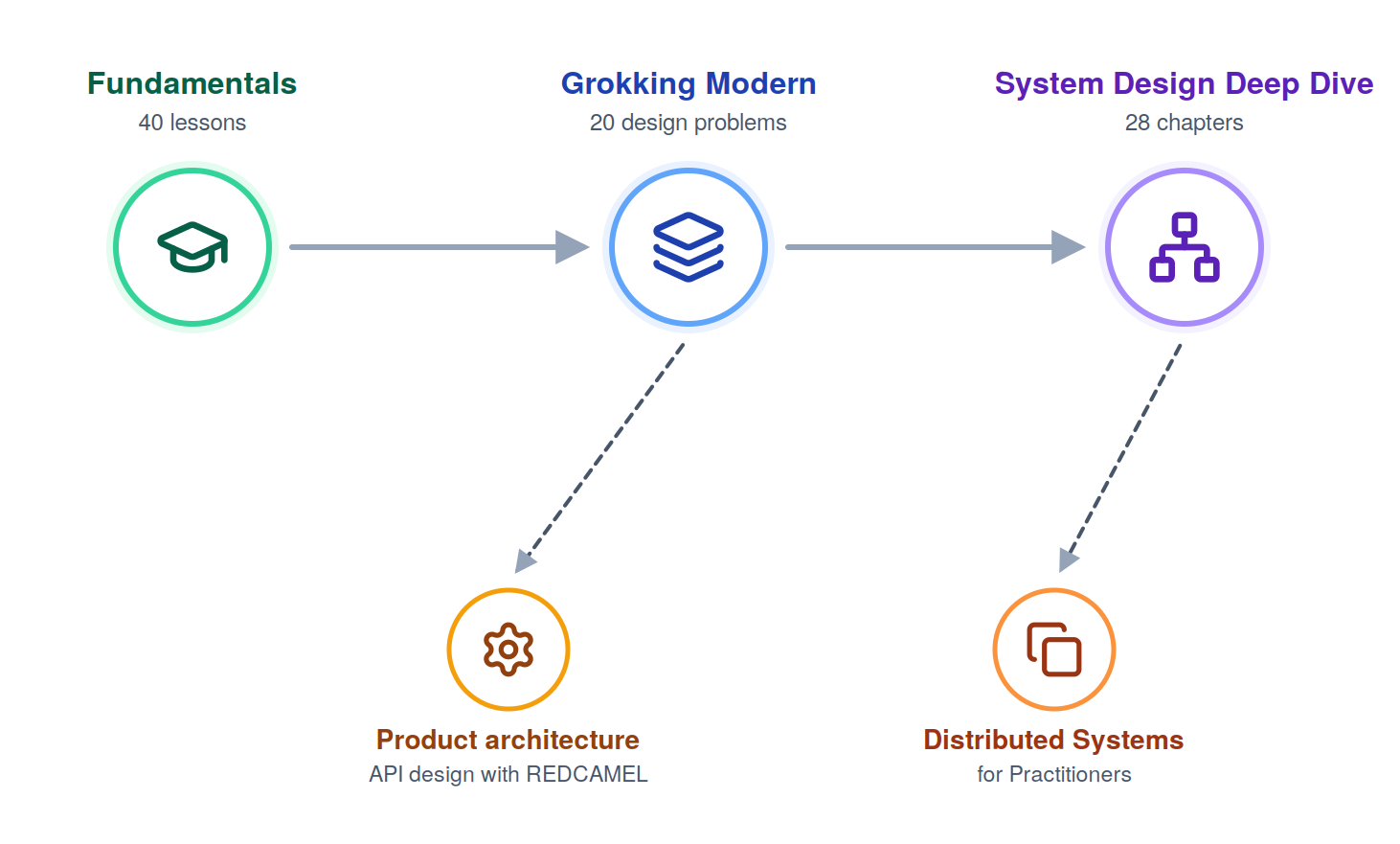
The two branches are optional, and each answers a different gap.
Direct competitors to Grokking
Three platforms sell a course in the same space. Each comparison below isolates one difference from Grokking.
ByteByteGo
ByteByteGo’s System Design Interview course is a numbered sequence. Its outline lists chapters 02 through 04 on scaling, estimation, and an interview framework, followed by 25 design chapters, and the chapter text needs a login.
Its pricing page bundles eight courses and an Ask Alex tool trained on its books. Grokking separates 16 building blocks from 20 design problems, while ByteByteGo places its designs in one sequence.
Hello Interview
Hello Interview’s System Design guide lists 32 question breakdowns, nine core concepts, ten key technologies, and seven patterns, and its breakdowns spell out what is expected at each level.
Where Grokking teaches building blocks first, Hello Interview starts from a delivery framework and works through problems. Its live mock interview and mentorship programs ended on May 31, 2026, while Premium, Guided Practice, and its free content and videos continue.
Exponent (Aced)
Exponent’s System Design course combines video lessons, interactive exercises, AI feedback, and full mock interview videos. The site now shows the name Aced, formerly Exponent.
Grokking lists eight AI mock interviews on its Premium plans and above, while Exponent’s membership adds mocks with AI and peers and a question database.
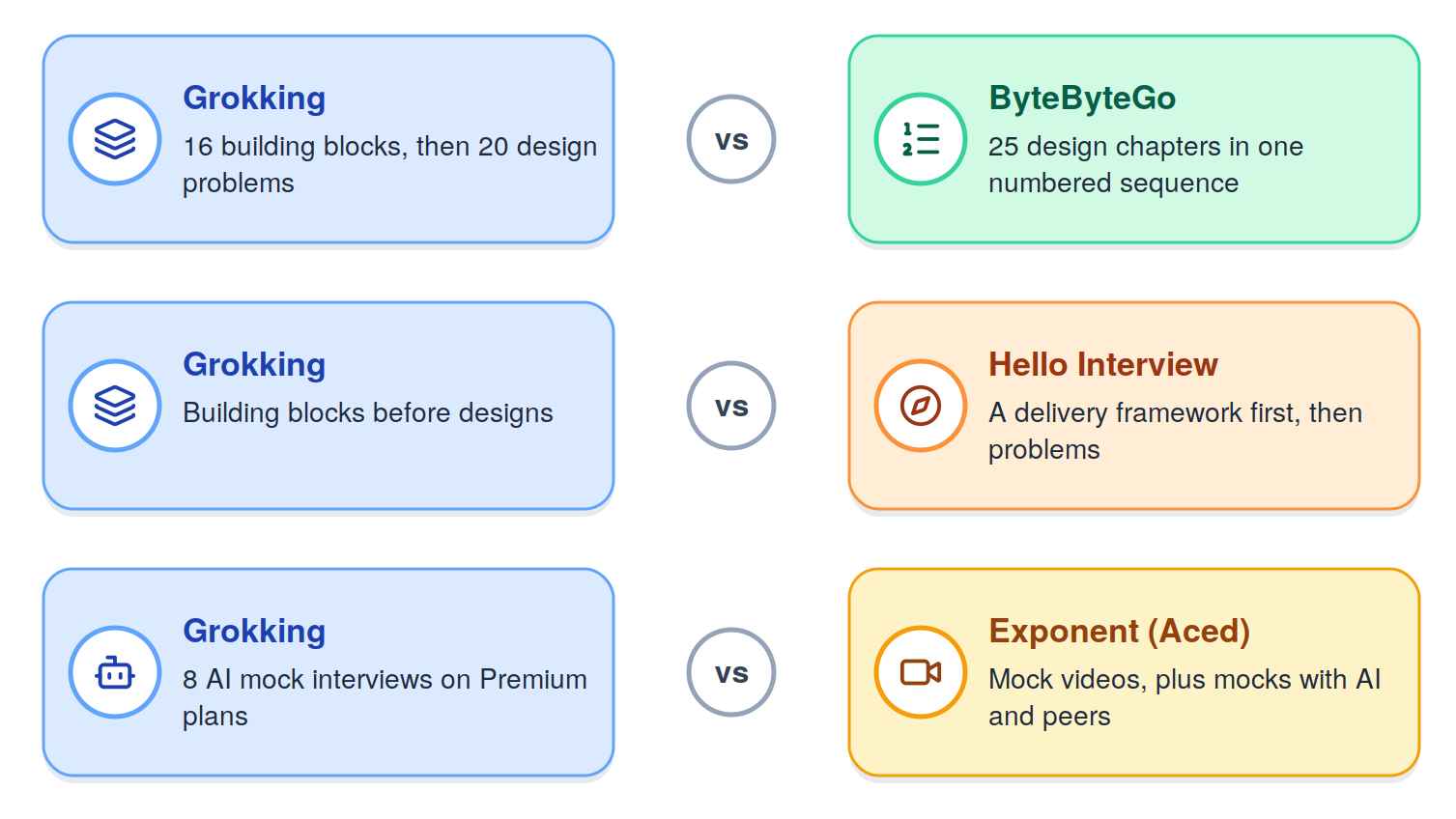
Each row isolates one difference and leaves the rest of the comparison to you.
Format differences
Not every alternative is a course. Some arrive as books, a repository, or live sessions.
Books
Designing Data-Intensive Applications (DDIA) has a first edition from March 2017 and a second edition with Chris Riccomini from February 2026, and O’Reilly rates it intermediate to advanced. Alex Xu’s System Design Interview books come as digital and physical copies, and he has noted that the ByteByteGo courses carry their full content in a web format.
Books suit readers who prefer paper or a single download over a lesson sequence with quizzes.
Repository and flashcards
The System Design Primer is an open source GitHub repository with an index of topics, eight solved questions, and three Anki flashcard decks that use spaced repetition. Its study guide scales effort to a short, medium, or long timeline.
Flashcards turn review into short sessions, which suits the weeks before an interview.
Live sessions
interviewing.io runs anonymous mock interviews with senior, staff, or principal-level engineers or managers. Sessions use audio and chat in a shared editor with no video, and each ends with feedback.
With Hello Interview’s live mocks ended, anonymous sessions like these are one of the places left to find a human interviewer.
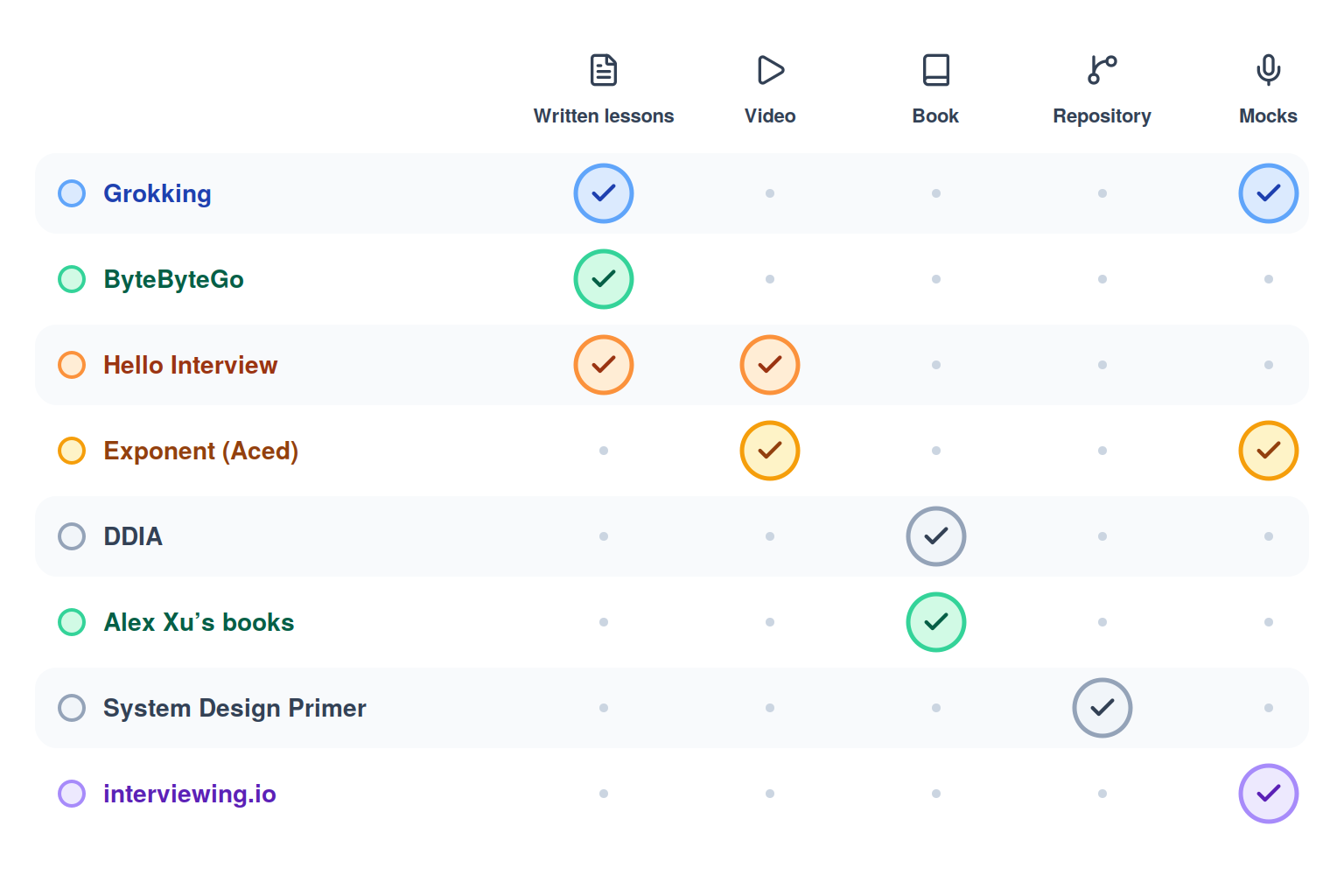
A filled cell marks a format listed on a public page, and a dot means the page did not mention it.
Pricing model differences
The shape of a plan matters more here than its amount, so this section lists models without prices.
Pay for time
Educative bills monthly, annually, or every two years. ByteByteGo offers one year of access, and Hello Interview sells Premium for one month or one year without auto-renewal.
Time-boxed plans fit a fixed interview date, and the end date arrives whether or not you finished.
Pay once
ByteByteGo’s pricing page lists a pay-once lifetime option, and Hello Interview sells lifetime Premium that includes future content.
Lifetime access suits readers who expect to return to the material.
Try first
Educative lists 78 free lessons and a 21-day free trial. Hello Interview’s paid tier has no free trial, but many of its resources are free and one Guided Practice problem is free to try.
O’Reilly’s book page mentions a free trial, and the System Design Primer, the Amazon Web Services (AWS) Architecture Blog, and AWS post-event summaries are free to read.
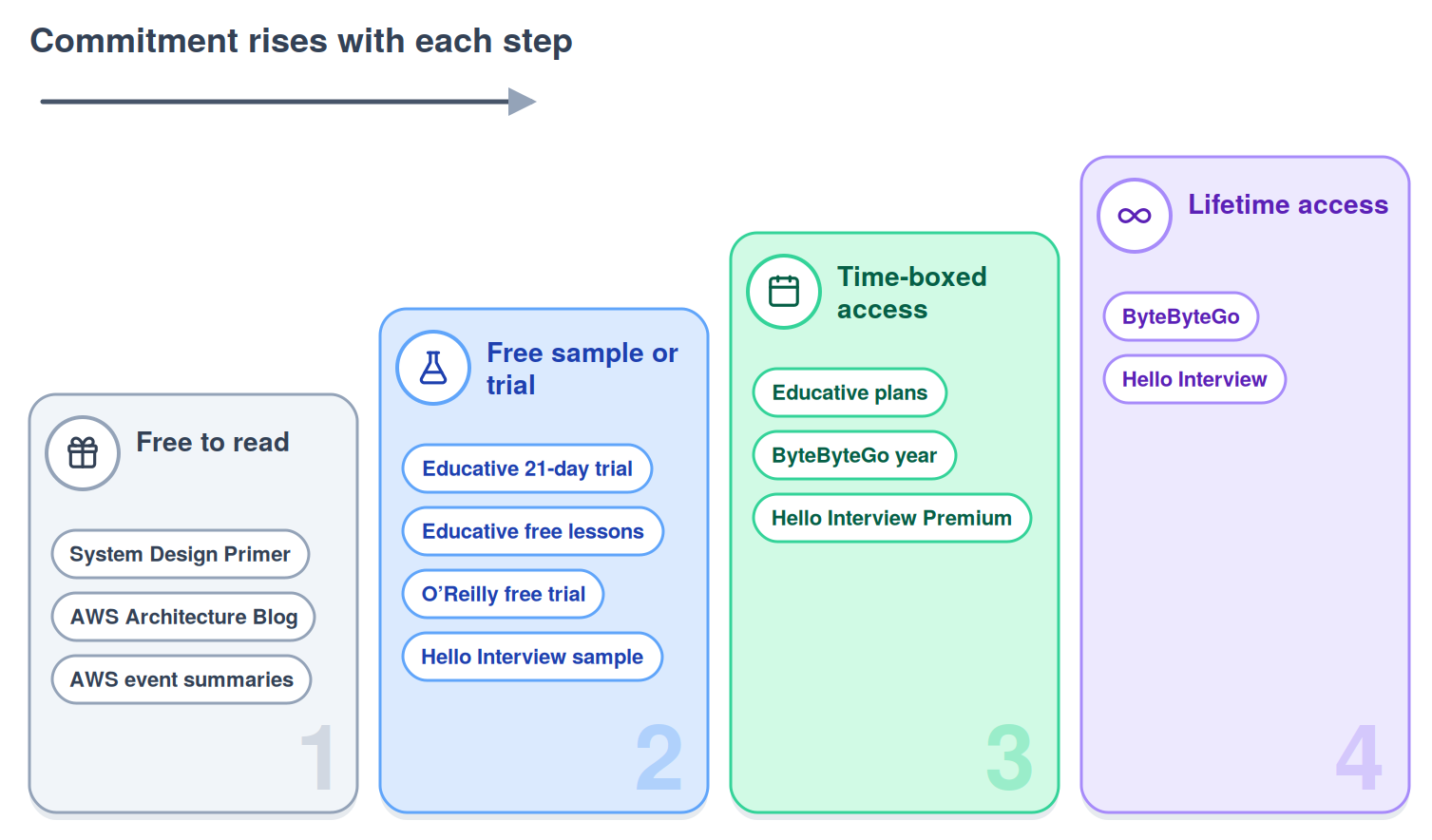
Higher steps ask for more commitment, so start low and climb only if the material earns it.
Switch or supplement
The useful question is which gap you need to close.
When switching makes sense
Switch when the format itself is the obstacle. A reader who loses focus on text lessons may prefer Exponent’s video lessons, and a reader who wants a numbered run of designs may prefer ByteByteGo’s sequence.
Switching also resets progress, so confirm the new platform covers the designs you still need and use its free material to test the fit.
When supplementing makes sense
Supplement when one course already covers most topics. Add a book such as DDIA for depth, the Primer for flashcards, an Educative course such as the Deep Dive for research, or a mock platform for delivery practice.
A short list of weak spots after each practice session shows which supplement to pick next.
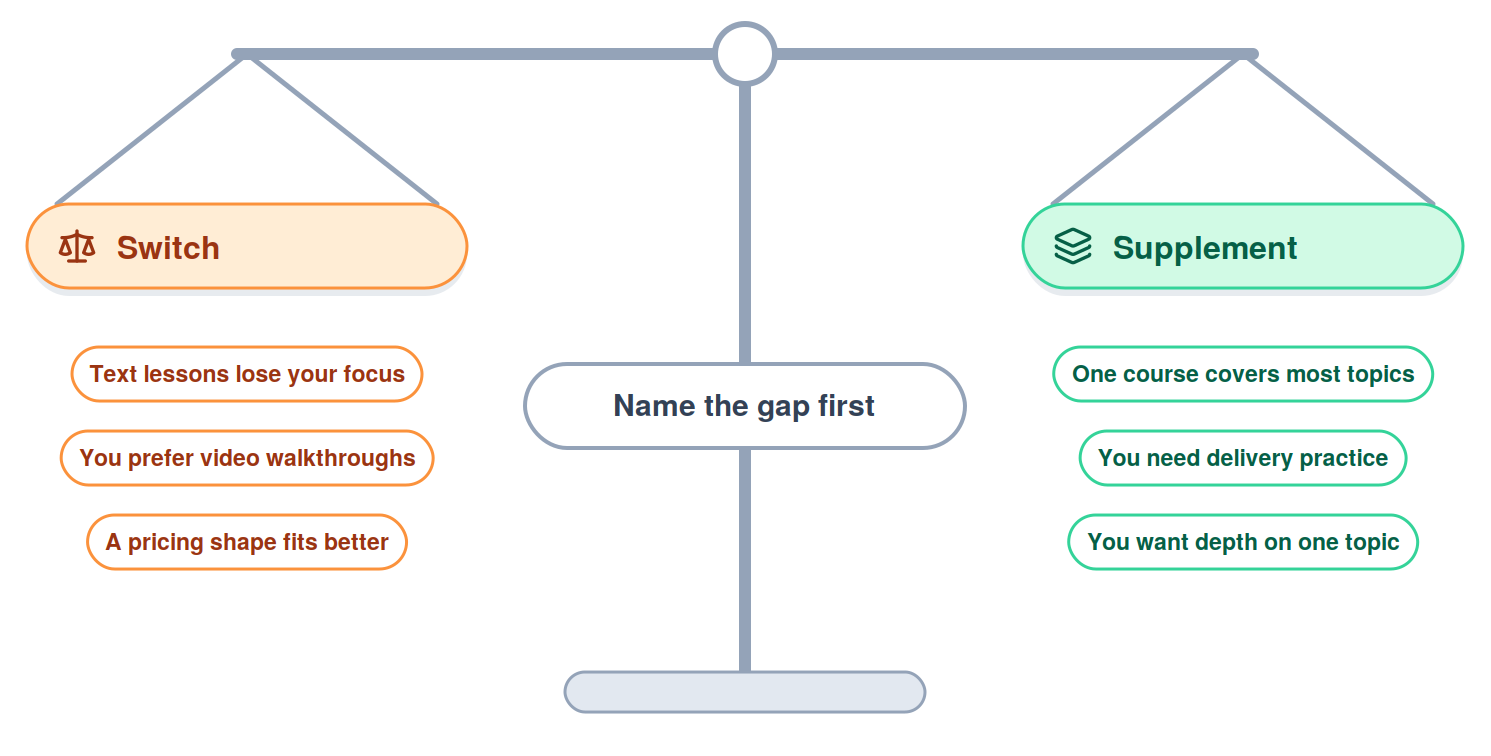
Neither side outweighs the other, because the right choice depends on your gap.
Start by naming the gap, whether it is vocabulary, depth, designs, or delivery. Use free pages and trials before paying, and prefer a supplement when most of your plan works. Switch when the format or the pricing shape blocks your progress. Keep timed, spoken practice on the calendar throughout.