
Whenever someone asks me, “I have an interview coming soon at Apple. Where should I prep?”, I usually tell them not to prepare for Apple the same way they would prepare for every other Big Tech company.
Coding and System Design are still essential, but Apple interviews often evaluate something broader. Interviewers want to see strong engineering fundamentals, thoughtful technical judgment, clear communication, and an appreciation for how engineering decisions affect the products millions of people use every day.
If you build your preparation around those signals instead of focusing only on algorithms, you’ll be much better prepared for the entire interview loop.
What Apple Is Really Testing
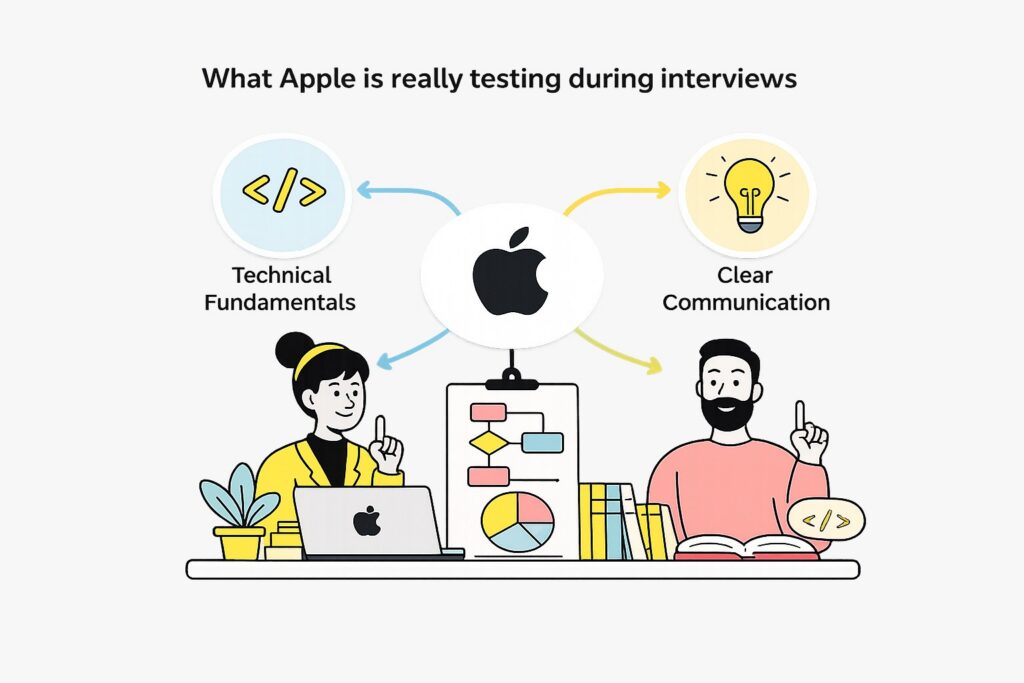
One misconception I see quite often is that Apple interviews are purely technical. Strong coding skills certainly matter, but they’re only one part of the evaluation.
Throughout the interview process, Apple interviewers are trying to understand how you approach engineering problems, communicate technical ideas, collaborate across teams, and make decisions that improve the user experience. A technically correct solution is important, but interviewers are often just as interested in why you chose that solution and whether it aligns with broader product goals.
That changes how I recommend preparing for the interview. Instead of treating every round as an isolated exercise, think about the broader qualities Apple is trying to evaluate.
| Interview Stage | Primary Focus | What You Should Practice |
|---|---|---|
| Recruiter Screen | Experience and team fit | Resume, projects, motivation |
| Coding Interviews | Algorithms, communication, clean implementation | Pattern-based problem solving |
| System Design | Scalability, simplicity, engineering trade-offs | Architecture fundamentals |
| Behavioral | Collaboration, ownership, communication | Real project discussions |
| Product Thinking | Customer impact and user experience | Connect technical decisions to user outcomes |
One thing I appreciate about Apple’s interview process is that it reflects how engineers actually work. Most engineering decisions involve balancing technical constraints with product requirements, performance, reliability, and customer expectations. Those same conversations naturally appear throughout the interview process.
Where Should You Prep for Coding Interviews?
Coding interview prep remains a major part of Apple’s software engineering process, but I don’t think solving hundreds of random LeetCode problems is the most efficient way to prepare. What consistently separates strong candidates isn’t the number of questions they’ve completed, but how well they understand the underlying concepts.
When I review mock interviews, I often notice candidates jumping straight into implementation before fully understanding the problem. The strongest engineers usually spend a few minutes clarifying requirements, discussing possible approaches, and explaining why one solution is preferable before writing any code. That structured thinking tends to produce cleaner implementations with fewer mistakes.
Rather than memorizing solutions, focus on the topics that repeatedly appear across software engineering interviews.
- Arrays and strings
- Hash maps
- Linked lists
- Stacks and queues
- Trees
- Graphs
- Binary search
- Dynamic programming
- Recursion
These topics form the foundation of most interview questions. Once you understand the reasoning behind each pattern, you’ll spend far less time trying to recognize individual problems and much more time solving unfamiliar ones with confidence.
The table below reflects how I usually prioritize these topics for candidates preparing for Apple.
| Topic | Priority | Why It Matters |
|---|---|---|
| Arrays & Strings | Very High | Foundation of many interview questions |
| Hash Maps | Very High | Efficient lookups and frequency counting |
| Trees | High | Traversal and recursive reasoning |
| Graphs | High | Dependency and relationship modeling |
| Binary Search | High | Efficient searching and optimization |
| Dynamic Programming | Medium-High | Optimization problems |
| Recursion | Medium | Divide-and-conquer reasoning |
| Linked Lists | Medium | Pointer manipulation and memory reasoning |
One habit that helped me significantly was treating every practice session like an actual interview. Instead of solving problems silently, I explained my reasoning as I worked through each step. That simple change made technical interviews feel much more natural because communication became part of my normal problem-solving process instead of something I had to remember during the interview.
Don’t Forget to Test Your Code
One area candidates often overlook is validation. Apple builds products that millions of people depend on every day, so reliability naturally becomes part of the engineering culture.
I’ve noticed that interviewers appreciate candidates who automatically think about edge cases before they’re prompted. Rather than stopping once the code compiles, walk through several examples, test boundary conditions, and explain how your solution behaves when the input changes unexpectedly. Those small habits demonstrate the kind of engineering discipline that translates well to production software.
System Design Preparation for Apple
For mid-level and senior software engineering roles, System Design becomes one of the most important parts of the interview process. Apple’s System Design interviews certainly explore scalability, but they also emphasize simplicity, maintainability, reliability, and performance in ways that feel very practical.
One thing I’ve noticed is that Apple interviewers often care less about designing the biggest possible system and more about designing the right system. A solution that is elegant, reliable, and easy to operate is frequently better than an unnecessarily complicated architecture built around technologies that don’t solve a real problem.
When preparing, I recommend mastering the building blocks of distributed systems before attempting complete interview questions. Once those concepts become intuitive, designing larger systems becomes much easier.
The topics I would prioritize include:
- Caching
- Load balancing
- Database design
- Replication
- Message queues
- Event-driven architecture
- Rate limiting
- Content delivery networks
- Monitoring
- Fault tolerance
Rather than studying each topic independently, try to understand how they interact inside real production systems. For example, a cloud photo storage service combines distributed storage, caching, synchronization, replication, and monitoring into a single architecture. Understanding those relationships is much more valuable than memorizing diagrams you’ll probably never recreate during an interview.
The kinds of systems Apple interviewers frequently discuss also tend to reflect products that customers use every day.
| System Design Question | Concepts Commonly Evaluated |
|---|---|
| Photo Storage Service | Storage, synchronization, replication |
| Messaging Platform | Delivery guarantees, queues, scalability |
| Notification Service | Reliability, retries, prioritization |
| Media Streaming | CDN, caching, bandwidth optimization |
| Cloud Synchronization | Consistency, conflict resolution |
| Recommendation System | Ranking, personalization, scalability |
Product Thinking Can Separate Strong Candidates
This is probably the biggest difference between Apple and many other large technology companies.
During System Design discussions, don’t stop at explaining how the architecture works. Explain how your technical decisions improve the customer’s experience. Apple engineers constantly balance performance, battery usage, latency, privacy, reliability, and simplicity, so interviewers naturally appreciate candidates who think beyond infrastructure alone.
For example, if you’re designing a synchronization service, don’t just discuss replication strategies or database consistency. Also consider what happens when a user loses network connectivity, switches between devices, or expects changes to appear instantly across their Apple ecosystem. Those conversations demonstrate that you understand software engineering is ultimately about building products that people enjoy using.
Behavioral Interviews Are More Important Than Many Candidates Realize
Behavioral interviews are sometimes treated as the easiest part of the Apple interview process, which is probably why they’re also one of the most common reasons candidates underperform. After spending weeks preparing coding problems and System Design questions, many engineers assume they can simply “talk about their experience” without much preparation.
In reality, Apple places significant value on collaboration, communication, and engineering judgment. Interviewers want to understand how you work with other engineers, how you handle ambiguity, and how you make technical decisions when there isn’t a perfect solution. Those conversations often reveal just as much about your engineering maturity as the technical rounds themselves.
When I prepare candidates for behavioral interviews, I encourage them to revisit the projects they’re genuinely proud of instead of memorizing STAR templates. Think about production incidents you helped resolve, difficult architectural decisions, disagreements within your team, or projects where you had to balance competing priorities. Those stories usually feel much more authentic because they’re based on real engineering experiences rather than rehearsed interview answers.
I also recommend preparing examples around a handful of recurring themes.
- Leading or owning a challenging project
- Resolving technical disagreements
- Working across multiple teams
- Solving production issues under pressure
- Improving performance or reliability
- Learning from a failed project or design decision
Strong answers don’t simply explain what happened. They explain why you made certain decisions, what alternatives you considered, what trade-offs existed, and what measurable results your work produced. Those details demonstrate thoughtful engineering much better than generic leadership stories.
Build a Small but Effective Preparation Stack
One mistake I see repeatedly is candidates collecting dozens of interview resources without mastering any of them. Interview preparation becomes much more effective when you consistently use a small number of high-quality resources instead of constantly searching for something new.
For System Design, I generally recommend System Design Handbook because it provides a structured approach to distributed systems, architectural patterns, scalability, and engineering trade-offs. More importantly, it emphasizes the reasoning behind architectural decisions instead of encouraging candidates to memorize reference diagrams.
For structured interview preparation, Educative remains one of the strongest options. Courses like Grokking the Modern System Design Interview and System Design Interview: Fast-Track in 48 Hours help organize your preparation while reinforcing the patterns that appear repeatedly during software engineering interviews.
I also recommend using Fenzo.ai as a learning companion. It’s particularly useful for reviewing concepts, generating interview questions, identifying weak areas, and practicing technical explanations before mock interviews.
Together, these resources cover nearly every area you’ll need during the interview process.
| Resource | Best Used For |
|---|---|
| System Design Handbook | Distributed systems, scalability, architecture patterns |
| Educative | Structured coding and System Design preparation |
| Fenzo.ai | AI-assisted review, concept reinforcement, mock questions |
| Mock Interviews | Communication and interview simulation |
Adjust Your Preparation to Your Timeline
One question I hear almost as often as “Where should I prep?” is “What should I focus on first?” My answer depends almost entirely on how much time remains before the interview.
If your interview is only a week away, don’t try to learn entirely new technologies or advanced algorithms. You’ll get far more value from reinforcing what you already know while improving consistency across coding, System Design, and behavioral preparation.
Here’s the approach I usually recommend.
| Timeline | Primary Focus |
|---|---|
| Days 1-2 | Coding patterns and timed practice |
| Days 3-4 | System Design fundamentals and architecture discussions |
| Days 5-6 | Behavioral preparation and project review |
| Final Day | Mock interviews and light revision |
If you have three or four weeks, you can spread the preparation more evenly. Spend the first week strengthening your coding fundamentals, the second week on System Design, the third week combining technical practice with mock interviews, and use the final week to refine behavioral stories and revisit weaker topics.
I’ve found that candidates who study consistently for a few hours each day usually perform much better than those trying to fit everything into a few marathon sessions. Interview preparation is much more about consistency than intensity.
Common Mistakes I See Candidates Make
After helping candidates prepare for interviews across several large technology companies, I’ve noticed that the same preparation mistakes appear again and again. Fortunately, they’re also some of the easiest mistakes to fix once you recognize them.
| Common Mistake | Better Approach |
|---|---|
| Preparing only for coding interviews | Balance coding, System Design, behavioral, and product thinking |
| Memorizing System Design solutions | Understand architectural trade-offs and reasoning |
| Ignoring product impact | Connect technical decisions to customer experience |
| Skipping behavioral preparation | Prepare detailed project discussions |
| Practicing silently | Explain your reasoning throughout every solution |
Another mistake is assuming communication only matters during behavioral interviews. In reality, every interview is evaluating how clearly you explain technical ideas, respond to feedback, and collaborate with another engineer. Practicing aloud during coding and System Design sessions is one of the simplest ways to improve that skill.
Finally, don’t ignore product thinking. Apple builds products that millions of people use every day, and interviewers naturally appreciate engineers who think beyond implementation details. Explaining how an architectural decision improves reliability, reduces latency, protects privacy, or creates a better customer experience often distinguishes strong candidates from equally capable engineers.
Final Thoughts
Whenever someone asks me, “I have an interview coming soon at Apple. Where should I prep?”, I encourage them to think beyond coding practice alone.
Strong Apple candidates prepare across algorithms, System Design, behavioral interviews, communication, and product thinking because that’s how Apple evaluates engineers. If you approach every interview round by asking not only “Is this technically correct?” but also “Does this create a better product for the user?”, you’ll naturally have stronger engineering discussions throughout the interview process.
Technical ability will always be the foundation, but Apple is ultimately looking for engineers who can solve complex problems, collaborate effectively, make thoughtful decisions, and build products that people genuinely enjoy using. Those are the qualities worth developing, whether you’re preparing for an interview next week or building the next stage of your engineering career.