
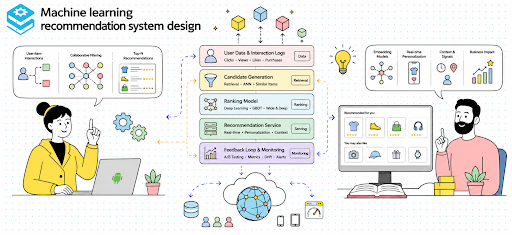
You start with a simple idea: show users content they might like. Maybe it is a list of suggested products, videos, or articles. At the beginning, the logic is straightforward—perhaps a few heuristics or a basic model trained on historical interactions. But as the product grows, so do expectations. Users want recommendations that feel personal, timely, and relevant, and suddenly what seemed like a feature becomes a system that touches nearly every part of your application.
This is where machine learning system design begins to reveal its true complexity. What looks simple on the surface quickly turns into a full-stack problem involving data pipelines, model training, real-time serving, and continuous feedback loops. The challenge is not just to generate recommendations, but to do so at scale, under latency constraints, and in a way that adapts to constantly changing user behavior.
Understanding ML recommendation system design as a system-level discipline is essential if you want to make sense of how these systems operate in production. It is not about picking the right algorithm in isolation, but about orchestrating multiple components so that they work together reliably. This article explores that reality, focusing on architecture, trade-offs, and the challenges that emerge when recommendation systems move from prototypes to production environments.
Why recommendation systems are fundamentally complex
Recommendation systems are complex because they operate at the intersection of personalization, scale, and uncertainty. Each user interacts with the system differently, generating unique patterns of behavior that must be captured and interpreted. At the same time, the system must serve millions of users simultaneously, each expecting recommendations that feel tailored to their preferences. This creates a tension between individual relevance and system-wide efficiency.
Another layer of complexity comes from the need to balance multiple objectives. It is not enough to recommend the most relevant items; the system must also consider diversity, novelty, and fairness. Over-optimizing for relevance can lead to repetitive or narrow recommendations, while introducing diversity can reduce immediate engagement. These trade-offs are inherent to recommendation systems and must be carefully managed.
Consider a streaming platform recommending videos. If the system focuses solely on what a user has watched recently, it may create a feedback loop that limits exposure to new content. On the other hand, introducing too much variety can make recommendations feel irrelevant. Designing a system that navigates this balance requires more than just model tuning—it requires a deep understanding of user behavior and system dynamics.
Understanding ML recommendation system design in context
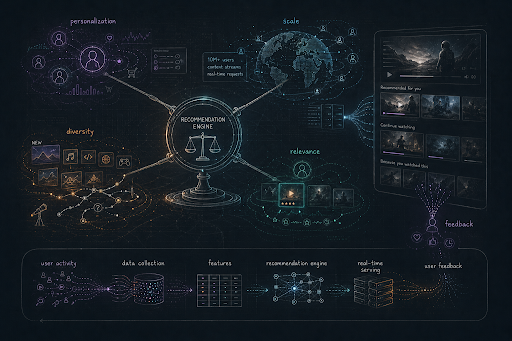
When you think about system design, it is helpful to view it as an end-to-end system rather than a single model or algorithm. The system begins with data collection, where user interactions, metadata, and contextual signals are captured. This data is then processed and transformed into features that can be used for training and inference. The model layer uses these features to generate predictions, which are ultimately served to users in real time.
These components are tightly interconnected. Decisions made in the data pipeline affect the quality of features, which in turn influence model performance. The serving layer must deliver results quickly, which can constrain the complexity of the models used. Feedback from users feeds back into the system, influencing future recommendations and model updates.
This interconnectedness is what makes recommendation systems challenging to design. You are not optimizing a single component, but an entire pipeline. The rest of this article explores these layers in detail, highlighting how they interact and where the most significant challenges arise.
Data pipelines and feature generation
Data pipelines form the backbone of any recommendation system. They are responsible for collecting, processing, and transforming raw user interactions into structured data that can be used by models. This includes events such as clicks, views, purchases, and time spent on content, as well as metadata about items and users. The scale of this data can be enormous, requiring robust systems for ingestion and processing.
Feature generation is where raw data is converted into meaningful signals. This might include aggregating user behavior over time, extracting patterns from interaction histories, or encoding item attributes in a way that models can understand. The quality of these features has a direct impact on the effectiveness of the recommendations, making this stage critical to the overall system.
Another important consideration is data freshness. In many applications, user preferences change rapidly, and stale data can lead to outdated recommendations. Designing pipelines that can process and update data in near real time is a significant challenge, particularly at scale. This makes data engineering a central component of recommendation system design, rather than a supporting role.
Modeling approaches in recommendation systems
Recommendation systems rely on a variety of modeling approaches, each with its own strengths and limitations. Collaborative filtering, for example, leverages patterns in user interactions to identify similarities between users or items. It works well when there is sufficient interaction data, but struggles with new users or items that lack historical data.
Content-based filtering takes a different approach, focusing on the attributes of items rather than user behavior. It can provide recommendations even in the absence of interaction data, but may lack the ability to capture complex user preferences. Hybrid models combine these approaches, attempting to leverage the strengths of each while mitigating their weaknesses.
The choice of model depends on factors such as data availability, system scale, and latency requirements. In production systems, it is common to use multiple models in different stages of the pipeline, such as candidate generation and ranking. This layered approach allows systems to balance efficiency and accuracy, but also introduces additional complexity in managing and integrating models.
Serving layer and real-time inference
The serving layer is where recommendations are delivered to users, often under strict latency constraints. Users expect responses in milliseconds, which means that the system must generate recommendations quickly and efficiently. This requires careful optimization of both infrastructure and model complexity.
One common approach is to precompute candidate recommendations offline and use a lightweight model to rank them in real time. This reduces the computational burden during inference, but requires maintaining up-to-date candidate sets. Another approach is to use real-time models that generate recommendations on demand, which can improve personalization but increases latency and resource usage.
Scaling the serving layer is another major challenge. As the number of users grows, the system must handle increasing volumes of requests without degrading performance. This often involves distributed systems, caching strategies, and load balancing mechanisms. The goal is to ensure that recommendations remain fast and reliable, even under heavy load.
Feedback loops and system evolution
Feedback loops are a defining characteristic of recommendation systems. Every user interaction generates new data that can be used to improve the system. This creates a continuous cycle of data collection, model training, and deployment, allowing the system to adapt to changing user behavior.
However, feedback loops also introduce challenges. Positive feedback loops can reinforce existing patterns, leading to reduced diversity and potential bias. Negative feedback loops, on the other hand, can degrade performance if not properly managed. Designing systems that balance these effects requires careful consideration of how feedback is collected and used.
Over time, recommendation systems evolve as new data, models, and requirements are introduced. This evolution requires systems that are flexible and maintainable, capable of incorporating changes without disrupting existing functionality. It also requires ongoing monitoring to ensure that the system continues to perform effectively.
Comparison of recommendation system components
| Component | Role in system | Key challenges | Impact on performance |
|---|---|---|---|
| Data pipeline layer | Collect and process user data | Scale, data quality, freshness | Foundational to system accuracy |
| Model layer | Generate and rank recommendations | Accuracy, cold start, generalization | Core to personalization quality |
| Serving layer | Deliver recommendations in real time | Latency, scalability, efficiency | Critical for user experience |
| Feedback & monitoring layer | Track performance and update models | Bias, drift, feedback loops | Essential for long-term success |
Each component plays a distinct role, but their effectiveness depends on how well they integrate. Data pipelines ensure that the model has access to relevant and up-to-date information, while the model layer transforms that data into actionable insights. The serving layer makes these insights available to users, and the feedback layer ensures that the system continues to improve over time.
Understanding these interactions is key to designing effective recommendation systems. Weaknesses in any one component can propagate through the system, affecting overall performance. This is why system-level thinking is essential in ML recommendation system design.
Trade-offs in recommendation system design
Designing recommendation systems involves navigating a range of trade-offs. One of the most prominent is the balance between accuracy and diversity. Highly accurate recommendations may focus on a narrow set of items, while more diverse recommendations can expose users to new content but may reduce immediate engagement.
Another important trade-off is between latency and personalization. More sophisticated models can provide better recommendations, but they often require more computation, increasing response times. In real-time systems, this trade-off must be carefully managed to ensure that recommendations are both relevant and fast.
Consider an e-commerce platform during a major sale event. The system must generate recommendations quickly to handle high traffic, but it also needs to maintain personalization to drive conversions. Balancing these requirements requires careful design of both the model and the serving infrastructure, highlighting the complexity of real-world systems.
Common misconceptions about recommendation systems
One common misconception is that better models automatically lead to better recommendations. While model improvements can enhance performance, they cannot compensate for poor data quality or inadequate system design. The effectiveness of a recommendation system depends on the entire pipeline, not just the model.
Another misconception is that data alone is sufficient. While data is essential, it must be processed and interpreted correctly to be useful. Raw data without proper feature engineering and modeling does not translate into effective recommendations.
There is also a belief that recommendation systems are static once deployed. In reality, they are dynamic systems that require continuous updates and maintenance. User behavior changes, new items are introduced, and system requirements evolve, all of which require ongoing adaptation.
How recommendation systems evolve at scale
As recommendation systems scale, their architecture must evolve to handle increasing complexity. This often involves moving from simple models to multi-stage pipelines, incorporating additional data sources, and optimizing infrastructure for performance and cost. The system becomes more modular, with distinct components for data processing, modeling, and serving.
Scaling also introduces challenges related to consistency and coordination. Ensuring that different parts of the system remain synchronized becomes more difficult as complexity increases. This requires robust infrastructure and careful design of data flows and interfaces.
Over time, recommendation systems become critical components of the overall product, influencing user engagement and business outcomes. This makes their design and evolution a central concern for engineering teams, requiring long-term thinking and continuous investment.
Conclusion
ML recommendation system design is not just about choosing the right algorithm—it is about building and maintaining a complex system that operates at scale. It involves data pipelines, models, serving infrastructure, and feedback mechanisms, all working together to deliver personalized experiences.
By understanding these systems as interconnected components rather than isolated models, you gain a clearer picture of what it takes to build effective recommendation systems. It is this system-level perspective that defines success in real-world environments and separates prototypes from production-ready systems.
Happy learning!