
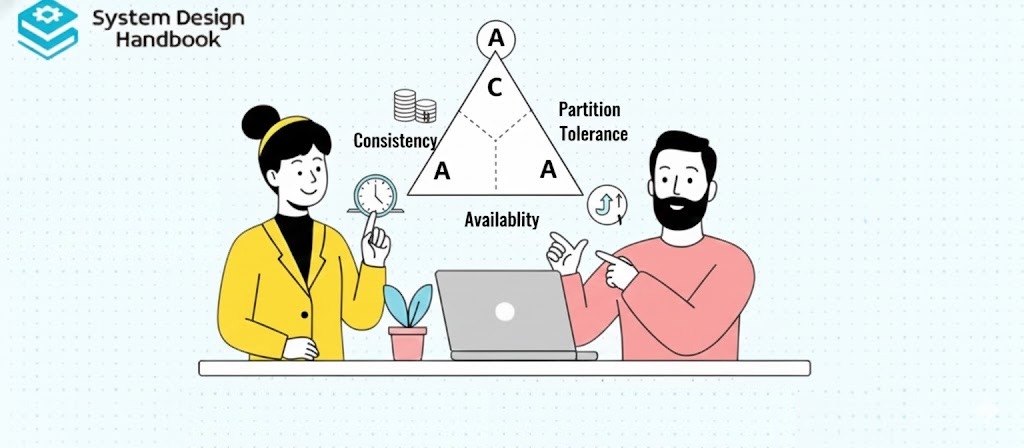
When you walk into a System Design interview, the interviewer is not testing whether you can recite definitions. They are testing whether you understand trade-offs. CAP theorem in System Design exists almost entirely to test that skill.
Interviewers care about CAP because it forces you to reason under failure. Real systems do not fail politely. Networks break, nodes disappear, and latency spikes without warning. CAP is the mental framework interviewers use to see how you think when systems stop behaving perfectly.
If you cannot explain the CAP theorem clearly, interviewers often assume you are memorizing architectures instead of understanding them. If you can explain it well, they assume you can reason through real-world design constraints.
How the CAP Theorem Shows Up Without Being Named
Many interviewers never say the words “CAP theorem” directly. Instead, they ask questions that quietly depend on it.
They might ask what happens when a database node becomes unreachable. They might ask whether your system should serve stale data or reject requests during a failure. They might push you to choose between correctness and responsiveness under network issues.
Each of those questions is really about the CAP theorem in System Design. Strong candidates recognize this early and frame their answers around consistency, availability, and partition tolerance without sounding academic.
What Strong Interview Answers Look Like
A weak answer treats CAP like trivia. A strong answer treats CAP like a decision-making tool.
When you explain CAP well, you sound like someone who has designed systems under pressure. You explain what breaks, what users experience, and why the trade-off you chose makes sense for the product. You do not pretend there is a perfect answer. You explain why the compromise is acceptable.
This is why mastering the CAP theorem in System Design often becomes the difference between a “good” interview and a “hire” signal.
What CAP Theorem In System Design Actually States
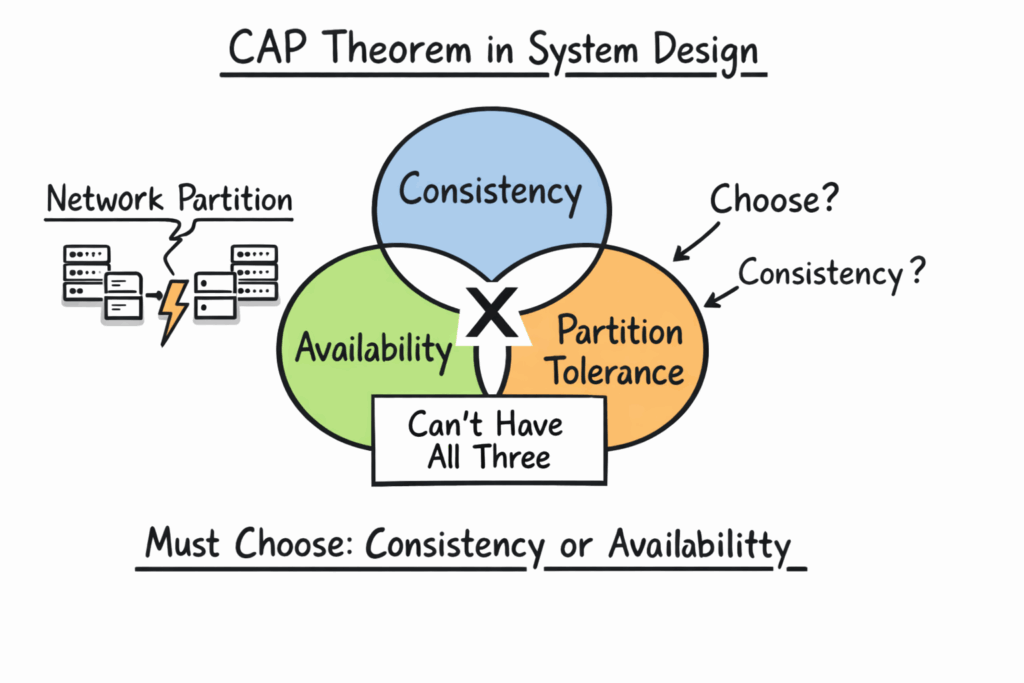
CAP theorem in System Design states that in a distributed system, when a network partition occurs, the system must choose between consistency and availability. You cannot fully guarantee all three properties at the same time.
Those three properties are consistency, availability, and partition tolerance. The theorem is not a suggestion. It is a constraint imposed by physics and networks.
What makes CAP tricky in interviews is not the definition. It is understanding when the trade-off actually matters.
What “Guarantee” Means In Distributed Systems
One of the most misunderstood parts of the CAP theorem in System Design is the word “guarantee.”
Guarantee does not mean “usually” or “most of the time.” It means “under all conditions, including failure.” A system can behave consistently and be highly available during normal operation. CAP only becomes relevant when the system experiences a partition.
This distinction matters deeply in interviews. Interviewers expect you to say that CAP trade-offs apply during failures, not during steady-state operation.
The Three Properties At A Glance
The table below summarizes the three components of CAP theorem in System Design in a way interviewers often appreciate.
| Property | What It Guarantees | What The User Experiences |
| Consistency | All nodes see the same data at the same time | Reads always return the latest write |
| Availability | Every request receives a response | The system never refuses a request |
| Partition Tolerance | The system continues despite network splits | The system survives node communication failures |
Understanding these guarantees at the user-experience level makes your explanations feel practical rather than theoretical.
Understanding Consistency Beyond The Textbook Definition
In interviews, consistency is rarely about theory. It is about whether users see the correct data.
When you choose consistency in the CAP theorem in System Design, you are saying that correctness matters more than responsiveness during failures. If the system cannot guarantee correct data, it will stop responding rather than return something potentially wrong.
This often feels uncomfortable to candidates because “not responding” sounds bad. In reality, many critical systems choose this path deliberately.
Strong Consistency Vs Eventual Consistency
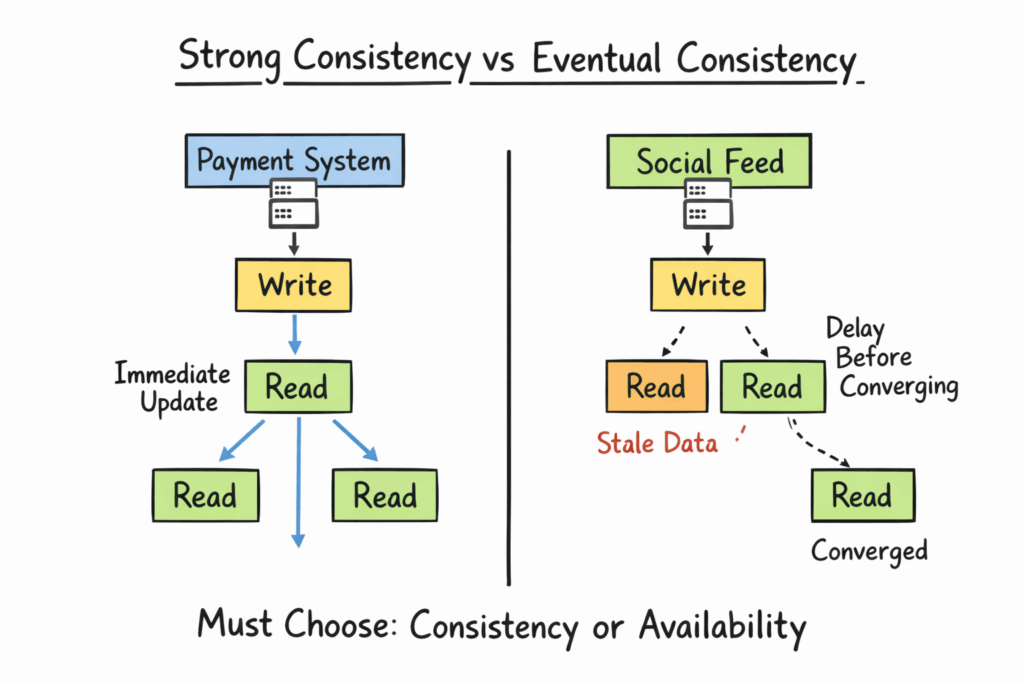
Strong consistency means that once a write completes, every subsequent read sees that write immediately. Eventual consistency means the system will converge over time, but some reads may temporarily return stale data.
Interviewers expect you to know this distinction and apply it appropriately. Payment systems often require strong consistency. Social feeds usually tolerate eventual consistency.
The key is not memorizing which system uses which model. The key is explaining why the trade-off matches the business need.
Consistency From A System Design Perspective
Consistency decisions affect architecture. They influence replication strategies, quorum sizes, leader election, and write paths.
If you claim your system is consistent, interviewers may ask how you enforce that consistency. This is where many candidates struggle. They say “strong consistency” without explaining coordination, locking, or quorum mechanisms.
When you explain consistency in CAP theorem in System Design, you should always be ready to explain the cost of enforcing it.
Availability Explained From An Interview Perspective
One of the most common interview mistakes is confusing availability with uptime metrics.
In CAP theorem in System Design, availability has a very specific meaning. Every request made to a non-failing node must receive a response, even during a partition. The response does not have to be correct. It just has to exist.
This definition often surprises candidates, but interviewers expect you to know it.
What Availability Looks Like During Failure
Availability only matters when something goes wrong. During a network partition, an available system continues responding even if it cannot coordinate with other nodes.
This means the system may return stale data, conflicting updates, or temporary inconsistencies. Choosing availability means accepting that risk in exchange for responsiveness.
This is why availability-heavy systems often include conflict resolution logic and background reconciliation processes.
Why Many User-Facing Systems Choose Availability
From a product perspective, users often prefer a fast, imperfect response over an error. Social media feeds, messaging systems, and recommendation engines all benefit from this trade-off.
In interviews, explaining availability through user experience makes your reasoning more persuasive. You are no longer talking about abstract properties. You are talking about how real users experience downtime.
Availability Trade-Offs Interviewers Expect You To Acknowledge
When you prioritize availability in CAP theorem in System Design, interviewers expect you to acknowledge the cost. You may serve stale data. You may need complex conflict resolution. You may sacrifice strict correctness temporarily.
Showing that you understand these consequences signals maturity as a System Designer.
Partition Tolerance And Why It Is Non-Negotiable
In theory, a partition sounds abstract. In practice, it is painfully common. A partition occurs when nodes in a distributed system cannot communicate reliably with each other. The nodes are still running. The network between them is not.
From a System Design interview perspective, this distinction matters. Partitions are not crashes. They are communication failures. Each side of the system believes the other side might be slow, unreachable, or dead.
Types Of Network Partitions You Must Assume
| Partition Scenario | What Breaks | Why It Happens In Practice | Interview Relevance |
| Data Center Isolation | Entire region unreachable | Fiber cuts, power loss | Forces global systems to split |
| Partial Node Isolation | Some nodes unreachable | Switch or router failure | Creates split-brain risk |
| High Latency Partition | Communication too slow | Network congestion | Often harder to detect than outages |
| Asymmetric Partition | One side can communicate, the other cannot | Firewall or routing bugs | Leads to inconsistent assumptions |
CAP theorem in System Design assumes partitions will happen. This is not pessimism. It is realism.
Why Modern Systems Must Assume Partitions
Any system that spans data centers, availability zones, or geographic regions is exposed to network failures. Even systems running inside a single data center can experience partial outages due to switch failures, misconfigurations, or congestion.
Because partitions are inevitable, partition tolerance is not optional. If a system cannot tolerate partitions, it is not truly distributed. It is merely pretending to be.
This is why interviewers often say that in real-world distributed systems, the true choice is between consistency and availability.
What Partition Tolerance Guarantees
Partition tolerance means the system continues operating even when communication between nodes breaks down. It does not promise correctness or responsiveness. It promises survival.
During a partition, each side of the system must decide how to behave independently. That decision is where the CAP theorem in System Design becomes unavoidable.
How Interviewers Expect You To Talk About Partitions
Strong candidates describe partitions as normal operating conditions rather than rare disasters. They explain how the system behaves during a split and how it recovers afterward.
If you frame partition tolerance as a theoretical concern, interviewers may push back. If you frame it as an engineering reality, your explanation feels grounded and credible.
The Core Trade-Off: Choosing Between Consistency And Availability
What Actually Happens During A Partition
When a partition occurs, the system is forced into a corner. Nodes cannot coordinate. Writes cannot be reliably propagated. Reads may return conflicting data depending on which node is queried.
At this point, the CAP theorem in System Design becomes active. The system must choose how to respond to requests it can no longer validate globally.
This is not a design-time decision. It is a runtime behavior triggered by failure.
Choosing Consistency During A Partition
If the system chooses consistency, it refuses to respond when it cannot guarantee correctness. Some requests may fail. Some users may see errors.
From an interview standpoint, this choice signals that correctness matters more than availability. The system protects invariants even at the cost of user-facing downtime.
Choosing Availability During A Partition
If the system chooses availability, it continues responding even when data may be stale or inconsistent. Users can still interact with the system. Conflicts are handled later.
This choice prioritizes user experience and responsiveness. It assumes that temporary inconsistency is acceptable.
Why CA Systems Rarely Exist In Practice
Many candidates assume a CA system is ideal. In reality, CA systems only exist when partitions are impossible or ignored.
In distributed systems, partitions are unavoidable. As soon as you acknowledge them, you must choose between consistency and availability. This is why CA is mostly a theoretical category in the CAP theorem in System Design interviews.
| Assumption | Why It Fails In Reality |
| No Network Failures | Networks always fail at scale |
| Perfect Communication | Latency and packet loss are unavoidable |
| Single Data Center Safety | Even single regions experience partitions |
How To Explain This Trade-Off Clearly Under Pressure
The most effective explanations focus on failure behavior. You explain what the system does when communication breaks and why that behavior aligns with the product’s priorities.
This approach shows that you understand CAP as a dynamic constraint rather than a static label.
CP Systems In CAP Theorem In System Design
CP systems prioritize consistency and partition tolerance. When a partition occurs, they sacrifice availability.
This means the system may reject requests or block operations until consistency can be guaranteed again. The goal is to avoid returning incorrect data at all costs.
How CP Systems Behave During Failure
During a partition, CP systems often rely on quorum mechanisms or leader-based coordination. If a node cannot reach a majority, it stops accepting writes. Reads may also be restricted.
This behavior protects data integrity but reduces availability. Users may experience errors even though parts of the system are still running.
Common Examples Of CP Systems
Distributed databases that enforce strong consistency often fall into the CP category. Coordination systems used for leader election and configuration management also prioritize CP behavior.
Interviewers care less about memorizing examples and more about understanding why these systems choose consistency over availability.
When CP Is The Right Choice In Interviews
CP is appropriate when incorrect data is worse than downtime. Financial systems, inventory management, and authentication services often fall into this category.
In interviews, explaining the consequences of inconsistency makes your CP choice feel justified rather than dogmatic.
AP Systems In CAP Theorem In System Design
AP systems prioritize availability and partition tolerance. When a partition occurs, they continue responding to requests even if the data may be inconsistent.
The system accepts that different nodes may temporarily diverge. Correctness is restored later through reconciliation.
How AP Systems Handle Inconsistency
AP systems rely on eventual consistency. Conflicts are resolved using timestamps, version vectors, or application-specific logic.
This adds complexity, but it allows the system to remain responsive under failure.
Why AP Systems Are Common In User-Facing Products
Many user-facing systems tolerate temporary inconsistency without serious consequences. A delayed message or a slightly outdated feed is usually acceptable.
From a System Design interview perspective, this makes AP systems easier to justify for large-scale consumer applications.
When AP Is The Right Choice In Interviews
AP is appropriate when availability is critical and occasional inconsistency is acceptable. Social platforms, analytics systems, and content delivery services often prioritize this model.
Strong candidates explain not only why AP is chosen, but also how the system eventually converges.
AP System Characteristics During Failure
| Aspect | AP System Behavior | Interview Implication |
| Writes | Always accepted | Maximizes availability |
| Reads | May return stale data | Acceptable for many use cases |
| Recovery | Conflict resolution required | Added system complexity |
Common Misconceptions About CAP Theorem In System Design Interviews
The “You Can Only Choose Two” Oversimplification
One of the most common interview mistakes is repeating the phrase “you can only choose two” without explaining when the choice actually happens. CAP theorem in System Design does not mean a system permanently lacks one property.
Most distributed systems operate with high consistency and high availability during normal conditions. The trade-off only becomes mandatory during a partition. Interviewers look for candidates who explicitly state this distinction.
When you clarify that CAP constraints apply under failure, your explanation immediately sounds more mature.
Confusing Availability With Uptime Metrics
Another frequent misconception is equating availability with uptime percentages or service-level objectives. In CAP, availability does not mean 99.99% uptime. It means every request receives a response during a partition.
This nuance matters in interviews. If you talk about uptime dashboards while discussing CAP, interviewers may assume you do not fully understand the theorem.
Assuming CAP Choices Are Permanent
Some candidates believe that once a system is labeled CP or AP, it cannot adapt. In reality, many systems allow configuration changes, tunable consistency, or dynamic behavior based on request type.
CAP theorem in System Design describes theoretical guarantees, not rigid product branding. Showing awareness of this flexibility signals real-world experience.
Treating CAP As A Design Goal Instead Of A Constraint
CAP is not something you optimize for. It is something you work around.
When candidates talk about “maximizing CAP,” interviewers often push back. Strong explanations treat CAP as a boundary condition that informs design trade-offs rather than an objective.
CAP Theorem Vs Related System Design Concepts
| Concept | Focus | How It Relates To CAP |
| Consistency Models | Read/write behavior | Operate within CAP limits |
| ACID | Transaction guarantees | Often sacrificed for availability |
| BASE | Availability-first systems | Emerges from CAP trade-offs |
| PACELC | Latency vs consistency | Extends CAP beyond partitions |
CAP Theorem Vs Consistency Models
CAP theorem defines what can be guaranteed during partitions. Consistency models define how reads and writes behave over time.
Strong consistency, causal consistency, and eventual consistency are implementation choices within the CAP constraint. Interviewers expect you to understand that CAP sets the limits, while consistency models define behavior within those limits.
CAP Theorem Vs ACID And BASE
ACID properties apply to transactions, usually within a single database or tightly coupled system. BASE principles describe systems that prioritize availability and eventual consistency.
CAP theorem in System Design explains why BASE-style systems exist. It provides the theoretical foundation for choosing availability over strict transactional guarantees in distributed environments.
CAP Theorem Vs PACELC
PACELC extends CAP by addressing trade-offs when the system is not partitioned. It states that if there is a partition, you choose between availability and consistency. Else, you choose between latency and consistency.
Interviewers sometimes bring up PACELC to see if you understand that trade-offs exist even during normal operation. Mentioning PACELC briefly can elevate your explanation without derailing it.
How Interviewers Expect You To Connect These Ideas
Interviewers do not expect encyclopedic recall. They expect conceptual clarity.
If you can explain how CAP influences consistency models, transactional guarantees, and latency trade-offs, you demonstrate systems thinking rather than rote memorization.
Applying CAP Theorem In Real System Design Interview Questions
Using CAP To Frame Design Decisions
In System Design interviews, CAP should guide your reasoning rather than dominate your explanation. You introduce it when discussing failure scenarios, not in the opening minutes of the design.
When an interviewer asks what happens during a network failure, that is your moment to apply CAP theorem in System Design naturally.
Applying CAP To Common Interview Systems
When designing a chat system, you might prioritize availability so users can continue messaging during partitions. When designing a payment system, you might prioritize consistency to avoid double-spending.
The key is explaining why the trade-off matches the system’s requirements. Interviewers care more about justification than the choice itself.
How To Defend Your CAP Choice
Once you choose a direction, interviewers may challenge you. They might ask what users experience during failure or how conflicts are resolved.
Strong candidates anticipate these questions and explain mitigation strategies. They show that they understand both the benefits and the costs of their decision.
Turning CAP Into A Strength Rather Than A Limitation
When you use CAP effectively, it simplifies complex decisions. Instead of hand-waving about “distributed complexity,” you provide a structured explanation grounded in known constraints.
This is often where candidates distinguish themselves.
How To Explain CAP Theorem In System Design Interviews And Final Thoughts
| Weak Explanation | Strong Explanation |
| Recites definitions | Explains failure behavior |
| Uses theory-heavy language | Uses user impact |
| Avoids trade-offs | Embraces trade-offs |
| Sounds absolute | Acknowledges uncertainty |
A strong explanation of the CAP theorem in System Design follows a clear flow. You start by defining the three properties briefly. You explain that partitions are inevitable. You describe the forced choice between consistency and availability during failure. You apply the trade-off to the system being designed.
This structure keeps your explanation concise and focused.
Language That Signals Seniority
Senior candidates talk about user experience, failure modes, and recovery. They avoid academic phrasing and focus on behavior.
When you explain CAP in terms of what users see and how systems recover, interviewers hear practical experience rather than theory.
Red Flags To Avoid During CAP Discussions
Avoid absolute statements. Avoid claiming perfect guarantees. Avoid dismissing trade-offs.
Interviewers listen carefully for humility and realism when discussing distributed systems. CAP is an excellent place to demonstrate both.
Using structured prep resources effectively
Use Grokking the System Design Interview on Educative to learn curated patterns and practice full System Design problems step by step. It’s one of the most effective resources for building repeatable System Design intuition.
You can also choose the best System Design study material based on your experience:
Final Thoughts On Mastering CAP Theorem
CAP theorem in System Design is not about memorization. It is about disciplined thinking under uncertainty.
If you can explain why trade-offs exist, how systems behave during failure, and why your choices align with real-world constraints, you demonstrate exactly what System Design interviews are meant to test.
When CAP becomes a lens rather than a buzzword, you stop sounding like a candidate and start sounding like an engineer.