

Agentic System Design refers to architecting systems in which AI agents operate with a degree of autonomy to pursue goals, make decisions, and take actions over time. In a System Design interview, this concept represents a shift away from static request-response architectures toward systems that behave more like distributed decision-makers.
When an interviewer asks about agentic System Design, they are not testing whether you can define an agent. They are evaluating whether you understand how autonomy changes system behavior. Traditional System Design focuses on throughput, latency, and consistency. Agentic System Design adds new dimensions such as non-determinism, feedback loops, and evolving state.
In an interview setting, you are expected to treat the agent as a system component rather than a magical black box. That means you must reason about how it receives goals, how it decides what to do next, how it interacts with external systems, and how its behavior is constrained. Interviewers care less about which model you use and more about how you design the surrounding architecture.
Why Agentic Systems Are Showing Up In Interviews Now
Agentic System Design questions are becoming common because real-world systems are changing. Products like AI copilots, autonomous workflows, and decision-support platforms are no longer experimental. Companies need engineers who can design systems where AI components act independently but safely.
From an interview perspective, agentic systems are useful because they expose your ability to think across multiple layers. You must reason about AI behavior, system boundaries, failure modes, and tradeoffs simultaneously. This makes agentic System Design an effective proxy for senior-level thinking.
What Interviewers Expect You To Demonstrate
When you talk about agentic System Design in an interview, you are expected to demonstrate clarity of thought. You should show that you understand autonomy as a design choice rather than a default. You should also show that you can articulate constraints, not just capabilities.
A strong answer frames agentic System Design as an evolution of System Design, not a replacement. You anchor your discussion in familiar concepts like control flow, state management, and reliability, then explain how agents change the implementation and risk profile.
Why Interviewers Ask Agentic System Design Questions
Interviewers use agentic System Design questions to evaluate how you think under uncertainty. Unlike traditional System Design problems, agentic systems do not behave deterministically. The same input may produce different actions depending on context, memory, and planning strategy. This uncertainty forces you to reason about safeguards rather than precise outputs.
From an interviewer’s perspective, agentic System Design questions reveal whether you can design systems that remain stable even when components behave probabilistically. This is increasingly important as AI systems move closer to production-critical workflows.
Signals Interviewers Are Looking For
Agentic System Design allows interviewers to assess multiple signals at once. They want to see whether you can decompose a complex problem into components, reason about boundaries of responsibility, and anticipate failure modes.
They also want to understand how you balance autonomy with control. Candidates who propose highly autonomous agents without guardrails often signal inexperience. Candidates who overconstrain agents signal fear of complexity. Strong candidates find a middle ground.
How Agentic Questions Differ By Seniority Level
At mid-level roles, interviewers focus on whether you can identify core components such as agents, memory, and tools. At senior and staff levels, the focus shifts toward tradeoffs. You are expected to discuss why you would or would not allow an agent to plan, retry, or act without approval.
Agentic System Design questions also allow interviewers to evaluate communication skills. Because these systems are abstract, clarity matters. If you can explain agent behavior in simple, structured terms, you demonstrate leadership-level thinking.
How Agentic System Design Differs From Traditional System Design Questions
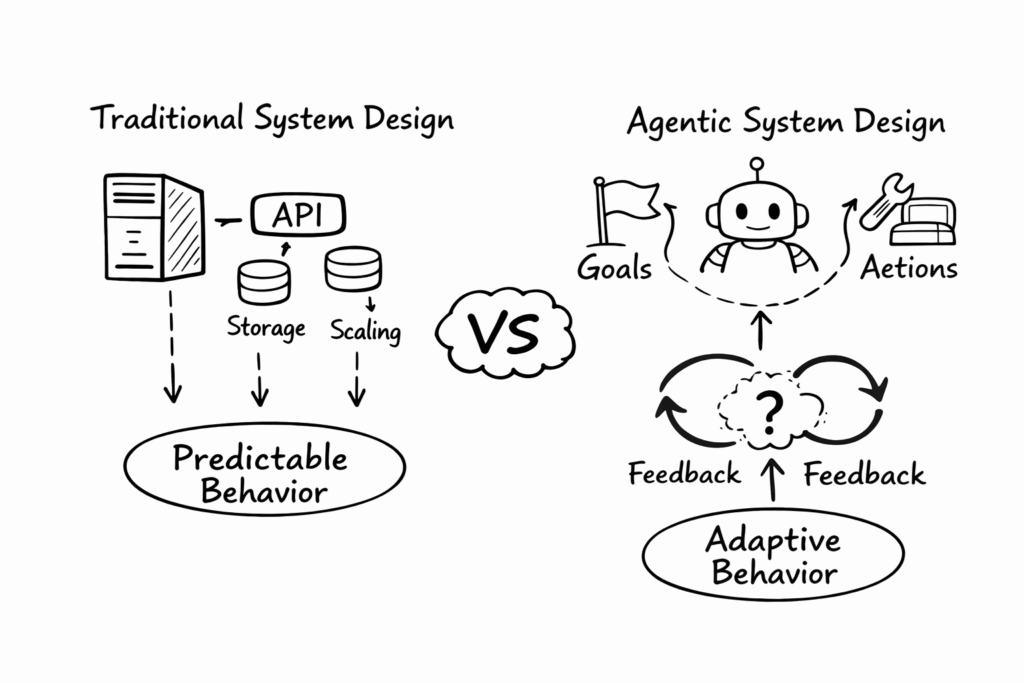
Traditional System Design interviews usually involve designing deterministic services. You define APIs, storage, caching, and scaling strategies. Once deployed, the system behaves in predictable ways given known inputs. Agentic System Design breaks this assumption.
In agentic systems, control flow is not fully defined upfront. The agent decides what to do next based on goals, memory, and feedback. This makes the system adaptive but also harder to reason about.
Control Flow And Decision Making
In a traditional design, you explicitly encode decision logic. In an agentic system, you design a decision-making framework and allow the agent to operate within it. This means you must reason about meta-level behavior rather than individual code paths.
From an interview standpoint, you should highlight this distinction clearly. Interviewers want to hear that you understand how planning loops and feedback introduce complexity that must be managed deliberately.
State And Memory As First-Class Concerns
Traditional systems often externalize state to databases and caches. In agentic systems, the state also exists inside the agent in the form of memory and context. This internal state influences future behavior in ways that are not always obvious.
You should explain how memory introduces both power and risk. Persistent memory allows learning and adaptation. It also introduces the possibility of drift or bias over time. Interviewers expect you to acknowledge this tradeoff.
Comparing Interview Expectations Side By Side
The table below highlights how interview expectations differ between traditional and agentic System Design questions.
| Dimension | Traditional System Design | Agentic System Design |
| Control Flow | Explicit and static | Emergent and dynamic |
| State | Externalized | Internal and external |
| Failure Modes | Predictable | Probabilistic |
| Evaluation Focus | Scalability and latency | Autonomy and safety |
Being explicit about these differences signals maturity. It shows you understand why agentic systems require a different design mindset.
Core Building Blocks Interviewers Expect You To Identify
Every strong agentic System Design interview answer starts by identifying the core building blocks. This immediately signals structured thinking. Rather than jumping into tools or models, you show that you understand the system at a conceptual level.
Interviewers expect you to explicitly name and explain these components. Doing so creates a shared mental model and makes the rest of your answer easier to follow.
The Agent As A System Component
In interviews, you should describe the agent as an active decision-maker rather than a simple model call. The agent interprets goals, reasons about actions, and evaluates outcomes. It is responsible for deciding what to do next, but not for defining the system’s rules.
This distinction is important. You want to show that the agent operates within boundaries you design.
Goals And Success Criteria
Goals define what the agent is trying to achieve and when it should stop. Interviewers look for candidates who treat goals as explicit, structured inputs rather than vague instructions. Clear goal definition enables planning, prioritization, and termination.
Actions And External Interaction
Actions are how agents affect the world. In interviews, you should emphasize that actions must be scoped and validated. Every action increases the system’s blast radius, so action design is a safety concern, not just a functional one.
Memory And Feedback Loops
Memory allows continuity across steps and sessions. Feedback loops allow adaptation based on outcomes. Together, they form the behavioral core of an agentic system. Interviewers expect you to reason about how memory is stored, updated, and bounded.
How These Components Fit Together
The table below shows how interviewers typically expect these components to interact.
| Component | Role In Interview Answer | Key Design Concern |
| Agent | Decision-making entity | Scope and authority |
| Goals | Direction and termination | Clarity and measurability |
| Actions | World interaction | Safety and validation |
| Memory | Context and learning | Drift and cost |
| Feedback | Adaptation mechanism | Stability |
Ending this section with a clear component model sets you up for deeper discussion in later stages of the interview.
Designing The Agent: Responsibilities, Scope, And Boundaries
In an agentic System Design interview, the agent itself is the first component interviewers expect you to reason about deeply. You are not designing “an AI.” You are designing a system actor with defined responsibilities, authority, and limits.
A strong interview answer makes it clear that the agent is not all-powerful. Instead, it is intentionally constrained. This immediately signals maturity, because unbounded autonomy is one of the fastest ways to create unsafe or unmanageable systems.
Defining The Agent’s Responsibility
The agent’s responsibility answers a simple but critical question: what decisions is this agent allowed to make on its own? In an interview, you should frame the agent as responsible for reasoning and sequencing actions, not for defining business rules or system policies.
For example, the agent may decide how to achieve a goal, but it does not decide which goals are acceptable. That distinction shows you understand separation of concerns, even in AI-driven systems.
Establishing Scope And Authority
Scope defines how far the agent’s influence extends. Authority defines what actions it can take without approval. Interviewers want to hear that you would limit both initially and expand them gradually as confidence grows.
An agent that can read data but not write it behaves very differently from one that can trigger irreversible actions. Making this explicit demonstrates that you think in terms of blast radius, which is a core System Design competency.
Behavioral Constraints And Predictability
Behavioral constraints shape how the agent reasons. This includes how cautious it should be, whether it should ask clarifying questions, and how it handles uncertainty. In an interview, describing these constraints helps you move beyond surface-level architecture and into behavioral design.
A well-designed agent is not one that always finds an answer. It is one that knows when it should stop.
Goal Definition And Task Decomposition In Agentic Systems
Goals are the backbone of agentic behavior, and interviewers care deeply about how you define them. Vague goals lead to unpredictable behavior. Clear goals enable planning, prioritization, and termination.
In a System Design interview, how you talk about goals often matters more than the goals themselves.
Goals As Persistent System Inputs
Unlike prompts, goals persist across multiple steps. They give the agent a reason to continue acting and a signal for when to stop. Interviewers expect you to treat goals as structured inputs, not just text instructions.
You should emphasize that goals are machine-interpretable and measurable. This allows the system to evaluate progress rather than relying on intuition or guesswork.
Task Decomposition And Planning Signals
Once a goal is defined, the agent decomposes it into smaller tasks. In an interview, describing this decomposition process demonstrates structured thinking. It shows that you understand how complex objectives are broken into manageable units.
Task decomposition also creates natural checkpoints where the system can validate progress or escalate issues. Interviewers often probe this area to see whether you understand how agents avoid going off track.
Termination Conditions And Success Criteria
One of the most common failures in agentic System Design interviews is neglecting termination logic. Interviewers will often push candidates by asking, “How does the agent know it’s done?”
A strong answer explains that success criteria are defined alongside goals. When those criteria are met, the agent stops acting. When they cannot be met safely, the agent escalates or fails gracefully.
Tooling And Action Design From A System Design Perspective
Tools are how agents interact with the real world, and this is where interviewers often shift from conceptual questions to production realism. Once an agent can take actions, System Design discipline becomes critical.
In interviews, you should frame tools as controlled interfaces rather than raw capabilities.
Tools As Contracts, Not Shortcuts
Each tool represents a contract between the agent and the system. It defines what inputs are allowed, what outputs are returned, and what side effects occur. Interviewers want to hear that you would avoid giving agents unrestricted access to internal systems.
By describing tools as contracts, you show that you think in terms of API design and governance, even in AI-driven architectures.
Action Validation And Orchestration Layers
A key System Design insight is that agents should not execute actions directly. Instead, an orchestration layer validates intent, enforces constraints, and records outcomes. This allows the system to remain observable and debuggable.
In an interview, mentioning an orchestration layer immediately elevates your answer. It signals that you are designing for reliability, not just functionality.
Action Scope And Blast Radius
Interviewers often ask what happens when an agent makes a mistake. This is where action scope matters. Narrow, atomic actions limit damage. Broad actions increase efficiency but also risk.
The table below summarizes how interviewers evaluate action design choices.
| Action Design Choice | Interview Signal | Tradeoff |
| Atomic Actions | Safety awareness | More coordination |
| Broad Actions | Performance focus | Higher risk |
| Validated Execution | Production readiness | Added latency |
| Direct Execution | Simplicity | Low observability |
Being explicit about these tradeoffs demonstrates senior-level judgment.
Memory Design And State Management In Agentic Systems
Memory is one of the most nuanced topics in agentic System Design interviews. It forces you to reason about state, cost, consistency, and long-term behavior all at once.
Interviewers are not looking for a perfect memory solution. They are looking for thoughtful constraints.
Short-Term Memory And Context Management
Short-term memory supports immediate reasoning and planning. It includes the current goal, recent actions, and intermediate results. In interviews, you should emphasize that this memory is intentionally bounded to control cost and complexity.
A bounded context window keeps reasoning focused and predictable.
Long-Term Memory And Learning Over Time
Long-term memory allows agents to retain knowledge across sessions. This can improve efficiency and personalization, but it introduces the risk of drift. Interviewers expect you to acknowledge that not all information should be remembered indefinitely.
You should describe mechanisms for updating, expiring, or validating long-term memory to prevent stale or harmful behavior.
Shared Memory In Multi-Agent Systems
When multiple agents collaborate, shared memory becomes necessary. This introduces challenges around consistency and access control. In an interview, discussing shared memory shows that you are thinking beyond single-agent designs.
The table below captures how different memory types are evaluated in interviews.
| Memory Type | Interview Focus | Risk |
| Short-Term | Reasoning clarity | Context overflow |
| Long-Term | Adaptability | Drift and bias |
| Shared | Coordination | Consistency issues |
A strong answer frames memory as a tool, not a crutch. The agent remembers what helps it achieve goals safely and forgets the rest.
Control Flow, Planning, And Stopping Conditions
Control flow is one of the fastest ways to distinguish a strong candidate from an average one in an agentic System Design interview. Once you introduce an agent that can act autonomously, the interviewer expects you to explain how the system decides what happens next and when it should stop.
In traditional systems, control flow is static. In agentic systems, control flow is dynamic and often emergent. This shift introduces power but also risk, which is why interviewers probe this area deeply.
Reactive Versus Planning-Based Execution
Some agentic systems operate reactively. The agent receives an input, selects the next best action, and repeats the loop. This approach keeps latency low and behavior simple. Other systems use planning, where the agent generates a multi-step plan before executing actions.
In interviews, you should frame this as a tradeoff rather than a preference. Planning improves performance on complex tasks but increases cost and unpredictability. Reactive execution is easier to reason about but may struggle with long-horizon goals.
Reflection And Self-Correction
More advanced agentic systems include reflection, where the agent evaluates the outcome of an action before continuing. This can improve reliability but must be bounded carefully. Interviewers want to hear that you would limit reflection depth to avoid infinite loops or excessive cost.
Reflection should be a safety mechanism, not an excuse for unbounded retries.
Termination Logic And Escalation Paths
Stopping conditions are critical. Interviewers often ask explicitly how the agent knows it is done. A strong answer explains that termination logic is defined alongside goals and enforced by the system, not left to the agent’s intuition.
When termination criteria are not met, the agent should escalate or fail gracefully. This demonstrates that you design for control rather than blind autonomy.
The table below summarizes how interviewers assess control flow decisions.
| Control Flow Choice | Interview Signal | Risk |
| Reactive Loop | Simplicity and speed | Limited reasoning |
| Planned Execution | Depth and foresight | Higher cost |
| Reflection | Self-correction | Runaway loops |
| Explicit Termination | Maturity | Reduced flexibility |
Multi-Agent System Design And Coordination Tradeoffs
Multi-agent System Design is where many candidates overcomplicate their answers. Interviewers are not impressed by the number of agents you propose. They are impressed by whether you can justify why more than one agent is needed.
A single agent is often sufficient. Multiple agents are introduced only when specialization or parallelism provides clear benefits.
When To Propose Multiple Agents
In an interview, you should introduce multi-agent designs only after establishing a clear baseline. You then explain that multiple agents can improve scalability, reliability, or reasoning depth by dividing responsibilities.
This sequencing signals discipline. It shows that you resist overengineering.
Coordination And Communication Overhead
Once multiple agents exist, coordination becomes a System Design problem in itself. Agents must share context, delegate tasks, and resolve conflicts. Interviewers expect you to acknowledge that communication overhead grows quickly and must be managed carefully.
You should emphasize that coordination mechanisms are explicit rather than emergent. This keeps the system understandable and debuggable.
Failure Isolation In Multi-Agent Systems
One advantage of multi-agent designs is failure isolation. If one agent fails, others can continue or compensate. Interviewers often probe this area to see whether you understand resilience beyond redundancy.
The table below captures how interviewers evaluate multi-agent proposals.
| Design Choice | Interview Interpretation | Tradeoff |
| Single Agent | Simplicity | Limited scalability |
| Specialized Agents | Clear separation of concerns | Integration complexity |
| Manager Agent | Structured control | Single point of failure |
| Peer Agents | Flexibility | Coordination drift |
A strong answer makes it clear that multi-agent systems are a tool, not a default.
Reliability, Safety, And Failure Modes Interviewers Care About
Reliability and safety are where agentic System Design answers either impresses or fails. Interviewers expect you to acknowledge that autonomous systems will make mistakes and to explain how your design limits the impact of those mistakes.
Agentic systems introduce failure modes that do not exist in traditional software. These include hallucinated actions, overconfident decisions, and runaway execution loops.
Guardrails At Multiple Layers
Strong interview answers describe guardrails at multiple layers. Reasoning constraints limit what the agent can consider. Action validation prevents unsafe operations. System-level monitoring detects anomalous behavior.
This layered approach shows that you think defensively rather than optimistically.
Safe Degradation And Human Escalation
Interviewers want to hear that your system fails safely. When uncertainty is high, the agent slows down, asks for clarification, or escalates to a human. This signals maturity and production awareness.
You should emphasize that autonomy is reversible. Humans remain in control.
Common Failure Modes And Mitigations
The table below highlights failure modes interviewers often ask about.
| Failure Mode | Why Interviewers Care | Mitigation Strategy |
| Hallucinated Tool Calls | Direct system impact | Strict validation |
| Infinite Loops | Cost and instability | Step limits |
| Drift Over Time | Trust erosion | Memory curation |
| Overconfidence | Silent failures | Secondary checks |
Being explicit about these risks demonstrates that you understand the realities of agentic systems.
How To Answer An Agentic System Design Interview Question Step By Step
The final section of your interview answer should bring everything together into a clear, repeatable structure. Interviewers value candidates who can organize complexity under pressure.
You begin by clarifying requirements. Ask what level of autonomy is expected, what constraints exist, and what success looks like. This shows that you do not assume problem details.
Next, you define the core components. You describe the agent, goals, tools, memory, and control flow. This establishes a shared mental model.
You then discuss tradeoffs. You explain why you chose certain design decisions and what alternatives exist. Interviewers often probe here, so being proactive helps.
Finally, you address scalability, reliability, and safety. Ending on these topics signals senior-level thinking.
A strong close ties the design back to real-world constraints and acknowledges that no design is perfect.
Using structured prep resources effectively
Use Grokking the System Design Interview on Educative to learn curated patterns and practice full System Design problems step by step. It’s one of the most effective resources for building repeatable System Design intuition.
You can also choose the best System Design study material based on your experience:
- LLM System Design
- Generative AI System Design interview
- Best System Design Courses
- Best System Design Platforms
Final Thoughts
Agentic System Design is not about showcasing AI knowledge. It is about demonstrating system thinking in an era where software behaves autonomously.
In interviews, your goal is to show that you can design systems that balance autonomy with control. You want to make it clear that you understand not just how agents work, but how they fail and how to contain those failures.
When you frame agentic System Design as an extension of classic System Design principles rather than a novelty, you position yourself as an engineer who can adapt to the future without abandoning fundamentals.