
When a major earthquake strikes or a political crisis unfolds, millions of people reach for their phones expecting to read about it within minutes. Google News makes this possible by aggregating content from thousands of publishers worldwide. The engineering challenge behind this seemingly simple experience is staggering.
Articles arrive in different formats, from different time zones, at unpredictable intervals. The system must ingest, categorize, rank, and serve news almost instantly while making results relevant to each individual user.
This complexity is precisely why Google News has become a favorite case study in System Design interviews. You are not building a static search engine. You are designing a dynamic, always-updating feed that must balance speed, freshness, and personalization at massive scale. Interviewers use this problem to test your ability to reason through real-time distributed systems where every design decision involves meaningful trade-offs.
In this guide, you will learn how to approach this System Design problem methodically. We will cover everything from ingestion pipelines and fan-out models to event detection and multi-tier caching. By the end, you will have a complete framework to explain Google News System Design confidently in any interview, along with the depth to handle follow-up questions that separate good candidates from great ones.
Problem definition and requirements
Before diving into architecture, you need to establish what the system should accomplish. Google News System Design is not simply about displaying articles. It is about reliably delivering the right news at the right time to billions of users while handling unpredictable traffic spikes during breaking events. Starting with clear requirements demonstrates structured thinking to interviewers and prevents you from building the wrong system.
Functional requirements
The system must aggregate news from thousands of publishers through RSS feeds, web crawlers, and direct APIs. Each article needs to be categorized into topics like World, Business, Technology, and Sports using natural language processing. Breaking news should appear within seconds of publication, not minutes.
Users expect personalized feeds based on their interests, reading history, and location alongside trending and top stories sections that surface globally important content. Finally, the system must support search functionality allowing users to find specific topics and filter results by date, source, or category.
Non-functional requirements
The non-functional requirements are equally critical. Feed updates should achieve sub-100ms latency to feel instantaneous. The system must maintain high availability with a target of 99.99% uptime because news outages during critical events erode user trust immediately.
Scalability requirements are substantial. The platform handles millions of articles daily and billions of user requests. Fault tolerance ensures that server failures do not affect feeds or cause missed updates. Data freshness guarantees that outdated content is replaced quickly as stories develop.
Pro tip: In interviews, explicitly stating both functional and non-functional requirements before designing shows that you understand real-world system constraints. Interviewers want to see that you think about reliability and scale, not just features.
Understanding these requirements sets the foundation for architectural decisions. With the scope defined, we can now examine how the major components work together in a coherent pipeline.
High-level architecture of Google News System Design
With requirements established, you can map out the high-level System Design. At its core, Google News consists of several major components working together in a pipeline where each stage transforms raw article data into personalized, ranked feeds. This modular design allows each component to scale independently. You can add more crawlers without touching ranking logic or expand storage without changing personalization algorithms.
The core components include an ingestion layer that collects news articles from feeds, crawlers, and APIs. A parsing and categorization module extracts text, metadata, and topics using NLP models. The indexing and storage system stores articles and builds searchable structures optimized for low-latency retrieval. A ranking and recommendation engine scores articles by freshness, publisher authority, and personalization signals. Finally, the serving layer delivers feeds and search results to users through a multi-tier caching hierarchy designed for sub-100ms response times.
The data flow follows a predictable sequence. Articles arrive from multiple sources and enter the ingestion layer. Content is cleaned, parsed, and classified into topics and event clusters. Metadata and text are indexed for fast retrieval using inverted indexes. Articles are then prioritized based on recency, authority, and user-specific personalization signals. Feeds and results are returned to users through cached serving infrastructure distributed across geographic regions.
Real-world context: Google’s actual News infrastructure uses stream processing frameworks like Apache Kafka and Apache Flink to handle the real-time ingestion pipeline. These tools enable processing of millions of articles per hour with exactly-once delivery semantics.
In interviews, laying out this high-level pipeline demonstrates systematic thinking. It establishes a strong foundation before diving into the technical depth of each component, which we will explore starting with the ingestion layer.
Ingestion layer and collecting news in real time
The first step in Google News System Design is collecting articles. Without a robust ingestion system, everything downstream fails. Articles are collected through three primary mechanisms. RSS feeds come from publishers who provide structured data. Web crawlers handle sites without feeds. Direct APIs serve major news agencies and large publishers who offer programmatic access.
Several challenges make ingestion complex at scale. Duplicate articles appear constantly because the same story may be published by dozens of outlets. The system must deduplicate or cluster these into coherent story groups. Format variability requires flexible parsing since publishers use wildly different HTML structures, metadata schemas, and encoding formats.
Politeness constraints mean crawlers must respect robots.txt files and avoid overwhelming publisher servers with requests. Real-time speed is essential because breaking news should be visible within seconds, requiring streaming architectures rather than batch processing.

The trade-offs in ingestion design are significant. Speed versus completeness creates tension because crawling too aggressively may overload servers, but being too conservative delays news delivery. Systems typically prioritize high-authority sources with more frequent polling intervals.
Freshness versus cost is another consideration since continuous crawling consumes substantial computational resources. Smart systems use adaptive polling frequencies, checking sources that publish frequently more often than those that update rarely.
Watch out: A common interview mistake is describing ingestion as a simple pull-based system. Real news aggregators use hybrid approaches with webhooks from major publishers, scheduled polling for smaller sources, and real-time stream processing to handle the volume.
Once articles are ingested, they contain raw content that needs structure. The next step transforms this unstructured data into categorized, searchable information through natural language processing and classification.
Categorization and classification
Ingested articles must be organized into meaningful categories. Without classification, users would face a chaotic flood of content with no way to browse by topic. Google News System Design uses multiple classification approaches working together to achieve accurate categorization at scale.
Natural language processing forms the foundation, with algorithms analyzing article text to determine primary topics. Modern systems use transformer-based models that understand context and nuance far better than older keyword-matching approaches. Entity recognition identifies people, places, and organizations mentioned in articles, enabling connections like “Elon Musk” linking to Technology and Business sections.
Topic clustering groups similar stories together, so when multiple publishers cover the same breaking news event, users see a consolidated story cluster rather than dozens of separate entries. Metadata extraction pulls structured information from headlines, bylines, timestamps, and schema markup to support classification decisions.
Classification faces several challenges that require careful engineering. Ambiguity is common because articles often span multiple topics, such as a sports story involving political controversy. Systems must decide whether to assign multiple categories or choose the most relevant one.
Language diversity means news arrives in many languages, requiring multilingual models that can classify content regardless of the source language. Balance between breadth and precision is critical since over-classification splits related stories into too many categories, while under-classification merges unrelated content together.
Historical note: Early news aggregators relied heavily on publisher-provided categories and keyword matching. The shift to ML-based classification happened around 2012-2015 as deep learning models became practical for text classification at scale.
Without robust classification, users could not browse news by topic effectively. Mentioning NLP, entity recognition, and clustering in your interview explanation demonstrates understanding of how unstructured data becomes user-friendly feeds. With articles categorized, the next challenge is storing them for fast retrieval through efficient indexing systems.
Indexing and storage systems
After categorization, articles must be stored in ways that enable fast retrieval and searching. Imagine if Google News had to scan every article sequentially each time you searched for “climate change.” Response times would be unacceptable. Instead, the system relies on sophisticated indexing structures designed for sub-millisecond lookups.
The inverted index is the backbone of search systems. It maps words to the documents containing them, so a search for “climate” immediately returns document IDs [2, 15, 27] without scanning all content. Metadata indexes store attributes like publish time, category, publisher authority scores, and geographic relevance for quick filtering operations. Cluster indexes group related articles into event clusters, enabling the system to retrieve all coverage of a single story efficiently.
Storage strategies must handle the scale and real-time requirements of news. Distributed storage spreads articles across many servers for horizontal scalability. Replication stores data in multiple locations for fault tolerance, typically using three replicas across different availability zones. Partitioning through sharding divides data by category, geographic region, or publish time to reduce query load on individual servers. Time-based sharding is particularly effective for news because queries heavily favor recent content.
| Storage strategy | Use case | Trade-off |
|---|---|---|
| Time-based sharding | Recent articles (hot data) | Fast queries for fresh content, requires shard rotation |
| Category-based sharding | Topic browsing | Efficient topic queries, cross-category searches need scatter-gather |
| Geographic sharding | Local news delivery | Low latency for regional content, global stories replicated everywhere |
| Hybrid approach | Production systems | Balances all needs but increases operational complexity |
The challenges in storage center on maintaining freshness while handling scale. New articles must appear in indexes instantly, requiring fast index update mechanisms rather than batch rebuilds. Billions of articles must be stored without degrading query performance, necessitating careful capacity planning and index optimization. Durability guarantees ensure articles are never lost even when servers fail, typically achieved through synchronous replication and write-ahead logging.
Real-world context: Systems like Elasticsearch and Apache Lucene power many news search implementations. Google uses proprietary systems but the principles of inverted indexes, sharding, and replication apply universally.
With articles indexed and stored, the system must decide which ones to show users first. This is where ranking becomes critical, applying signals far more complex than traditional search engines use.
Ranking and relevance
Categorization and indexing prepare data for retrieval, but ranking determines what users actually see. In Google News System Design, ranking is more nuanced than general search because news has unique characteristics. Freshness matters enormously, publisher credibility varies widely, and showing diverse perspectives is both an editorial and ethical responsibility.
Key ranking dimensions
Recency is paramount because a story from ten minutes ago is dramatically more relevant than one from last week for breaking news. However, recency alone would surface low-quality content from fast publishers over authoritative analysis from slower ones.
Publisher authority addresses this by scoring sources based on journalistic standards, editorial processes, and historical accuracy. Articles from established outlets like Reuters or the BBC typically receive higher baseline scores. Diversity prevents the feed from being flooded with duplicate perspectives on the same story, ensuring users see multiple viewpoints.
Personalization tailors recommendations to user interests, reading history, and geographic location. Engagement signals like click-through rates and time spent reading provide feedback on article quality, though these must be used carefully to avoid amplifying sensationalism.
Balancing trade-offs in ranking
Every ranking decision involves trade-offs that require careful calibration. Freshness versus authority creates tension when a new article from a smaller outlet covers breaking news before major publishers. The system must decide whether speed or source credibility matters more in that moment.
Personalization versus fairness is another balance because excessive personalization creates filter bubbles where users only see content reinforcing existing beliefs. Relevance versus speed requires ranking to produce results in milliseconds, limiting how sophisticated scoring algorithms can be for real-time requests.
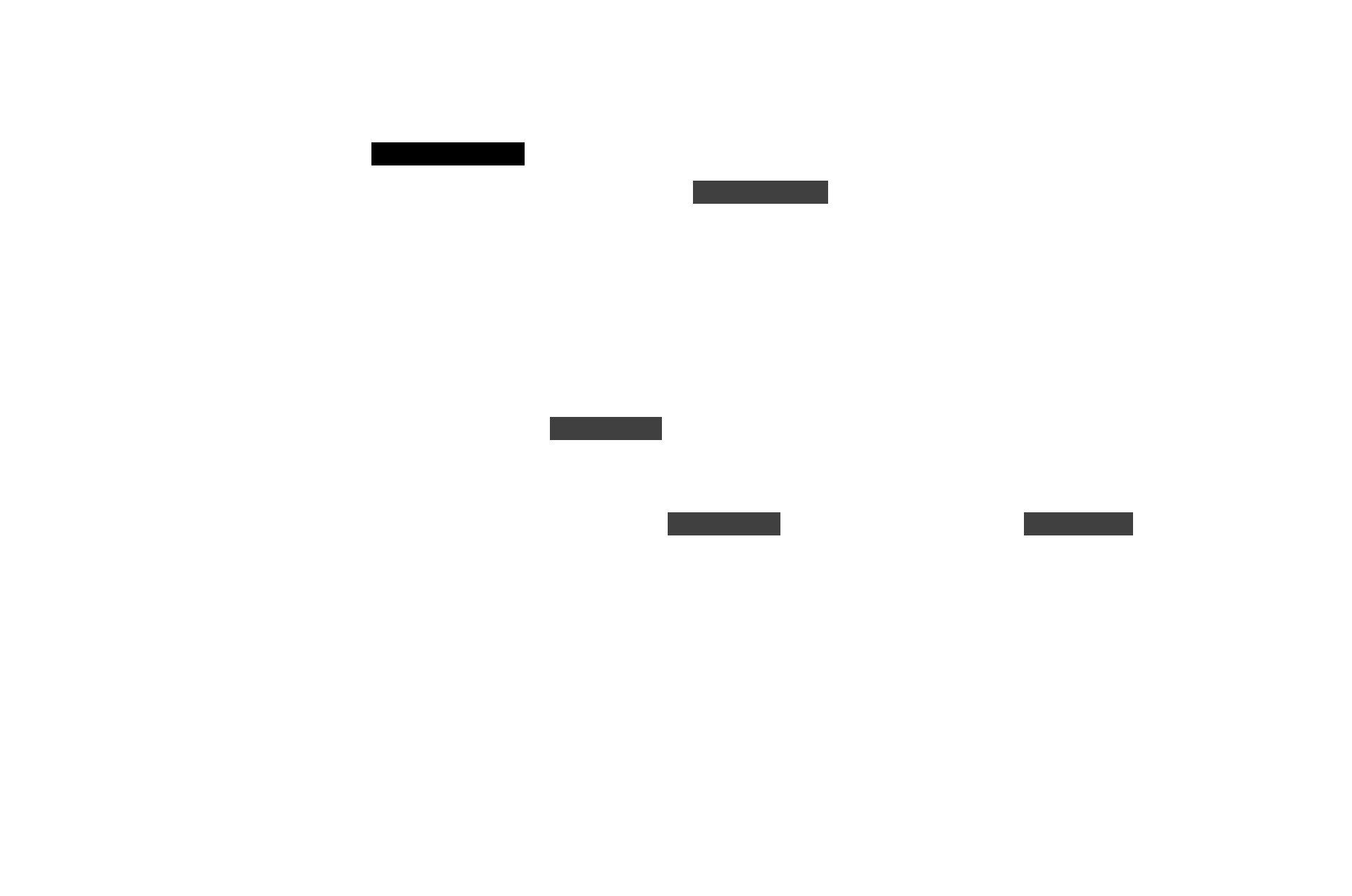
The Top Stories section exemplifies these ranking rules in action. Breaking news is prioritized by recency, but only from sources meeting authority thresholds. Stories are clustered to avoid duplication, with representative articles chosen from each cluster. A mix of sources ensures diversity and fairness, preventing any single publisher from dominating the section regardless of publishing volume.
Pro tip: When discussing ranking in interviews, explicitly mention the tension between personalization and diversity. This shows awareness of both technical and ethical dimensions that real systems must address.
Ranking determines what appears at the top of feeds, but personalization goes further by tailoring the entire experience to individual users. Understanding how personalization works and its limitations is essential for a complete System Design.
Personalization and recommendations
News is not one-size-fits-all. What matters to a technology executive in San Francisco differs from what a teacher in London needs. Personalization makes Google News relevant to each user, but it must be balanced against the need for diverse, fair information access.
User profiles are built from reading history, explicit preferences, click patterns, and time spent on articles. These profiles capture interests across topics and preferred source types. Collaborative filtering recommends articles that similar users enjoyed, identifying patterns like “users who read about AI policy also tend to read about semiconductor manufacturing.”
Content-based filtering suggests articles similar to ones you have already read, using entity embeddings and topic vectors to measure similarity. Location signals surface local stories alongside global news, ensuring a user in Tokyo sees relevant local coverage. Device context adapts presentation, with mobile users potentially seeing shorter summaries while desktop users receive more detailed content.
Personalization introduces several challenges that require thoughtful solutions. Echo chambers are a risk when over-personalization limits exposure to diverse viewpoints. Systems must intentionally inject serendipity and opposing perspectives.
The cold start problem affects new users who have no reading history. Default feeds based on trending topics, location, and general popularity provide reasonable starting points until the system learns preferences. Balancing personalization with trending topics ensures users still see major world events even if those topics do not match their usual interests.
Watch out: Interviewers often ask how you would handle cold start. A strong answer mentions default feeds based on location and trending content, gradual profile building from implicit signals, and explicit preference collection during onboarding.
Personalization ensures relevance, but users also need the ability to actively search for specific topics. The query processing system handles these explicit information needs with requirements distinct from personalized feeds.
Query processing and search
Beyond personalized feeds, users search for specific topics directly. Search in Google News System Design differs from general web search because it prioritizes recency and newsworthiness over static relevance. A search for “election results” should show articles from the last few hours, not comprehensive background pieces from months ago.
Query processing follows a sequence of steps to transform user input into ranked results. Tokenization breaks queries into individual terms, handling phrases like “climate change summit 2024.” Normalization standardizes text through lowercasing, punctuation removal, and Unicode normalization.
Synonym expansion recognizes equivalent terms, so “climate summit” matches articles about “environmental conference.” Spell correction suggests fixes for typos, improving recall for misspelled queries. Recency filtering applies temporal constraints, heavily weighting recent articles in results.
Ranking for news search applies similar signals to feed ranking but with adjusted weights. Fresh articles receive significant score boosts, often overriding authority signals for breaking topics. Diverse sources are included to show multiple perspectives on developing stories. Clustering techniques filter out duplicates, showing one representative article per story cluster rather than flooding results with identical coverage.
Latency considerations drive architectural decisions in search. Queries must return results within tens of milliseconds to feel responsive. Caching stores results for popular queries like “World Cup results” that many users search simultaneously. Sharding allows multiple servers to process different parts of the index in parallel, aggregating results for the final response. Query planning optimizes execution order, evaluating cheap filters before expensive ranking computations.
Historical note: Google News search evolved significantly from its 2002 launch. Early versions used relatively simple keyword matching. Modern versions employ semantic understanding through neural models that comprehend query intent beyond literal word matching.
Search handles explicit information needs, but news systems must also detect and surface breaking events automatically. Event detection is one of the most challenging aspects of real-time news architecture.
Real-time updates and event detection
One of the hardest challenges in Google News System Design is delivering breaking news as events unfold. A story cannot take hours to appear. Users expect coverage within minutes of major events, which requires sophisticated real-time processing infrastructure.
How real-time updates work
Streaming pipelines form the foundation of real-time processing. New articles are fed into message queues like Apache Kafka as soon as they are ingested, enabling downstream systems to process them immediately rather than waiting for batch jobs.
Event clustering groups articles about the same event together, detecting when multiple publishers are covering a developing story. Prioritization pushes breaking stories higher in rankings even before engagement metrics accumulate, using signals like publication velocity and cross-source confirmation. Push notifications deliver urgent news directly to mobile users who have opted in for alerts on specific topics.
Event detection strategies
Detecting that something newsworthy is happening requires multiple approaches working together. Frequency analysis identifies sudden spikes in article volume on specific topics. When dozens of articles about an earthquake appear within minutes, the system recognizes this as a significant event.
Keyword co-occurrence detects patterns in entity mentions, such as articles simultaneously mentioning “earthquake” and “California” clustering together. Cross-source validation considers a story high-priority when multiple trusted sources confirm it, filtering out single-source rumors. Modern systems increasingly use entity embeddings and graph neural networks to detect related stories even when they use different terminology.

Trade-offs in real-time processing are significant. Speed versus accuracy creates tension because publishing too quickly risks surfacing false or incomplete information. Systems typically require confirmation from multiple sources before promoting breaking news.
Global versus local event importance varies. A story may be globally irrelevant but critical locally. The system must balance both by understanding geographic context. Resource allocation is another concern because real-time processing pipelines are expensive to operate at scale, requiring careful decisions about which sources and topics warrant continuous monitoring.
Real-world context: Google announced AI-powered improvements to News event detection at Google I/O, using machine learning to understand story development and surface related coverage automatically as events unfold.
Real-time processing handles the speed requirements, but the system must also scale to handle traffic from billions of users worldwide. Scalability techniques ensure performance remains consistent regardless of load.
Scalability techniques
Google News serves millions of articles daily to billions of users worldwide. Designing for this scale is one of the most demanding aspects of the system. Scalability ensures the platform remains fast and reliable regardless of traffic volume or data size, including during unpredictable spikes when major events drive everyone to check the news simultaneously.
Horizontal scaling adds more servers instead of overloading individual machines. Each server handles a slice of the workload, and the system can grow by adding capacity rather than replacing existing infrastructure.
Sharding divides data strategically. Articles might be partitioned by category, region, or publication time. Time-based sharding is particularly effective for news because queries heavily favor recent content, allowing older shards to be stored on cheaper hardware or archived entirely. Elastic scaling automatically adds resources during traffic spikes like elections, natural disasters, or major sports events, then reduces capacity during normal periods to control costs.
Multi-tier caching architecture
Caching is essential for achieving sub-100ms latency at scale. Google News System Design employs multiple caching layers working together. Edge caches and CDNs store popular content close to users geographically, reducing round-trip times dramatically.
Service-level caches store frequently accessed data within the application tier, avoiding repeated database queries. Query result caches store responses for common searches, so popular queries like “election results” are served from cache rather than computed repeatedly. Warm versus cold paths distinguish between cached responses (warm) and full computation (cold), with systems designed to maximize warm path usage.
Load balancing distributes traffic evenly across servers to prevent hotspots. Sophisticated load balancers consider server health, current load, and geographic proximity when routing requests. This prevents any single server from becoming a bottleneck during traffic surges.
| Cache layer | Location | Typical latency | Content type |
|---|---|---|---|
| Browser cache | User device | <1ms | Static assets, recently viewed articles |
| Edge/CDN cache | Geographic PoPs | 5-20ms | Popular articles, trending content |
| Service cache | Application servers | 1-5ms | User profiles, ranking models |
| Database cache | Storage layer | 5-10ms | Index segments, metadata |
Pro tip: In interviews, mentioning specific latency targets and how caching layers achieve them demonstrates practical understanding. Saying “we need sub-100ms responses, so we use edge caching for trending content” is more compelling than vague statements about caching.
Scalability ensures the system handles load, but failures will inevitably occur in any distributed system. Fault tolerance mechanisms ensure users never experience outages even when components fail.
Fault tolerance and reliability
Downtime is unacceptable in news delivery. If the system fails during a major event, users miss critical updates and trust erodes immediately. Fault tolerance is therefore a cornerstone of Google News System Design, ensuring continuous operation despite inevitable component failures.
Replication stores articles and indexes in multiple locations. When one server fails, others serve requests immediately without data loss. Production systems typically maintain three replicas across different availability zones.
Leader-follower architecture organizes service clusters so one leader coordinates updates while followers stay ready to take over instantly if the leader fails. Automatic failover reroutes requests to healthy servers when components crash, often completing the transition before users notice any disruption. Idempotent operations ensure that updates can be safely re-applied without duplicating articles or corrupting indexes, simplifying recovery after failures.
Geo-distributed data centers replicate content worldwide so users always connect to nearby, available servers. This geographic redundancy also protects against regional outages from natural disasters or network issues. Redundancy at every layer prevents single points of failure. Multiple ingestion pipelines, storage nodes, and serving clusters ensure that losing any individual component does not affect users. Monitoring systems detect issues like slow crawlers or failing nodes before users notice, enabling proactive intervention.
Watch out: A common interview mistake is describing replication without explaining consistency trade-offs. News systems typically favor availability over strict consistency, accepting that users in different regions might see slightly different content during failures rather than making the system unavailable.
Reliability ensures the system stays operational, but not all content should be served. Security and spam filtering protect users from misinformation and malicious content.
Security and spam filtering
Not all news is trustworthy. Without strict filtering, fake stories, propaganda, or malicious links could flood the system and damage user trust. Security and spam filtering are built into every layer of Google News System Design.
Source verification ensures only articles from vetted publishers receive priority treatment. Publishers go through verification processes that assess journalistic standards, editorial oversight, and historical accuracy. Publisher authority scores reflect this verification, with trusted sources ranking higher by default.
Duplicate detection prevents spammers from gaming the system by republishing identical content across multiple domains. Content moderation uses machine learning models to detect inappropriate, harmful, or policy-violating material before it reaches users.
Detecting spam and fake news requires multiple signals working together. Trust signals from domain reputation, historical accuracy, and editorial standards influence ranking. Suspicious sites are flagged for review or downranked automatically.
Cross-source validation gives higher weight to stories confirmed by multiple reputable publishers, making it harder for single-source misinformation to spread. Anomaly detection triggers review when suspicious patterns appear, such as sudden traffic surges for low-quality sites or coordinated publishing of similar content.
Security considerations extend beyond content quality. HTTPS encryption protects article ingestion and user requests from interception. Access control limits who can submit feeds or publish into the system, preventing unauthorized content injection. Bot detection prevents automated systems from manipulating engagement signals like clicks and shares that influence ranking.
Real-world context: Google has invested heavily in combating misinformation, particularly around elections and health topics. The system includes specific policies and enhanced verification for content in these sensitive categories.
With the core pipeline and safety mechanisms covered, we can examine advanced features that differentiate sophisticated news systems from basic aggregators.
Advanced features
Beyond the core pipeline of ingestion, categorization, indexing, and ranking, Google News System Design supports advanced features that significantly improve user experience and engagement.
Trending topics detection uses real-time analytics to identify spikes in article volume around specific keywords or entities. When hundreds of articles suddenly mention “World Cup Final,” the system recognizes this as trending and surfaces it prominently. This requires scalable stream processing pipelines tracking frequency patterns across all sources continuously.
Local news personalization delivers region-specific articles using geolocation signals from user devices and IP addresses. A user in San Francisco sees local election coverage alongside global news, with the system balancing local relevance against broader importance. This feature requires geographic tagging of articles and location-aware ranking adjustments.
Multimedia integration recognizes that articles are not just text. Google News supports images, video clips, and live updates embedded within stories. This requires additional storage infrastructure, specialized indexing for multimedia content, and rendering pipelines that adapt to different device capabilities. Live video streams for breaking events add particular complexity, requiring low-latency delivery infrastructure.
Push notifications deliver critical news to mobile users in real time. This feature connects to event detection pipelines, triggering alerts when significant stories break. The system must balance urgency against user preferences, avoiding notification fatigue while ensuring truly important news reaches users promptly.
Multilingual support handles news in dozens of languages, requiring language detection, multilingual classification models, and potentially cross-language matching to cluster stories about the same event published in different languages. Translation services may provide summaries of foreign-language articles for users who cannot read the original.
Pro tip: Mentioning one or two advanced features in interviews shows you can extend basic designs to deliver richer experiences. Pick features relevant to the specific role or company you are interviewing with.
Understanding the technical system is essential, but interviews also require demonstrating communication skills and avoiding common pitfalls. The following sections cover practical interview preparation.
Common interview questions
When interviewers ask about Google News System Design, they test both technical knowledge and your ability to reason through complex problems under pressure. Certain questions appear frequently, and preparing structured answers helps you respond confidently.
“How would you design a real-time news aggregation system?” This broad question expects you to cover the full pipeline. Address ingestion from multiple sources, categorization using NLP, indexing for fast retrieval, ranking with freshness and authority signals, and serving through cached infrastructure. Structure your answer around these stages rather than diving into any single component.
“How do you handle duplicate articles from multiple publishers?” Explain clustering techniques that group articles about the same event using entity matching and semantic similarity. Mention deduplication at ingestion time and trust signals that help select representative articles from each cluster.
“How would you rank stories for freshness and relevance?” Discuss the multiple signals involved. Cover recency as a time decay function, publisher authority scores, personalization based on user history, and diversity constraints to avoid flooding feeds with duplicate perspectives.
“What caching strategies would you use for trending news?” Describe the multi-tier caching architecture including edge caches near users, service-level caches for frequently accessed data, and query result caches for popular searches. Explain cache invalidation strategies for rapidly changing content.
“How do you prevent fake news or spam from surfacing?” Cover source verification processes, publisher authority scoring, cross-source validation requirements, and anomaly detection systems that flag suspicious patterns for review.
Watch out: Interviewers often follow up with “what would you do differently if latency requirements were 10x stricter?” or “how would this change for a system 100x smaller?” Prepare to discuss how your design scales in both directions.
Knowing common questions helps you prepare, but avoiding typical mistakes is equally important for standing out in interviews.
Mistakes to avoid
Even strong candidates fall into predictable traps during System Design interviews. Awareness of these mistakes helps you deliver cleaner, more impressive answers.
Ignoring real-time challenges is a frequent error. News is fundamentally different from static search because freshness matters enormously. If you design a system using only batch processing, your answer feels incomplete for a news aggregator.
Over-focusing on ranking at the expense of other components leaves gaps. While ranking is important, interviewers expect discussion of ingestion challenges, categorization approaches, storage strategies, and fault tolerance mechanisms.
Neglecting spam and trust signals that you have not thought about real-world operating conditions. Any production news system must filter misinformation and handle malicious actors trying to game rankings.
Skipping fault tolerance raises red flags about your operational experience. Failing to explain how the system survives server crashes, network partitions, or data center outages suggests you have only worked on toy systems.
Over-complicating the solution by adding unnecessary layers without explaining trade-offs confuses interviewers. A clear, well-reasoned simple design beats a complex one you cannot explain coherently.
Poor communication undermines even technically correct answers. Staying silent while drawing diagrams instead of walking through your reasoning step by step makes it hard for interviewers to follow your thinking and provide helpful guidance.
A solid, structured answer is far stronger than an over-engineered but unclear one. With these pitfalls in mind, consider how to prepare systematically for Google News System Design questions.
Preparation strategy
Success in System Design interviews requires more than technical knowledge. You need practice, structure, and communication skills developed through deliberate preparation.
Master the fundamentals before attempting complex designs. Review distributed systems concepts including sharding, replication, caching strategies, and load balancing patterns. Understand information retrieval basics like inverted indexes and clustering algorithms. Learn how ranking signals differ for news systems where freshness competes with static relevance.
Practice mock designs under realistic conditions. Set a timer for 45-60 minutes and work through complete designs from requirements to trade-off discussions. Practice the flow from ingestion through processing, indexing, ranking, and serving. Use whiteboards or online diagramming tools to get comfortable visualizing architectures while explaining them verbally.
Build a reusable framework that you apply consistently. Start every answer by clarifying requirements with the interviewer. Outline high-level architecture before diving into details. Focus on key challenges like real-time updates and spam filtering. Close with scalability, reliability, and trade-off discussions that demonstrate mature engineering judgment.
Get feedback on your explanations from peers or mentors. Record yourself to identify verbal tics, unclear explanations, or pacing problems. Mock interviews with experienced engineers reveal gaps that self-practice misses.
Supplement with structured resources that break down complex systems into learnable frameworks. The Grokking the System Design Interview course provides patterns applicable to news aggregators and similar real-time systems. Consistent practice builds the confidence needed to handle Google News System Design questions under interview pressure.
Conclusion
Google News represents a masterclass in designing real-time distributed systems that affect millions of people daily. The system combines sophisticated ingestion pipelines handling thousands of sources with NLP-powered categorization that transforms unstructured content into organized topics.
Low-latency indexing enables sub-100ms retrieval across billions of articles. Multi-signal ranking balances freshness, authority, personalization, and diversity in ways that general search engines do not require. Fault tolerance and security mechanisms ensure the system remains reliable and trustworthy even under failure conditions and adversarial attacks.
The future of news aggregation will likely incorporate more advanced AI capabilities. These include better detection of developing stories through event graphs, more nuanced understanding of article quality and bias, and increasingly sophisticated personalization that avoids filter bubbles while remaining relevant. Real-time video and multimedia integration will continue expanding as bandwidth improves and user expectations evolve.
Mastering Google News System Design teaches you to think systematically about trade-offs, communicate complex ideas clearly, and design systems that operate reliably at massive scale. These skills transfer directly to any distributed systems challenge you will face in your engineering career.