

When you first encounter System Design, it feels like a subject you are supposed to “study.” You look for notes, definitions, and diagrams the same way you would for algorithms or data structures. That approach almost always leads to frustration.
System Design is not a syllabus you finish. It is a skill you build.
Interviewers are not testing whether you remember architectures. They are testing whether you can reason through ambiguity, make trade-offs under constraints, and communicate those decisions clearly. This is why people who memorize answers struggle while others with fewer facts perform better.
Once you internalize that System Design is a thinking skill, your entire learning strategy changes.
Why System Design Feels Hard At First
System Design feels intimidating because it combines many moving parts. Networking, databases, caching, scaling, failure handling, and business requirements all collide at once. There is no single correct answer, only better and worse decisions depending on context.
This is uncomfortable if you are used to problems with clear right and wrong answers.
What you are really learning is how systems behave under stress. That is not something you absorb in one sitting. It emerges gradually as you see patterns repeat across different problems.
What Interviewers Are Actually Evaluating
In System Design interviews, interviewers are watching how you think out loud. They want to see how you clarify requirements, how you react to constraints, and how you adjust when new information is introduced.
They care less about whether you picked Redis or Memcached and more about whether you can explain why caching belongs there at all.
Understanding this early saves you months of unproductive preparation.
Accepting The Learning Curve And Letting Go Of Intimidation
Almost everyone feels lost when learning System Design. That feeling does not mean you are bad at it. It means you are encountering a different kind of problem-solving than you are used to.
System Design problems are intentionally under-specified. You are expected to ask questions, make assumptions, and revise decisions as you go. Feeling uncertain is not a failure signal. It is the starting point.
Once you accept that confusion is normal, you stop fighting it and start learning from it.
The Trap Of Comparing Yourself To Experts
One of the fastest ways to stall your progress is comparing your early attempts to polished expert designs. Experienced engineers compress years of intuition into a clear explanation. You only see the final form, not the messy thinking behind it.
Your goal is not to sound like an expert immediately. Your goal is to become clearer than you were last week.
When you shift your focus from perfection to progression, learning System Design becomes manageable.
Why Confidence Comes After Structure
Confidence in System Design does not come from knowing everything. It comes from knowing how to approach a problem even when you do not know the answer.
As soon as you have a repeatable way to think through designs, your anxiety drops. You may still make imperfect decisions, but you can explain them. That ability alone dramatically improves interview performance.
Breaking System Design Into Learnable Building Blocks
Trying to learn System Design as one giant topic is overwhelming. The skill becomes learnable only when you break it into smaller mental models that you can practice independently.
Each System Design problem is really a composition of recurring ideas. Once you recognize those ideas, problems stop feeling new and start feeling familiar.
| Design Aspect | What You Are Really Learning |
| Networking | How requests move and fail |
| Data Storage | How data is stored and retrieved |
| Caching | How load is reduced |
| Scaling | How systems grow under demand |
| Reliability | How systems survive failure |
Core Foundations You Must Understand First

At the foundation of System Design is how requests move through a system. Understanding what happens between a client and a server matters more than any database choice. When you grasp request lifecycles, load balancing stops feeling abstract.
Data storage is the next pillar. Knowing how data is stored, replicated, indexed, and retrieved shapes nearly every architectural decision you make. You do not need deep internals at first, but you must understand trade-offs.
Scaling and performance concepts are built on top of this. Throughput, latency, and bottlenecks are not separate topics. They are consequences of your earlier decisions.
How This Changes The Way You Study
When you study System Design in blocks, you stop memorizing diagrams and start understanding behaviors. Each new system becomes an exercise in recombining familiar components rather than inventing something from scratch.
This is where progress accelerates.
Learning By Watching How Real Engineers Think
The most valuable learning moments in System Design come from watching someone reason through uncertainty. Tutorials that jump straight to final architectures skip the part you actually need.
When you watch an experienced engineer think aloud, you see how they narrow the scope, challenge assumptions, and justify trade-offs. This teaches you how to think, not what to say.
That distinction is critical in interviews.
| Low-Value Observation | High-Value Observation |
| Final diagram | Decision-making sequence |
| Tool selection | Problem framing |
| Clean explanations | Handling uncertainty |
| Confident tone | Trade-off discussion |
What To Pay Attention To When Observing Designs
When observing System Design walkthroughs, focus on how decisions are made rather than what decisions are made. Notice when requirements are clarified, when scale assumptions are questioned, and when alternatives are discussed.
These moments reveal the mental checklist that strong candidates internalize over time.
You begin to see that good System Design is not about confidence. It is about structured doubt.
Translating Observation Into Your Own Thinking
The real value comes when you start pausing and asking yourself what you would do next. This active engagement turns passive watching into deliberate practice.
Over time, you begin to anticipate the next question or trade-off. That is when System Design stops feeling foreign and starts feeling intuitive.
Learning System Design By Drawing And Visualizing Systems
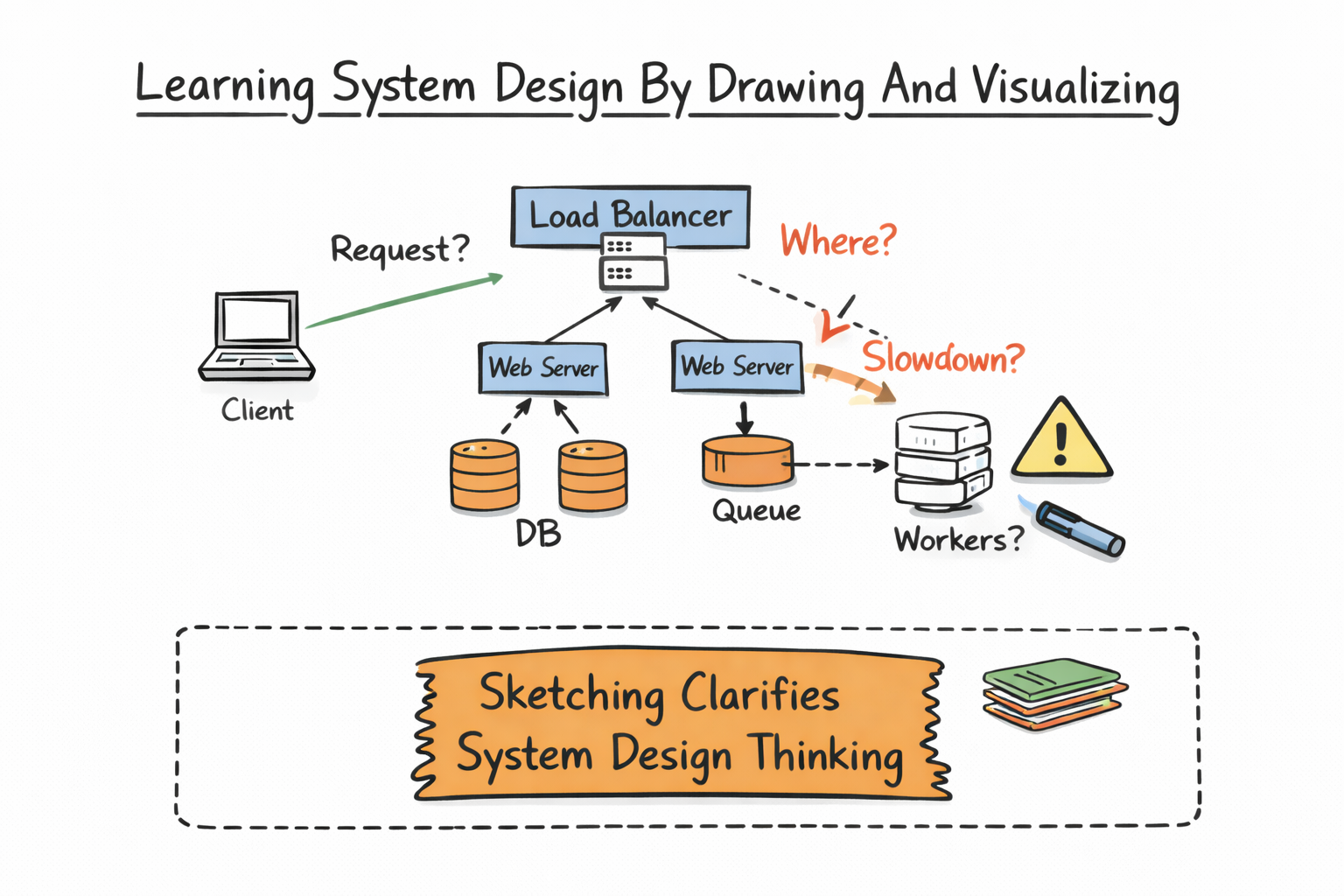
System Design rarely makes sense when it lives only in your head. The moment you start drawing, vague ideas turn into concrete structures. Even rough sketches force you to answer uncomfortable questions. Where does the request enter the system? Where does it fan out? Where does it slow down?
You do not need artistic diagrams or polished visuals. Simple boxes and arrows are enough. What matters is that you externalize your thinking so you can inspect it.
This habit alone dramatically improves how you perform in System Design interviews.
How Drawing Exposes Gaps In Your Thinking
When you try to draw a system, missing pieces reveal themselves immediately. You realize you never decided how data is stored. You notice that a component has no clear responsibility. You see that a single box is doing too much work.
These moments are not setbacks. They are learning accelerators.
Drawing transforms abstract concepts into problems you can reason about. It shifts you from passive understanding to active problem-solving.
Why Interviewers Love Candidates Who Draw Early
In interviews, drawing early signals clarity. It shows that you can organize complex ideas visually and guide the conversation rather than react to it.
Interviewers are not judging your art skills. They are evaluating how you structure systems and communicate decisions. Drawing gives them a window into your thought process.
Practicing System Design With Real Problems, Not Hypotheticals
System Design becomes meaningful only when applied to real problems. Abstract exercises feel safe, but they rarely build interview confidence.
Real systems force trade-offs. Designing a URL shortener forces you to think about scale. Designing a chat system forces you to think about real-time communication. Designing a payment system forces you to think about correctness under failure.
Each system stretches a different part of your thinking.
| System Type | What You Learn |
| URL Shortener | Scale and hashing |
| Chat System | Real-time communication |
| Feed System | Fan-out and caching |
| Payment System | Consistency and correctness |
How Repetition Builds Pattern Recognition
At first, every System Design problem feels unique. Over time, patterns emerge. You start recognizing familiar shapes. You see where caches usually fit. You anticipate where queues help. You know which components are likely to become bottlenecks.
This is not memorization. It is pattern recognition built through repetition.
Interviewers can tell when your answers come from patterns rather than scripts.
Why One Design Is Never Enough
Designing the same system multiple times is surprisingly effective. The first attempt is messy. The second is clearer. The third is confident.
Each iteration sharpens your intuition. You learn which decisions matter and which details can wait. This iterative process mirrors how real engineers design systems in practice.
Applying System Design Thinking In Everyday Engineering Work
System Design is often treated as an interview-only topic. That mindset limits how fast you improve.
Every engineering decision involves trade-offs. Choosing synchronous versus asynchronous communication is a System Design. Deciding how to structure a service boundary is System Design. Evaluating performance bottlenecks is a System Design.
Once you start viewing your daily work through this lens, learning accelerates naturally.
How Real Experience Reinforces Interview Readiness
When you apply System Design thinking at work, concepts stop being theoretical. You see firsthand how systems fail, how load behaves, and how small design choices scale into big consequences.
This experience changes how you speak in interviews. Your explanations become grounded. You reference behaviors instead of buzzwords.
Interviewers notice the difference immediately.
Turning Production Incidents Into Learning Opportunities
Production issues are some of the best System Design lessons available. Latency spikes, partial outages, and scaling failures all expose design trade-offs.
When you analyze these events through a System Design lens, you build intuition that no book can provide.
Teaching System Design To Solidify Mastery
Teaching forces precision. You cannot explain a concept clearly unless you understand it clearly.
When you explain System Design ideas to someone else, gaps in your understanding surface quickly. This feedback loop is invaluable.
You do not need an audience of thousands. Teaching can be as simple as explaining a design to a peer or writing a short breakdown for yourself.
How Explaining Designs Improves Interview Communication
System Design interviews reward clarity over cleverness. Teaching trains you to structure explanations, anticipate confusion, and emphasize key decisions.
As you practice explaining designs, you naturally improve your interview storytelling. You stop rambling and start guiding.
This is a skill that compounds over time.
When System Design Starts To Feel Natural
There is a moment when System Design stops feeling intimidating. You still face uncertainty, but you know how to navigate it.
At that point, you are no longer trying to impress interviewers. You are simply explaining how you think.
That shift is what separates candidates who struggle from candidates who stand out.
Common Mistakes That Slow Down System Design Progress
Treating System Design Like A Memorization Exercise
One of the most damaging mistakes is trying to memorize architectures. This usually happens when System Design feels overwhelming, and memorization feels safer.
The problem is that memorized designs collapse the moment the interviewer changes a requirement. If you cannot explain why a component exists, you cannot adapt when constraints shift.
| Memorization-Focused Approach | Reasoning-Focused Approach |
| Recites known architectures | Builds architecture from requirements |
| Struggles with follow-ups | Adapts design as constraints change |
| Uses tool names early | Introduces tools only when needed |
| Sounds rigid | Sounds thoughtful and flexible |
System Design rewards reasoning, not recall. Once you accept this, your preparation becomes more effective almost immediately.
Jumping To Diagrams Before Clarifying Requirements
Many candidates start drawing boxes before understanding what the system needs to do. This leads to over-engineered designs that solve the wrong problem.
Strong System Designers slow down at the beginning. They ask clarifying questions, define scale, and confirm priorities before committing to architecture.
Interviewers interpret this behavior as maturity, not hesitation.
Overusing Tools Without Justification
Naming technologies without explaining their role is another common pitfall. Saying “use Kafka” or “add Redis” without explaining why weakens your credibility.
Tools are solutions to problems. If you cannot articulate the problem, the solution feels arbitrary.
In interviews, fewer well-justified components are almost always better than a long list of buzzwords.
Developing The Interview-Ready System Design Mindset
System Design interviews are conversations, not exams. Your goal is not to arrive at the perfect architecture. Your goal is to demonstrate how you think.
This means explaining your assumptions, questioning your own decisions, and adjusting when new information appears.
Interviewers are evaluating adaptability as much as correctness.
Thinking In Terms Of Trade-Offs
Every design decision sacrifices something. Latency trades off with consistency. Cost trades off with redundancy. Simplicity trades off with flexibility.
When you acknowledge trade-offs openly, your answers sound balanced and realistic. Interviewers trust candidates who admit costs instead of pretending choices are free.
| Weak Explanation | Strong Explanation |
| “This is the best option” | “This trades consistency for availability” |
| Avoids downsides | Acknowledges limitations |
| Sounds absolute | Sounds balanced and realistic |
| Defends choices emotionally | Defends choices logically |
This mindset turns difficult questions into opportunities to show judgment.
Communicating Clearly Under Ambiguity
Clear communication is as important as technical correctness. A well-structured explanation helps interviewers follow your logic even if they disagree with your choices.
This is why practicing verbal explanations matters as much as practicing designs.
System Design interviews reward engineers who can guide others through complexity calmly.
A Week-By-Week Roadmap To Learning System Design
| Timeframe | Focus Area | What Changes In Your Thinking |
| Weeks 1–2 | Fundamentals | You understand request flow and data basics |
| Weeks 3–4 | Simple Systems | You can design end-to-end solutions |
| Weeks 5–6 | Patterns | You recognize bottlenecks early |
| Weeks 7+ | Interview Practice | You explain designs confidently |
Weeks One And Two: Building Mental Foundations
The first phase focuses on fundamentals. You build intuition around networking basics, request flows, data storage concepts, and core scalability ideas.
This stage is about understanding behavior, not designing large systems. Rushing past this foundation creates gaps that resurface later.
Weeks Three And Four: Learning Through Real Systems
At this stage, you begin designing simple systems end-to-end. URL shorteners, file storage systems, and basic messaging platforms are ideal starting points.
You practice identifying requirements, estimating scale, and drawing high-level architectures. The goal is comfort, not perfection.
Weeks Five And Six: Pattern Recognition And Trade-Offs
This phase deepens your understanding of common patterns such as caching, sharding, replication, and asynchronous processing.
You revisit earlier designs and refine them. You begin anticipating bottlenecks before they appear.
This is where System Design starts to feel less intimidating.
Weeks Seven And Beyond: Interview Simulation And Refinement
The final phase focuses on communication and adaptability. You practice explaining designs aloud, responding to follow-up questions, and defending decisions.
Mock interviews become especially valuable here. Feedback helps you identify weak explanations even when the design itself is solid.
By this point, System Design feels like a conversation rather than a test.
Using structured prep resources effectively
Use Grokking the System Design Interview on Educative to learn curated patterns and practice full System Design problems step by step. It’s one of the most effective resources for building repeatable System Design intuition.
You can also choose the best System Design study material based on your experience:
Final Takeaways: How System Design Finally Clicks
Why Consistency Beats Intensity
Learning System Design is not about cramming. Short, consistent practice sessions compound faster than long, irregular ones.
Regular exposure builds intuition. Over time, patterns replace anxiety.
When You Know You Are Making Real Progress
Progress in System Design shows up subtly. You stop panicking at open-ended questions. You ask better clarifying questions. You explain trade-offs without prompting.
These signals matter more than any checklist.
System Design As A Long-Term Career Skill
Even after interviews, System Design remains relevant. The same thinking skills apply to architecture reviews, technical leadership, and scaling real products.
When you stop treating System Design as an interview hurdle and start treating it as a professional skill, learning becomes sustainable.
Closing Thought
System Design is not about knowing everything. It is about thinking clearly when you do not.
Once you internalize that, System Design stops being intimidating and starts becoming intuitive.