

System design patterns represent solutions that have emerged repeatedly in real systems facing similar constraints. They are not recipes to follow step by step, and they are not guarantees of correctness. A pattern captures the shape of a solution and the tradeoffs it makes, not a finished architecture.
Interviewers expect candidates to understand patterns at this level. Treating a pattern as a rigid template often leads to over-engineered designs that do not fit the problem being discussed.
Patterns exist because constraints repeat
Patterns arise because the same constraints appear again and again. Systems need to scale reads, isolate failures, reduce latency, or coordinate distributed components. Over time, engineers converge on approaches that balance these constraints reasonably well.
Understanding the constraint that gave birth to a pattern is more important than memorizing its name. Interviewers listen to whether you can explain why a pattern exists in the first place.
What patterns are not
Patterns are not best practices that must always be applied. They are also not shortcuts that replace reasoning. Using a pattern without explaining its relevance is a common interview mistake.
Strong candidates use patterns to support decisions, not to justify them after the fact.
Why interviewers care about system design patterns

Interviewers have limited time. System design patterns act as signals of experience because they encode lessons learned from building and operating systems at scale. A candidate who naturally references a pattern in the right context often sounds grounded and practical.
However, interviewers do not reward pattern name-dropping. They reward understanding.
Patterns help interviewers probe in depth
When a candidate mentions a pattern, interviewers often use it as an entry point for deeper questions. They may ask what problems the pattern solves, what new problems it introduces, or how it behaves under failure.
Candidates who truly understand the pattern can explain these aspects calmly. Candidates who memorize the pattern usually struggle.
Knowing when not to use a pattern
One of the strongest signals interviewers look for is restraint. Recognizing when a pattern is unnecessary or harmful demonstrates judgment. Applying a complex pattern to a simple problem often signals inexperience rather than sophistication.
Interviewers trust candidates who can say why a pattern is not appropriate for the current constraints.
| Candidate behavior | Interviewer interpretation |
| Explains why a pattern fits | Practical experience |
| Explains downsides | Engineering maturity |
| Avoids unnecessary patterns | Good judgment |
| Uses patterns reflexively | Over-engineering risk |
How patterns emerge from constraints and tradeoffs
Patterns do not come first. Constraints do. Performance requirements, scale expectations, team structure, and operational realities shape designs. Patterns emerge as responses to these pressures.
Interviewers expect candidates to start with constraints and arrive at patterns naturally, rather than starting with patterns and forcing them onto the problem.
Tradeoffs define every pattern
Every system design pattern makes tradeoffs. A pattern that improves scalability may increase complexity. A pattern that improves reliability may increase cost. Understanding these tradeoffs is central to using patterns effectively.
Strong candidates articulate both sides of the tradeoff without being defensive.
How constraints map to pattern families
Certain constraints tend to produce certain types of patterns. High read volume often leads to caching or replication. High write volume may lead to sharding or batching. Frequent failures lead to fault-tolerance patterns.
Interviewers listen for this mapping because it shows cause-and-effect reasoning.
| Constraint pressure | Typical pattern response |
| Read scalability | Caching, replication |
| Write scalability | Sharding, partitioning |
| Failure isolation | Circuit breakers, bulkheads |
| Coordination | Leader election, consensus |
A framework for choosing the right system design pattern
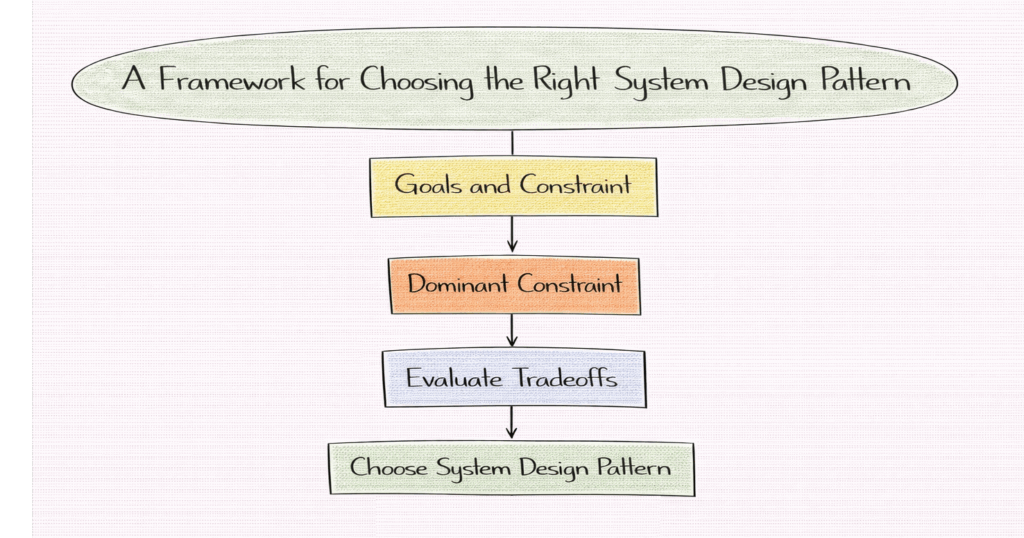
System design interviews move quickly, and pattern discussions can become chaotic without structure. A simple framework keeps your reasoning clear and prevents pattern overuse.
Interviewers expect experienced candidates to choose patterns deliberately rather than reactively.
Starting with goals and non-goals
Every pattern choice should begin with clarity around goals. What is the system optimizing for? What does it explicitly not need to optimize for? Stating non-goals helps eliminate unnecessary patterns early.
This step demonstrates discipline and prevents over-design.
Identifying the dominant constraint
Most systems have one dominant constraint at a time. It might be latency, throughput, reliability, or operational simplicity. Strong candidates identify this constraint explicitly and choose patterns that address it.
Interviewers often challenge this assumption to see how adaptable your reasoning is.
Evaluating tradeoffs before committing
Before committing to a pattern, strong candidates explain what it improves and what it complicates. This evaluation makes the decision feel intentional rather than accidental.
Patterns should feel like tools applied thoughtfully, not defaults.
| Framework step | What it signals |
| Clarifying goals | Structured thinking |
| Naming constraints | Problem understanding |
| Evaluating tradeoffs | Engineering judgment |
| Choosing patterns | Intentional design |
Core architectural patterns in system design
Architectural patterns define the overall structure of a system. They determine how responsibilities are divided, how teams work, and how the system evolves over time. Interviewers pay close attention to architectural choices because they influence nearly every downstream decision.
Choosing an architectural pattern is not about scale alone. It is about aligning structure with current constraints and future expectations.
Monolithic and layered architectures
Monolithic and layered architectures group functionality into a single deployable unit or a small number of layers. These patterns emphasize simplicity, ease of deployment, and straightforward debugging.
Interviewers often expect candidates to acknowledge that monoliths are not inherently bad. For early-stage systems or small teams, monolithic designs often outperform more complex alternatives.
Microservices and service-oriented architectures
Microservices patterns split systems into independently deployable services. This improves team autonomy and scalability but introduces coordination and operational complexity.
Interviewers listen for whether candidates understand that microservices solve organizational and scaling problems, not purely technical ones.
Event-driven architectures
Event-driven patterns decouple producers from consumers by communicating through events. These patterns improve scalability and flexibility but complicate debugging and reasoning about system state.
Strong candidates explain when event-driven designs are justified and when synchronous approaches are simpler and safer.
| Architectural pattern | Primary benefit | Primary cost |
| Monolith | Simplicity | Limited independent scaling |
| Layered system | Clear separation | Tight coupling |
| Microservices | Independent scaling | Operational complexity |
| Event-driven | Loose coupling | Debugging difficulty |
Scalability patterns for growing systems
Scalability patterns exist to handle growth without linear increases in cost or instability. Interviewers expect candidates to explain not just how a system scales, but why a particular scaling approach is chosen.
Strong candidates identify the bottleneck first and then apply patterns to relieve pressure at that point.
Horizontal scaling and stateless services
Horizontal scaling relies on adding more instances rather than increasing the size of a single machine. Stateless service patterns make this possible by ensuring any instance can handle any request.
Interviewers often probe whether a service can scale horizontally and what prevents it from doing so.
Sharding and partitioning patterns
Sharding divides data across multiple nodes to reduce load on any single database. This pattern improves scalability but introduces complexity around routing, rebalancing, and cross-partition queries.
Strong candidates explain how sharding changes failure modes and operational complexity.
Replication for read scalability
Replication increases read capacity by maintaining multiple copies of data. While effective for read-heavy workloads, it introduces challenges around consistency and replication lag.
Interviewers expect candidates to explain these tradeoffs clearly.
| Scalability pattern | Scaling benefit | Key tradeoff |
| Horizontal scaling | Elastic growth | Coordination |
| Sharding | Write scalability | Operational complexity |
| Replication | Read scalability | Consistency lag |
Performance and latency optimization patterns
Performance patterns can dramatically improve system responsiveness, but they also introduce subtle bugs and complexity. Interviewers expect candidates to use these patterns cautiously and justify them clearly.
Optimizing prematurely is a common interview mistake.
Caching patterns and their tradeoffs
Caching is one of the most widely used performance patterns. It reduces latency and backend load but introduces challenges around invalidation, staleness, and consistency.
Strong candidates explain where caches are placed and what happens when cached data becomes outdated.
Asynchronous processing and batching
Asynchronous patterns decouple request handling from processing. Batching groups work to improve throughput. Both improve performance under load but increase latency for individual operations.
Interviewers listen to whether candidates understand how these patterns affect user experience.
Read-write separation
Separating read and write paths allows systems to optimize each independently. This pattern improves performance but complicates consistency guarantees and debugging.
| Performance pattern | Benefit | Tradeoff |
| Caching | Low latency | Stale data |
| Async processing | High throughput | Delayed results |
| Batching | Efficiency | Latency spikes |
| Read-write split | Optimized paths | Consistency complexity |
Reliability and fault-tolerance patterns
Interviewers treat failure handling as a core system design skill. Patterns that address failure are often what separate senior candidates from mid-level ones.
Systems that assume perfect operation are unrealistic.
Retry, timeout, and circuit breaker patterns
Retry patterns improve resilience but can amplify failures if misused. Timeouts prevent resource exhaustion. Circuit breakers stop cascading failures by cutting off unhealthy dependencies.
Strong candidates explain how these patterns work together rather than in isolation.
Bulkheads and isolation patterns
Bulkhead patterns isolate failures by partitioning resources. This prevents one failing component from bringing down the entire system.
Interviewers often probe how failures are contained and how the blast radius is limited.
Graceful degradation and fallback behavior
Graceful degradation allows systems to continue operating in a reduced capacity when parts fail. This pattern prioritizes user experience over completeness.
Candidates who discuss fallback behavior demonstrate user-focused thinking.
| Reliability pattern | Failure handled | New complexity |
| Retries | Transient failures | Retry storms |
| Circuit breakers | Persistent failures | State management |
| Bulkheads | Resource exhaustion | Reduced flexibility |
| Graceful degradation | Partial outages | Feature inconsistency |
Data management and consistency patterns
In system design interviews, data patterns often matter more than infrastructure choices. Interviewers know that most real-world system failures originate from incorrect assumptions about data consistency, ownership, or evolution. A system with modest infrastructure but strong data patterns often performs better than a highly scaled system with poor data discipline.
Strong candidates treat data patterns as first-class design decisions rather than implementation details.
CQRS and separating read and write responsibilities
Command Query Responsibility Segregation separates read models from write models. This pattern is useful when read and write workloads differ significantly in scale or structure. It allows independent optimization but introduces complexity around synchronization and data duplication.
Interviewers expect candidates to explain why CQRS is chosen and how consistency between read and write models is maintained.
Event sourcing and append-only state
Event sourcing stores state as a sequence of immutable events rather than mutable records. This pattern improves auditability and enables time-based reconstruction but complicates querying and operational tooling.
Strong candidates explain that event sourcing is most valuable when historical accuracy and traceability outweigh simplicity.
Idempotency and exactly-once illusions
Idempotency patterns ensure that repeated operations do not cause unintended side effects. Interviewers often probe this area because distributed systems rarely provide true exactly-once guarantees.
Candidates who explain idempotency in terms of retries and failure recovery demonstrate practical experience.
| Data pattern | Primary benefit | Primary cost |
| CQRS | Read/write optimization | Synchronization complexity |
| Event sourcing | Auditability | Query complexity |
| Idempotency | Safe retries | State tracking |
Communication and integration patterns
How services communicate determines latency, coupling, and failure propagation. Interviewers expect candidates to reason carefully about communication patterns because they influence both performance and reliability.
Strong candidates choose communication patterns deliberately rather than defaulting to synchronous APIs.
Synchronous communication patterns
Synchronous APIs provide simplicity and immediate feedback but create tight coupling and amplify failures. They are often appropriate for request-response interactions where low latency and immediate consistency are required.
Interviewers listen for awareness of how synchronous calls affect failure propagation.
Asynchronous messaging and pub-sub patterns
Asynchronous messaging decouples producers and consumers, improving scalability and resilience. Pub-sub patterns allow multiple consumers to react independently to events.
These patterns introduce complexity around ordering, duplication, and observability. Strong candidates explain how these challenges are managed.
Streaming patterns and continuous data flow
Streaming patterns support high-throughput, continuous data processing. They are useful for analytics, monitoring, and event-driven systems, but require careful handling of state and backpressure.
Interviewers expect candidates to explain when streaming is justified and when simpler messaging is sufficient.
| Communication pattern | Strength | Weakness |
| Synchronous API | Simplicity | Tight coupling |
| Messaging queues | Resilience | Latency |
| Pub-sub | Fan-out | Ordering complexity |
| Streaming | High throughput | Operational overhead |
Common mistakes when using system design patterns
Treating patterns as mandatory solutions
A frequent mistake is applying patterns simply because they are known. Interviewers quickly recognize when a pattern is used without justification. Patterns should emerge from constraints, not from familiarity.
Strong candidates explain why a pattern is unnecessary just as clearly as why one is useful.
Overlapping patterns without understanding interactions
Combining multiple patterns can introduce unexpected interactions. For example, layering caching, replication, and event-driven updates can complicate consistency and debugging.
Interviewers often probe these interactions to assess the depth of understanding.
Using pattern names instead of explanations
Naming a pattern without explaining its behavior signals memorization rather than comprehension. Interviewers prefer clear explanations in simple language over correct terminology.
Patterns should support reasoning, not replace it.
| Misuse pattern | Interviewer reaction |
| Pattern overuse | Over-engineering |
| Pattern stacking | Risk blindness |
| Buzzword reliance | Shallow understanding |
How to practice system design patterns for interviews
Practicing pattern recognition through examples
The most effective way to practice patterns is through system design examples. Each example naturally surfaces multiple patterns. Practicing identifying and explaining these patterns builds fluency.
Strong candidates revisit the same example multiple times, exploring different constraints and observing how pattern choices change.
Practicing explanation before application
Explaining a pattern clearly is more important than applying it quickly. Practicing how to explain why a pattern fits a constraint prepares you for interviewer follow-ups.
Explaining aloud exposes gaps that silent study often hides.
Learning to adapt patterns under pressure
Interviewers frequently change requirements mid-discussion. Practicing how to adapt or remove patterns when constraints shift is critical. This demonstrates flexibility rather than rigidity.
Mock interviews are especially effective for building this skill.
| Practice focus | Skill developed |
| Pattern explanation | Clarity |
| Constraint shifts | Adaptability |
| Repetition | Confidence |
Using structured prep resources effectively
Use Grokking the System Design Interview to learn curated patterns and practice full System Design problems step by step. It’s one of the most effective resources for building repeatable System Design intuition.
You can also choose the best System Design study material based on your experience:
Final thoughts
System design patterns are tools, not answers. They exist to help engineers reason about recurring problems, not to eliminate thinking. Interviewers reward candidates who understand why patterns exist, when they apply, and what they cost.
Strong candidates do not search for the “right” pattern. They reason from constraints, articulate tradeoffs, and choose patterns intentionally. They remain willing to simplify when complexity is unjustified.
Mastering system design patterns is not about memorization. It is about developing the judgment to apply experience thoughtfully. That judgment is what interviewers recognize immediately and what ultimately distinguishes strong system designers.