
When an interviewer asks you to design an e-commerce system, they are not asking you to build a website with product pages and a checkout button. They are testing whether it is possible to design a large, multi-domain, distributed system where correctness, scalability, and user experience all matter simultaneously. E-commerce systems are especially challenging because they combine read-heavy workloads, write-heavy transactional flows, and strict correctness requirements around money and inventory.
Interviewers use this question to evaluate how you break down complex domains, define clear service boundaries, and reason about trade-offs between consistency, availability, and performance. They are also assessing whether you understand that different parts of the system have very different failure tolerance levels. Showing stale product recommendations is acceptable, but charging a customer twice or overselling inventory is not.
E-commerce as a collection of coordinated subsystems
A strong answer frames e-commerce not as a single system, but as a platform composed of loosely coupled subsystems. Browsing, search, cart, checkout, payments, inventory, and fulfillment all have distinct responsibilities and data models. Trying to design them as one monolithic system leads to tight coupling and cascading failures.
In interviews, it is important to explicitly state that e-commerce systems rely heavily on asynchronous workflows and eventual consistency. Orders flow through multiple stages, and many actions happen after the user clicks “Place Order.” Designing for these delayed effects is a core part of the problem.
Correctness boundaries and user trust
E-commerce systems deal directly with user trust. Users expect prices to be correct, payments to be processed exactly once, and orders to reflect what they purchased. Interviewers pay close attention to how you reason about these correctness boundaries.
A strong answer emphasizes that money, orders, and inventory are system of record domains. They require stricter guarantees and stronger validation than discovery or personalization features. Calling this out early signals senior-level judgment.
Clarifying requirements and assumptions upfront
E-commerce systems vary enormously depending on business model, geography, and scale. Designing a single-seller store for digital goods is fundamentally different from designing a global marketplace with physical inventory and third-party sellers. Clarifying requirements early prevents making assumptions that lead to incorrect architectural choices.
In System Design interviews, this step shows that you understand how deeply requirements shape system behavior and that there is no single “correct” e-commerce architecture.
Core business model assumptions
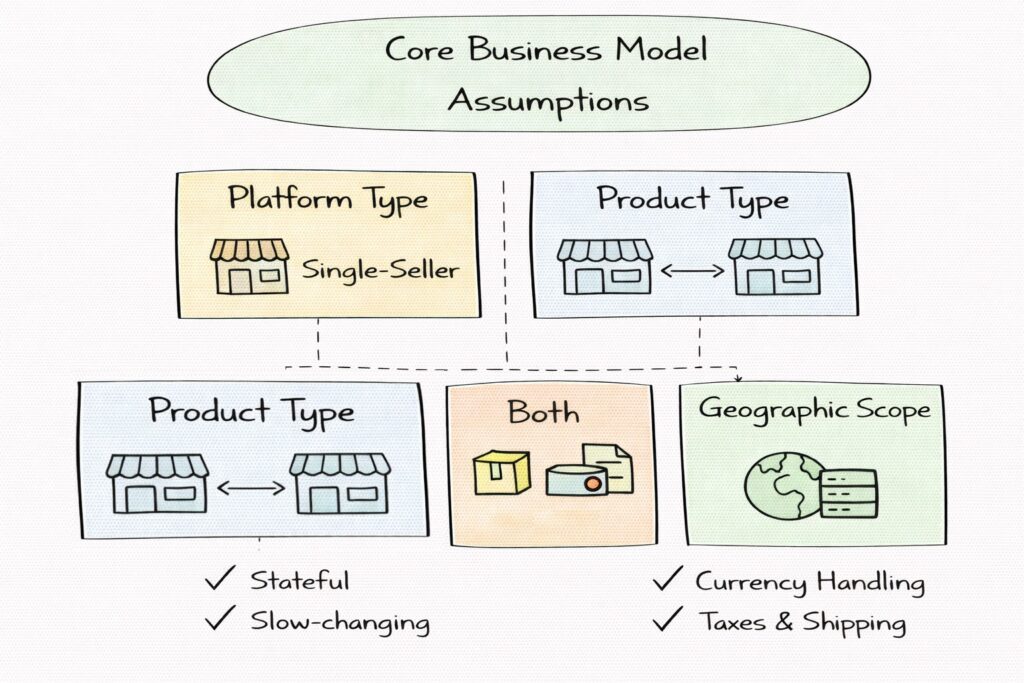
One of the first clarifications is whether the system is a single-seller platform or a marketplace. Marketplaces introduce additional complexity, such as seller onboarding, seller-specific inventory, payouts, and dispute handling. You should also clarify whether the system sells physical goods, digital goods, or both, since fulfillment and inventory behavior differ significantly.
Geographic scope matters as well. Supporting multiple regions introduces currency handling, taxes, shipping rules, and regulatory constraints. Even if the interviewer keeps the scope open, stating reasonable assumptions, such as multi-region support with a single currency, shows practical thinking.
Traffic patterns and peak behavior
E-commerce traffic is highly bursty. Flash sales, seasonal events, and promotions can generate traffic spikes orders of magnitude higher than baseline. Interviewers expect you to design for these spikes explicitly rather than assuming smooth traffic.
You should clarify expected read-to-write ratios. Browsing and search are read-heavy, while checkout and payments are write-heavy but have lower volume. This distinction strongly influences caching, database choices, and scaling strategies.
Non-functional requirements that drive architecture
Availability is critical, but not uniform across the system. Browsing and product pages should aim for very high availability, even if some data is slightly stale. Checkout and payments must prioritize correctness over availability. If payment providers are unavailable, the system should fail safely rather than attempt risky retries.
Latency expectations differ as well. Users expect fast product pages, but are more tolerant of slightly longer checkout steps if progress is clearly communicated. Fraud prevention, compliance, and auditability are additional non-functional requirements that affect System Design but are often overlooked by junior candidates.
Making reasonable assumptions when details are missing
If the interviewer leaves details vague, it is reasonable to assume a large-scale consumer e-commerce platform selling physical goods, with millions of daily users, multi-region traffic, and third-party payment integration. You can assume eventual consistency for catalog and search, and stronger guarantees for orders and payments.
Stating these assumptions explicitly allows you to proceed confidently and gives the interviewer a chance to adjust scope.
High-level architecture overview
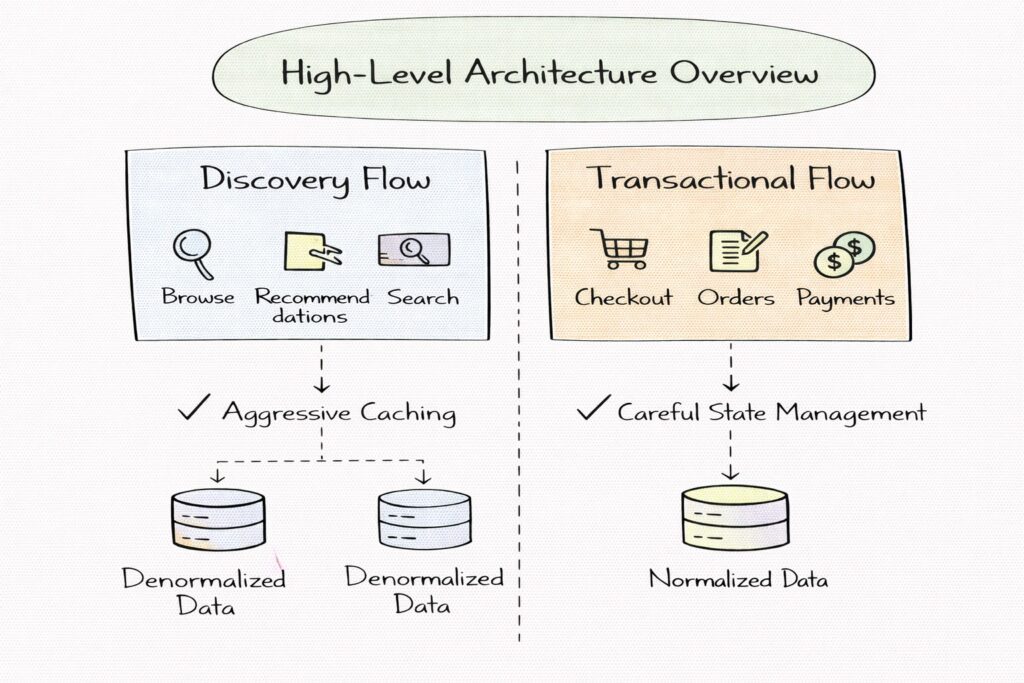
A key architectural principle in e-commerce systems is separating discovery flows from transactional flows. Product browsing, search, and recommendations are read-heavy and benefit from aggressive caching and denormalized data. Checkout, orders, payments, and inventory are write-heavy and require careful state management.
In interviews, calling out this separation early shows that you understand how different workloads impose different architectural constraints.
Layered system architecture
A typical high-level architecture includes client applications that communicate with edge services such as CDNs and API gateways. Behind this layer sit backend-for-frontend services or API layers that tailor responses for different clients. Core domain services handle catalog, cart, orders, payments, inventory, and fulfillment.
Each domain service owns its data and exposes well-defined APIs. This ownership model reduces coupling and allows teams to evolve independently. Interviewers often look for this clarity around data ownership.
Event-driven backbone for workflows
E-commerce workflows are naturally asynchronous. Order placement triggers inventory reservation, payment authorization, fulfillment planning, and notifications. These steps should not be tightly coupled in a synchronous chain.
A strong answer explains that an event-driven architecture connects these services. Events allow services to react independently and enable retries, compensation, and recovery without blocking the user flow. This is especially important for handling partial failures.
Datastores and data modeling at a high level
Different services require different storage characteristics. Catalog and product data may live in document stores or search indexes optimized for reads. Cart data often benefits from fast key-value stores. Orders and payments typically require relational databases or strongly consistent stores to support transactions and auditing.
In interviews, it is more important to explain why different storage choices are made than to name specific technologies.
Control plane versus data plane thinking
Finally, a mature design separates operational concerns from request handling. Configuration, feature flags, pricing rules, and promotions should be managed through a control plane that can be updated safely without redeploying core services. The data plane focuses on serving user traffic reliably.
Highlighting this separation demonstrates operational awareness and long-term thinking.
Product catalog and product detail page design
The product catalog is the foundation of the e-commerce platform. It defines what users can buy and provides the data that powers browsing, search, recommendations, and checkout validation. In interviews, it is important to emphasize that the catalog is read-heavy and latency-sensitive, and therefore optimized very differently from transactional systems like orders and payments.
A strong answer clarifies that the catalog is not a single table but a structured domain containing products, SKUs, variants, pricing, availability flags, images, descriptions, and metadata.
Product, SKU, and variant modeling
Products often represent a logical item, while SKUs represent purchasable units. Variants such as size or color map to different SKUs with distinct inventory and pricing. Modeling this distinction clearly prevents downstream confusion in cart, inventory, and fulfillment systems.
Interviewers often probe whether candidates understand why SKU-level modeling is required for correctness and inventory tracking.
Read optimization and caching strategy
Product detail pages are among the most frequently accessed endpoints in an e-commerce system. To achieve low latency and high availability, catalog data is typically heavily cached at multiple layers. This may include CDN caching for static assets and edge caching or in-memory caching for structured product data.
A strong answer explains that catalog updates are eventually consistent. Slight delays in reflecting price or description changes are acceptable, but the system must ensure that checkout always validates against authoritative pricing and availability.
Localization, pricing rules, and experimentation
Large platforms support localized content, region-specific pricing, taxes, and promotions. Catalog data often includes base prices with additional pricing rules applied dynamically. A/B testing and experimentation are layered on top to test layouts, copy, or pricing strategies.
In interviews, it is useful to call out that these concerns belong in the catalog and pricing layers, not embedded directly in frontend logic.
Search, recommendations, and discovery
Search is typically implemented as a separate system optimized for full-text queries, filters, ranking, and autocomplete. The search index is derived from the catalog but optimized for discovery rather than transactional correctness.
Interviewers expect candidates to recognize that search results can be stale and that this is acceptable as long as checkout validates the final state.
Indexing and update propagation
Catalog updates propagate asynchronously to the search index. This introduces eventual consistency, where a product may appear in search results briefly after it becomes unavailable or before a price update is visible.
A strong answer explains that this is a conscious trade-off to keep search fast and scalable, and that authoritative validation happens later in the flow.
Ranking, filtering, and performance constraints
Search ranking incorporates relevance, popularity, personalization, and business rules. Filters such as price range, category, and availability must be applied efficiently to maintain low latency.
In interviews, it is valuable to explain how search performance is protected under load, such as limiting expensive queries, precomputing facets, or degrading gracefully when systems are stressed.
Recommendations and personalization boundaries
Recommendation systems use historical data, user behavior, and contextual signals to surface relevant products. These systems are often asynchronous and probabilistic. They improve conversion but are not correctness-critical.
Interviewers like it when candidates explicitly state that recommendations should never block core flows and should degrade gracefully if unavailable.
Shopping cart design
The shopping cart represents a user’s intent to purchase. Carts may exist for anonymous users, logged-in users, or both. A key design decision is how carts are identified and persisted across sessions and devices.
A strong answer explains how carts are merged when a user logs in and how cart state is recovered after failures.
Cart persistence and storage choices
Cart data is frequently read and updated, but is not a system of record. It often lives in fast key-value stores or document databases optimized for low latency. The cart service must support concurrent updates, such as multiple tabs or devices.
Interviewers often probe how cart updates handle race conditions and conflicts, especially when inventory or pricing changes.
Handling price and availability changes
Prices and availability can change between the time an item is added to the cart and checkout. The cart service should surface warnings or update line items rather than silently failing later.
A strong answer emphasizes that the cart is advisory, and final validation always occurs during checkout.
Idempotency and correctness under retries
Cart operations must be idempotent to handle retries from unreliable clients. Adding or removing items should not result in duplicated quantities due to repeated requests.
Explaining idempotency at the cart level demonstrates awareness of client behavior and network unreliability.
Checkout workflow and order creation
Checkout is where browsing intent becomes a financial commitment. Interviewers pay close attention to how candidates model checkout because it involves validation, state transitions, and irreversible actions.
A strong answer frames checkout as a controlled, multi-step workflow rather than a single API call.
Validation and pricing confirmation
During checkout, the system must revalidate prices, promotions, taxes, shipping costs, and inventory. This ensures that stale cart data does not lead to incorrect charges.
Explaining why validation happens again at checkout shows an understanding of eventual consistency trade-offs earlier in the flow.
Order creation as a state machine
Orders should be modeled as state machines with explicit transitions such as created, payment authorized, confirmed, shipped, and completed. Each transition should be idempotent and auditable.
Interviewers often expect candidates to discuss order IDs, ordering guarantees, and how retries are handled without creating duplicate orders.
Handling failures and user experience
Failures during checkout must be handled carefully. Payment failures, inventory shortages, or timeout errors should produce clear, actionable feedback to users.
A strong answer emphasizes that partial failures should not leave the system in ambiguous states or erode user trust.
Payments, fraud, and refunds
Payments are typically handled through external payment gateways. The e-commerce system must integrate securely with these providers, manage credentials, and track payment status asynchronously.
In interviews, it is important to distinguish between authorization and capture and explain why separating them reduces risk.
Idempotency and webhook handling
Payment providers often use webhooks to notify systems of status changes. These callbacks can be delayed or duplicated. The payment service must handle them idempotently and reconcile the state correctly.
Explaining webhook handling shows familiarity with real-world payment integrations.
Fraud detection and risk management
Fraud checks may occur before authorization, after authorization, or asynchronously. These systems add latency and uncertainty. A strong design allows orders to be held or reviewed without blocking the entire checkout pipeline.
Interviewers value candidates who balance fraud prevention with user experience.
Refunds, chargebacks, and reconciliation
Refunds and chargebacks introduce long-lived workflows that may occur days or weeks after purchase. The system must track these events accurately and reflect them in order and payment history.
Discussing refunds and reconciliation demonstrates end-to-end thinking beyond the “happy path.”
Inventory, reservations, and consistency guarantees
Inventory sits at the intersection of user experience and system correctness. Users expect that if they can place an order, the item will be fulfilled. Interviewers pay close attention to how candidates reason about inventory because overselling directly damages trust and revenue.
A strong answer starts by acknowledging that inventory is inherently contentious, especially during high-demand events such as flash sales or promotions. The system must balance availability with correctness under extreme concurrency.
Inventory models and ownership
Inventory is typically tracked at the SKU level and owned by a dedicated inventory service. This service is the source of truth for available stock and exposes APIs for reservation, release, and decrement operations.
In interviews, it is important to emphasize clear ownership. Multiple services should not modify inventory directly, as that leads to race conditions and an inconsistent state.
Reservation-based approaches
Many e-commerce systems use inventory reservations during checkout. When a user initiates checkout, inventory is temporarily reserved for a short window. If payment succeeds, the reservation is converted into a permanent decrement. If checkout fails or times out, the reservation expires, and the stock is released.
This approach improves user experience during checkout but introduces complexity around expiration, cleanup, and edge cases. Interviewers often expect candidates to discuss reservation timeouts and background reconciliation.
Consistency trade-offs and high-contention scenarios
Strict consistency guarantees reduce overselling but can hurt availability during spikes. Eventual consistency improves throughput but risks conflicts. A strong answer explains that different SKUs may require different strategies. High-value or limited items may use stricter controls, while low-risk items tolerate eventual consistency.
Calling out adaptive strategies demonstrates senior-level judgment.
Handling flash sales and oversubscription
During flash sales, even reservation systems can be overwhelmed. Techniques such as inventory partitioning, queueing purchase attempts, or issuing purchase tokens help control contention.
Explaining how the system intentionally rejects or queues excess demand shows that you design for fairness and stability rather than optimistic success.
Fulfillment, shipping, returns, and customer notifications
Once an order is confirmed, fulfillment begins. Fulfillment involves warehouse assignment, picking, packing, shipping, and tracking. These steps happen asynchronously and may span hours or days.
A strong answer explains that fulfillment is event-driven. Order confirmation emits events that downstream systems consume independently. This decoupling allows fulfillment to scale and recover from failures without blocking the user flow.
Warehouse selection and shipping logic
Warehouse assignment depends on inventory location, shipping speed, cost, and capacity. This logic may evolve frequently and should be encapsulated in a fulfillment service rather than embedded in checkout.
Interviewers like it when candidates explain that fulfillment decisions can be revisited or adjusted as conditions change.
Returns and reverse logistics
Returns are a critical but often overlooked part of e-commerce design. Returns may trigger inventory updates, refunds, and restocking workflows. They often involve human intervention and long timelines.
Discussing returns demonstrates that you consider the full lifecycle of an order, not just the happy path.
Customer notifications and communication
Customers expect timely updates about order status, shipping, and issues. Notification systems typically consume events and send emails, SMS, or push notifications based on user preferences.
In interviews, it is valuable to explain that notifications must be idempotent and tolerant of delays to avoid confusing or duplicate messages.
Scaling, reliability, and failure handling
Scaling read-heavy and write-heavy paths independently
E-commerce systems must scale differently across domains. Browsing, search, and product pages scale horizontally with caching and CDNs. Checkout, orders, and payments scale through careful partitioning, queueing, and throttling.
Interviewers often expect candidates to articulate this distinction clearly.
Graceful degradation during peak events
During peak traffic, not all features need to be available. Recommendations can be disabled, images can be served at lower quality, or non-critical APIs can be rate-limited. The goal is to preserve core purchasing functionality.
Explaining graceful degradation shows that you design for survival under stress rather than perfect behavior.
Dependency failure handling
E-commerce systems rely on many external dependencies, such as payment gateways and shipping providers. These dependencies will fail occasionally. The system must detect failures quickly and respond predictably.
A strong answer explains fallback behavior, circuit breakers, and clear user messaging when dependencies are unavailable.
Disaster recovery and rollback strategies
Configuration errors and bad deployments can cause widespread outages. The system should support fast rollback, feature flags, and safe configuration changes. Data recovery strategies should be in place for orders and payments.
Interviewers value candidates who think about operator experience as much as user experience.
Observability, data analytics, and interview wrap-up with trade-offs
Observability in e-commerce is about understanding the user journey from browsing to fulfillment. Metrics should track funnel conversion, latency, error rates, and drop-off points. Tracing helps correlate failures across services.
Explaining observability in terms of business impact rather than just technical metrics demonstrates maturity.
Auditability and compliance
Orders, payments, and inventory changes must be auditable. Audit logs support compliance, dispute resolution, and debugging. These logs should be immutable and retained according to policy.
Interviewers often probe whether candidates understand why auditability matters beyond debugging.
Analytics and decision support
Analytics pipelines consume events to compute metrics such as conversion rates, inventory health, and fraud signals. These insights inform business decisions but should not interfere with real-time transaction processing.
Discussing analytics as a downstream concern shows proper separation of concerns.
Key trade-offs to articulate in interviews
E-commerce System Design is full of trade-offs. Strong consistency improves correctness but reduces availability. Aggressive caching improves performance but risks staleness. Fraud controls reduce losses but increase friction.
Explicitly naming these trade-offs and justifying decisions is often what separates strong candidates from average ones.
Using structured prep resources effectively
Use Grokking the System Design Interview on Educative to learn curated patterns and practice full System Design problems step by step. It’s one of the most effective resources for building repeatable System Design intuition.
You can also choose the best System Design study material based on your experience:
Final thoughts
Designing an e-commerce system is about orchestrating many subsystems with different priorities under constant change and failure. Interviewers use this question to evaluate whether you can reason about correctness, scalability, and user trust simultaneously.
Strong answers emphasize clear domain boundaries, thoughtful consistency guarantees, and asynchronous workflows. They acknowledge that not all parts of the system need the same guarantees and that trade-offs are inevitable. If you communicate these ideas clearly and structure your answer methodically, e-commerce System Design becomes an opportunity to demonstrate senior-level engineering judgment rather than a test of memorized patterns.