

If you have ever wondered why the Google Ads System Design shows up so often in interviews, the answer is simple. It compresses almost every hard systems concept into a single problem without feeling artificial. When an interviewer asks you to design Google Ads, they are not testing whether you understand advertising as a business. They are testing whether you can reason about scale, latency, ranking, and trade-offs under pressure.
Google Ads System Design forces you to think about real-time decision-making. Ads must be selected and served in milliseconds, often during a user search or page load. That immediately brings latency budgets, caching strategies, and regional availability into the conversation. Unlike many academic-style design questions, this problem does not allow slow backends or vague eventual answers.
Another reason interviewers love this problem is that it blends business logic with technical architecture. You are not just serving content. You are running auctions, enforcing budgets, prioritizing relevance, and ensuring fairness between advertisers. This gives interviewers a chance to see whether you can balance system correctness with revenue-driven constraints, which is a core skill at companies like Google, Meta, and Amazon.
From an interview signal perspective, Google Ads System Design also reveals how senior your thinking is. Junior candidates often jump straight into machine learning models or ranking formulas. Strong candidates slow down, define the problem, clarify constraints, and build the system layer by layer. Interviewers care far more about how you think than whether you remember the exact auction type.
Finally, this problem scales beautifully with experience level. For mid-level roles, interviewers focus on architecture and request flow. For senior roles, they probe trade-offs, failure scenarios, and optimization decisions. That flexibility makes the Google Ads System Design one of the most reusable interview questions across levels.
Defining The Problem Statement And Core Requirements
Before you design anything, you need to align with the interviewer on what “Google Ads” actually means in the scope of the interview. If you skip this step, you risk solving the wrong problem, no matter how impressive your architecture sounds.
At its core, Google Ads System Design is about selecting the right ad for the right user at the right moment. The system must accept ads from advertisers, match those ads to user queries or page contexts, run an auction, rank the results, and serve the winning ad almost instantly. That entire flow happens billions of times per day.
You should always start by framing the problem in simple language. You are designing a system that connects advertisers and users through real-time ad serving while maximizing relevance and revenue. This framing keeps your design grounded and helps guide every decision that follows.
Functional Requirements In Google Ads System Design
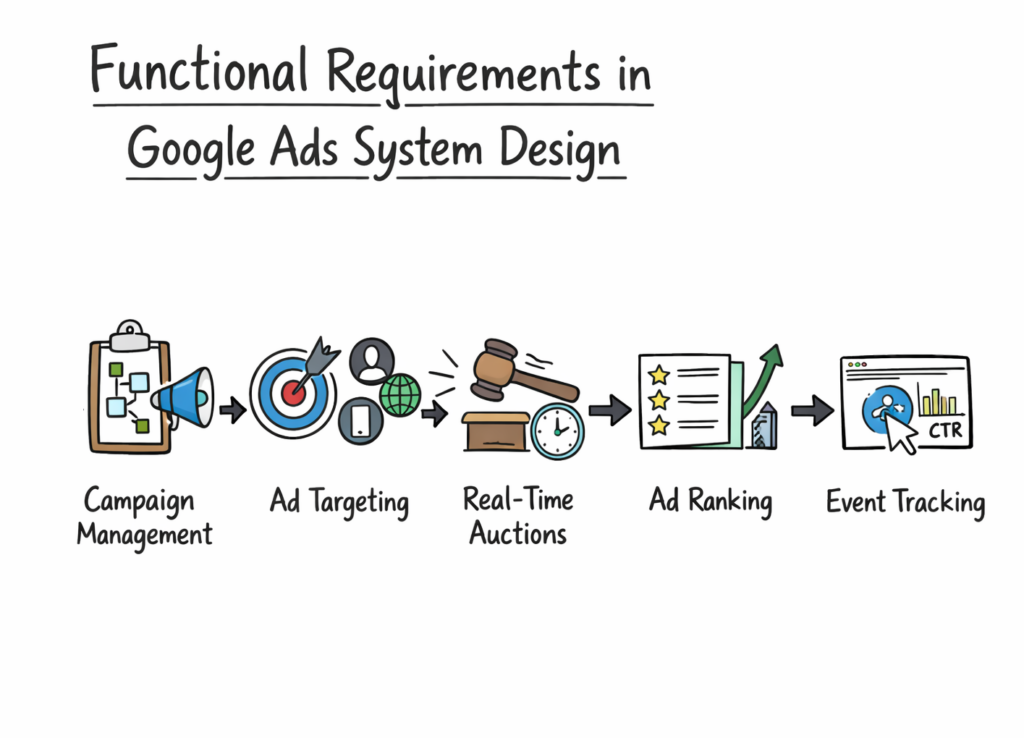
The functional requirements describe what the system must do. These requirements usually include advertiser onboarding, campaign and creative management, ad targeting based on user or query signals, real-time auction execution, ad ranking, and event tracking for impressions and clicks. While these features sound straightforward, each one introduces system-level complexity when you scale them globally.
Non-Functional Requirements And Constraints
Non-functional requirements are where the Google Ads System Design becomes interesting. Latency is the dominant constraint. In most real systems, ad selection must complete within tens of milliseconds. Availability is also critical because downtime directly translates into lost revenue. Scalability matters because traffic spikes are unpredictable and global. Cost efficiency matters because even small inefficiencies multiply at scale.
The table below shows how interviewers typically think about these requirements, even if they do not say them out loud.
| Requirement Type | Why It Matters In Interviews |
|---|---|
| Latency | Ads must be served in milliseconds during user actions |
| Scalability | System must handle billions of daily requests |
| Availability | Downtime directly impacts revenue |
| Consistency | Billing and reporting must remain accurate |
| Cost Efficiency | Infrastructure choices affect long-term viability |
By explicitly stating these constraints, you signal that you understand real-world systems, not just abstract architectures.
High-Level Architecture Of Google Ads System Design
Once the problem is clear, the next step is outlining a high-level architecture. This is where you show the interviewer that you can see the entire system without getting lost in implementation details.
At a high level, Google Ads System Design revolves around three main actors. Advertisers create and manage ads. Users trigger ad requests through searches or page visits. Publishers provide the surfaces where ads appear. The system sits in the middle, making real-time decisions that satisfy all three parties.
The request flow usually starts with a user action. That action generates an ad request containing context such as search keywords, page content, location, and device information. The request hits a front-facing ad server that handles authentication, rate limiting, and routing. From there, the system retrieves eligible ads, runs the auction, ranks candidates, and returns the winning ad.
You should describe this flow verbally before drawing any diagrams. Interviewers want to hear that you understand the sequence of interactions, not just the components themselves.
Core Components In The Architecture
Although implementations vary, most Google Ads System Design discussions include similar core services. There is an advertiser management service for campaigns and budgets, a targeting service for matching ads to requests, an auction service for bid evaluation, and an analytics pipeline for tracking events. These services communicate through well-defined APIs and are often deployed across multiple regions.
The table below summarizes how these components fit together conceptually.
| Component | Primary Responsibility |
|---|---|
| Ad Server | Entry point for ad requests |
| Targeting Service | Matches ads to users or queries |
| Auction Service | Evaluates bids and selects winners |
| Ranking Service | Orders ads based on relevance and value |
| Analytics Pipeline | Tracks impressions, clicks, conversions |
At this stage, you should avoid deep dives. High-level clarity matters more than technical depth here. Interviewers will guide you toward deeper areas later.
Data Modeling For Ads, Campaigns, And Users
Data modeling is where many candidates stumble in Google Ads System Design because they underestimate how much structure affects performance. When ads are served in real time, every database lookup matters.
You are dealing with multiple types of entities. Advertisers own campaigns. Campaigns contain ad groups. Ad groups contain creatives and targeting rules. Users generate signals that influence which ads are eligible. Each of these entities has different access patterns, which should influence how you model them.
Modeling Advertisers And Campaigns
Advertiser and campaign data tend to be write-heavy during setup and read-heavy during ad serving. Campaign structures rarely change during a single ad request, which makes them excellent candidates for caching and precomputation. In interviews, you should emphasize that campaign configuration is usually prepared ahead of time rather than assembled on the fly.
Relational databases are often used for advertiser-facing workflows because they enforce consistency and relationships. However, serving paths typically rely on denormalized or cached representations to reduce lookup latency.
Modeling Users And Context Signals
User data is more complex. You are often dealing with partial, anonymized, or probabilistic signals rather than a full user profile. Location, device type, recent activity, and inferred interests may all influence targeting. Because of privacy and scale concerns, this data is usually stored in distributed key-value stores optimized for fast reads.
The table below contrasts how different data types are typically handled in the Google Ads System Design.
| Data Type | Typical Storage Choice | Reason |
|---|---|---|
| Campaign Configuration | Relational Or Cached Objects | Strong consistency and structure |
| Ad Creatives | Object Storage Or CDN | Fast global access |
| User Signals | Distributed Key-Value Store | Low-latency reads at scale |
| Historical Metrics | Data Warehouse | Analytics and reporting |
By discussing data modeling this way, you demonstrate that you understand not just what data exists, but how access patterns drive architectural decisions.
Ad Targeting And Matching Logic
Once the system has received an ad request, the next critical step in Google Ads System Design is deciding which ads are even eligible to compete. This stage is often underestimated, but in reality, it determines both system performance and advertiser satisfaction.
At scale, you cannot afford to evaluate every ad for every request. Instead, the system narrows down a massive ad inventory into a manageable candidate set. This is where targeting and matching logic play a central role. You are essentially filtering millions of potential ads down to a few hundred or fewer, all within a tight latency budget.
Understanding Targeting Dimensions
Targeting works across multiple dimensions simultaneously. Search queries, page content, geographic location, device type, time of day, and advertiser-defined constraints all influence eligibility. In interviews, it helps to explain that targeting is not a single step but a layered filtering process.
Early filters tend to be coarse and fast. Later filters are more precise but applied to a smaller set. This staged approach allows the system to stay fast without sacrificing relevance.
Precomputation Versus Real-Time Matching
One of the most important trade-offs you should discuss is precomputation versus real-time matching. Precomputed indexes allow you to quickly retrieve ads relevant to a keyword or category. Real-time logic allows flexibility and personalization but costs more in latency.
Strong candidates explain that the Google Ads System Design typically uses a hybrid model. Keyword-to-ad mappings and campaign eligibility are precomputed. User-specific adjustments, such as location or device targeting, are applied in real time.
The table below shows how these two approaches complement each other.
| Matching Approach | Role In The System |
|---|---|
| Precomputed Indexes | Fast retrieval of candidate ads |
| Real-Time Filters | Contextual personalization |
| Hybrid Model | Balances speed and relevance |
By articulating this trade-off clearly, you show interviewers that you understand both system constraints and product needs.
Auction And Bidding System Design
After identifying eligible ads, the system must decide which ad actually wins the impression. This is where the Google Ads System Design transitions from filtering to economic decision-making.
The auction process happens in real time and must be completed within milliseconds. Every eligible advertiser submits a bid, but the highest bid does not automatically win. This nuance is critical in interviews, and missing it can weaken your answer.
How Real-Time Auctions Work
Most large ad platforms use variations of second-price auctions. In simple terms, the winning advertiser pays slightly more than the second-highest bid rather than their own maximum bid. This encourages truthful bidding and creates a fair marketplace.
In practice, auctions also account for advertiser budgets, pacing constraints, and fraud prevention. A campaign might be eligible but temporarily paused if it is spending too fast. These checks must happen quickly and reliably.
Budget Enforcement And Fairness
Budget management is one of the trickiest parts of the Google Ads System Design. Advertisers define daily or monthly limits, and the system must ensure those limits are respected without harming performance. This often involves probabilistic pacing rather than hard cutoffs.
In interviews, you should explain that strict consistency is often relaxed in favor of near-real-time enforcement. Slight overspending may be acceptable if it improves system throughput and advertiser outcomes.
The table below illustrates how auction-related factors influence ad selection.
| Factor | Impact On Auction |
|---|---|
| Bid Amount | Determines competitiveness |
| Budget Status | Controls eligibility |
| Pacing Logic | Prevents early exhaustion |
| Fraud Signals | Filters invalid traffic |
By walking through this logic step by step, you demonstrate economic intuition alongside System Design skills.
Ad Ranking And Relevance Scoring
Winning the auction is not just about money. Google Ads System Design also prioritizes user experience, which is why relevance plays a central role in ranking.
After the auction narrows down candidates, the system ranks ads based on a combined score. This score typically blends bid value with relevance metrics such as expected click-through rate and landing page quality.
Why Relevance Matters In Ranking
If ads were ranked purely by bid, user trust would erode quickly. Poorly matched ads reduce engagement, which ultimately hurts revenue. Interviewers expect you to recognize that ranking balances short-term profit with long-term platform health.
You should explain that relevance signals are often derived from historical data. Past performance, user behavior, and contextual similarity all feed into scoring models. These models are usually trained offline and applied in real time.
Integrating Machine Learning Into Ranking
Machine learning plays a major role in modern ad ranking, but you should be careful not to overemphasize it in interviews. What matters most is how models fit into the system.
Models must be fast, interpretable enough for debugging, and robust to missing data. They are typically served through dedicated inference services optimized for low latency.
The table below shows how ranking inputs contribute to the final decision.
| Input Signal | Role In Ranking |
|---|---|
| Bid Value | Revenue optimization |
| Expected CTR | User engagement |
| Ad Quality | Long-term trust |
| Context Match | Relevance to request |
By framing ranking as a balance rather than a formula, you align closely with how interviewers think about real systems.
Real-Time Ad Serving And Low-Latency Constraints
Everything in the Google Ads System Design ultimately converges at ad serving. This is the moment where all previous decisions must come together within an extremely tight time window.
Ad serving usually happens during a user action, such as a search or page load. If the system is slow, the ad may never be shown. This makes latency the single most important constraint in the entire design.
Request Flow And Latency Budgeting
A typical ad request travels through multiple services, but the total time budget is often less than 100 milliseconds. That includes network hops, cache lookups, targeting, auctions, ranking, and response rendering.
Strong candidates explicitly mention latency budgets and show how they influence architecture. This includes aggressive caching, regional deployments, and minimizing synchronous dependencies.
Caching And Geographic Distribution
Caching is essential for performance. Frequently accessed campaign data, targeting indexes, and creatives are cached close to users. Global systems deploy ad servers in multiple regions to reduce network latency and improve availability.
Fallback mechanisms also matter. If a downstream service fails or times out, the system should degrade gracefully rather than fail completely. Serving a less personalized ad is often better than serving nothing at all.
The table below summarizes key strategies used to meet latency goals.
| Strategy | Benefit |
|---|---|
| Edge Caching | Reduces network delay |
| Regional Servers | Improves availability |
| Timeouts And Fallbacks | Prevents request failure |
| Async Logging | Keeps serving path fast |
When you explain ad serving this way, you show that you understand how theoretical designs survive in production environments.
Analytics, Reporting, And Billing Pipelines
Once an ad is served, the system’s responsibility does not end. In Google Ads System Design, what happens after the impression is just as important as what happens before it. Analytics and billing pipelines ensure advertisers are charged correctly, performance is measured accurately, and optimization data flows back into the system.
Every impression, click, and conversion generates an event. These events are produced at a massive scale and must be processed reliably. You should emphasize in interviews that these pipelines are designed for throughput and correctness rather than immediate consistency. Delays of seconds or minutes are usually acceptable, but data loss is not.
Event Ingestion And Stream Processing
Ad events are typically ingested through high-throughput messaging systems. These systems decouple ad serving from analytics, which protects the serving path from downstream failures. Events are then processed by stream processors that aggregate metrics, detect anomalies, and enrich data.
A key interview insight is that analytics systems are usually append-only. This simplifies fault tolerance and replay. If a processor fails, the system can reprocess events without affecting live traffic.
Billing Accuracy And Delayed Consistency
Billing introduces stricter requirements. Advertisers expect accurate charges, even if reporting dashboards lag slightly. Google Ads System Design often uses reconciliation jobs that compare raw events with aggregated results to detect discrepancies.
You should explain that billing systems typically favor correctness over speed. Minor delays are acceptable if they prevent mischarging advertisers.
The table below illustrates how different analytics components prioritize system goals.
| Component | Primary Priority |
|---|---|
| Event Ingestion | Reliability |
| Stream Processing | Scalability |
| Aggregation | Accuracy |
| Billing Reconciliation | Correctness |
By separating analytics from serving, you show that you understand how production systems protect critical paths.
Scalability, Reliability, And Fault Tolerance
At the scale Google Ads operates, failures are not edge cases. They are expected events. Google Ads System Design must assume that machines, networks, and even entire regions can fail without bringing the system down.
Scalability starts with horizontal design. Services are stateless wherever possible, allowing them to scale by adding instances. State is pushed into distributed storage systems that support replication and sharding.
Handling Traffic Spikes And Regional Failures
Ad traffic is unpredictable. News events, product launches, and seasonal spikes can multiply request volume instantly. The system must absorb these spikes without manual intervention.
You should explain that regional isolation plays a key role. Requests are routed to nearby regions, and failover mechanisms redirect traffic when a region becomes unavailable. This design minimizes blast radius and improves resilience.
Graceful Degradation And Partial Availability
One of the most senior-level concepts you can mention is graceful degradation. When parts of the system fail, the platform should continue serving ads with reduced functionality rather than failing outright.
For example, if personalization data is unavailable, the system may serve generic ads. If analytics lag, serving continues uninterrupted. This mindset is highly valued in System Design interviews.
The table below highlights common resilience strategies.
| Strategy | Purpose |
|---|---|
| Stateless Services | Easy horizontal scaling |
| Data Replication | Prevents data loss |
| Regional Isolation | Limits outages |
| Graceful Degradation | Maintains availability |
Discussing these ideas shows that you design for reality, not perfection.
Trade-Offs, Bottlenecks, And Real-World Constraints
No Google Ads System Design is perfect. Every architectural choice introduces trade-offs, and interviewers care deeply about whether you can identify and justify them.
One common trade-off is consistency versus availability. Strong consistency is valuable for billing, but expensive at a global scale. As a result, many parts of the system use eventual consistency with reconciliation mechanisms layered on top.
Latency versus accuracy is another recurring tension. More complex targeting and ranking improve relevance, but slow down serving. You should explain how systems often use simpler models in real time and refine results offline.
Identifying Bottlenecks
Bottlenecks often appear at shared services such as targeting indexes, auction engines, or analytics sinks. Good candidates explain how caching, partitioning, and backpressure mechanisms reduce pressure on these components.
It is also valuable to discuss operational constraints. Infrastructure costs, regulatory requirements, and privacy considerations all shape design decisions in production systems.
The table below summarizes common trade-offs you can articulate in interviews.
| Trade-Off | System Impact |
|---|---|
| Consistency Vs Availability | Affects billing accuracy |
| Latency Vs Relevance | Influences user experience |
| Cost Vs Performance | Shapes infrastructure choices |
| Flexibility Vs Simplicity | Impacts maintainability |
By openly discussing trade-offs, you demonstrate engineering maturity.
How To Approach Google Ads System Design In An Interview
All of this knowledge only helps if you can communicate it clearly under interview conditions. Google Ads System Design interviews reward structured thinking more than perfect answers.
You should start by clarifying requirements and constraints. Then move from high-level architecture to deeper components. Let the interviewer guide depth rather than jumping ahead.
Throughout the discussion, narrate your reasoning. Explain why you chose one approach over another and acknowledge trade-offs. Interviewers are evaluating how you think, not whether your design matches an internal implementation.
Communicating Confidence Without Overengineering
A common mistake is overengineering too early. You do not need to design every microservice in detail unless prompted. Focus on correctness, scalability, and clarity first.
If an interviewer challenges an assumption, treat it as collaboration rather than correction. Adjust your design and explain the impact of the change.
The table below shows what interviewers typically look for at different stages.
| Interview Stage | What Is Being Evaluated |
|---|---|
| Problem Definition | Clarity and alignment |
| High-Level Design | System thinking |
| Deep Dives | Technical judgment |
| Trade-Off Discussion | Seniority and maturity |
Approaching the interview as a conversation rather than a performance significantly improves outcomes.
Using structured prep resources effectively
Use Grokking the System Design Interview on Educative to learn curated patterns and practice full System Design problems step by step. It’s one of the most effective resources for building repeatable System Design intuition.
You can also choose the best System Design study material based on your experience:
Final Thoughts
Google Ads System Design is not just an interview question. It is a condensed lesson in how large-scale, revenue-critical systems are built and operated. When you approach this problem thoughtfully, you demonstrate mastery of distributed systems, real-time decision-making, and business-aware engineering.
If you focus on clear problem framing, structured architecture, and honest trade-offs, you will stand out as a candidate who understands how systems behave in the real world. That is exactly what System Design interviews are trying to measure.