
Social media platforms often appear simple on the surface. A user uploads a photo and shares it with friends. Beneath this experience lies significant engineering complexity. Scaling simple interactions to billions of users changes the challenge. You move from building a feature to engineering a global ecosystem. You must account for media storage and for complex feed-generation algorithms. The system requires social graph queries and instant notifications. It must maintain very high availability (four nines or higher).

This guide transforms the abstract prompt of designing Instagram into a structured engineering plan. We will walk through clarifying requirements and defining the data model. We will sketch the architecture and solve specific scaling challenges. This includes the “celebrity problem” in feed generation. You will learn a repeatable framework to approach this System Design problem.
Step 1: Understand the problem statement
Your immediate goal is to define the scope when asked to design Instagram. Rushing into database selection without understanding constraints is a mistake. You must clarify that the engineering focus is on high-scale components. The system must support user registration and media uploads. It needs a social graph and a personalized feed. Engagement features like likes and comments are also necessary. The system requires massive scalability to handle billions of users. It needs low latency for feed generation and high availability.
Capacity estimation and constraints inform your architectural choices. Let us assume the platform has 100 million daily active users. Users upload 500 million photos per day. The daily storage requirement is 100TB if the average photo size is 200KB. This amounts to approximately 365 PB of storage over ten years. This necessitates an object storage solution rather than a traditional file system. The system is read-heavy if we assume an 80/20 read-to-write ratio. Our design must prioritize fast retrieval and caching strategies.
We can now outline the specific features that will drive our design.
Step 2: Define core features
We must prioritize features into a Minimum Viable Product and extend capabilities. The MVP focuses on the critical path of user account management. It includes media ingestion and the social graph. The media ingestion pipeline must handle large file uploads and compression. The social graph determines which content appears in a user’s feed. Feed generation requires logic to rank and display posts from followed accounts.
Extended features like Stories and the Explore page add complexity. Stories require ephemeral storage, with content expiring after 24 hours. The Explore page necessitates recommendation algorithms based on user behavior. It is best to focus on the feed and media upload flow first. You can mention these extensions as time permits.
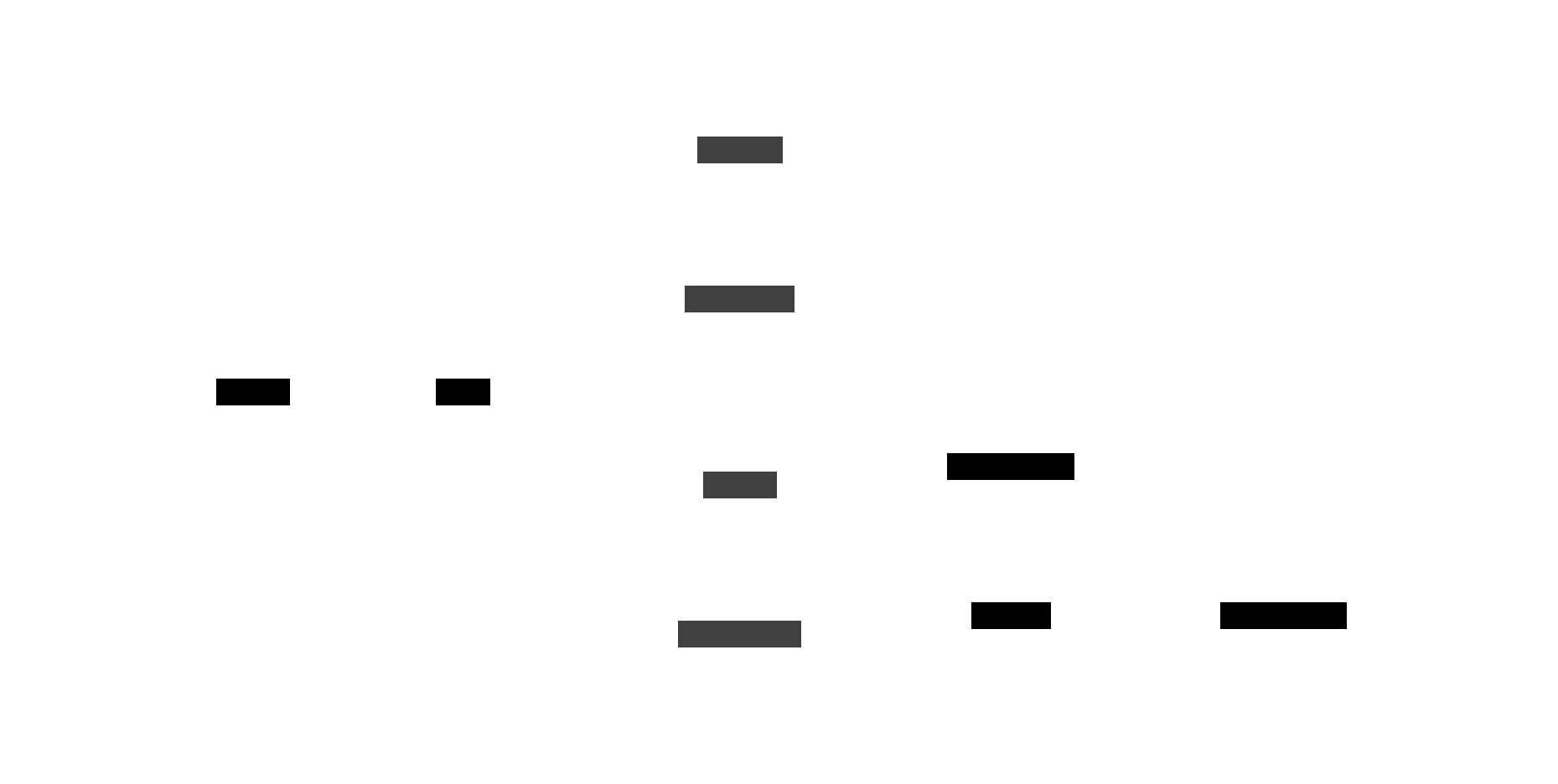
The following diagram illustrates how these core features map to specific API endpoints.

Step 3: High-level architecture and API design
The architecture uses loosely coupled microservices to ensure independent scaling. The entry point is an API Gateway that handles authentication. Distinct services behind the gateway handle specific domains. The User Service manages profile data and authentication tokens. The Media Service coordinates the upload and storage of images. The Feed Service aggregates posts from users you follow. The Social Graph Service manages the web of user relationships.
API design defines how clients interact with these services. We utilize RESTful endpoints for standard operations. A POST request to /api/v1/posts creates a new entry. A client calls /api/v1/feed to retrieve the news feed. This endpoint supports pagination via a cursor parameter. Separating the upload of binary media from the creation of post metadata is an optimization. Clients should upload media directly to object storage via a pre-signed URL.
We need to structure the data that powers these services.
Step 4: Data model and schema
Choosing the right database technology is a trade-off between consistency and availability. Relational databases like PostgreSQL are preferred for user data. They offer ACID properties and structured relationships. The “users table” stores the user ID and authentication details. The “follows table” represents the social graph. It uses a composite primary key to enable efficient bidirectional queries.
NoSQL solutions are appropriate for high-volume data, such as news feeds. A “posts table” might reside in a database such as Cassandra. This handles high write throughput for post metadata. A “feed table” could be a simple key-value store. The key is the user ID, and the value is a bounded, time-ordered list of post IDs. This denormalization allows for fast read operations.
Let us examine the lifecycle of the media assets in the system.
Step 5: Media upload and storage
The media upload flow must be efficient. The client compresses the photo locally to save bandwidth. The file is uploaded to a distributed object storage system. This storage should be replicated across multiple geographic regions. The database does not store the image itself. It only stores the metadata and a reference URL.
Transcoding and CDN integration are essential for performance. An asynchronous job generates multiple resolutions when an image is uploaded. This ensures a user on a slow connection does not download a 4K image. These processed images are pushed to a Content Delivery Network. The CDN caches content at edge locations near users. This reduces latency and offloads traffic from the core servers.
Step 6: Feed generation
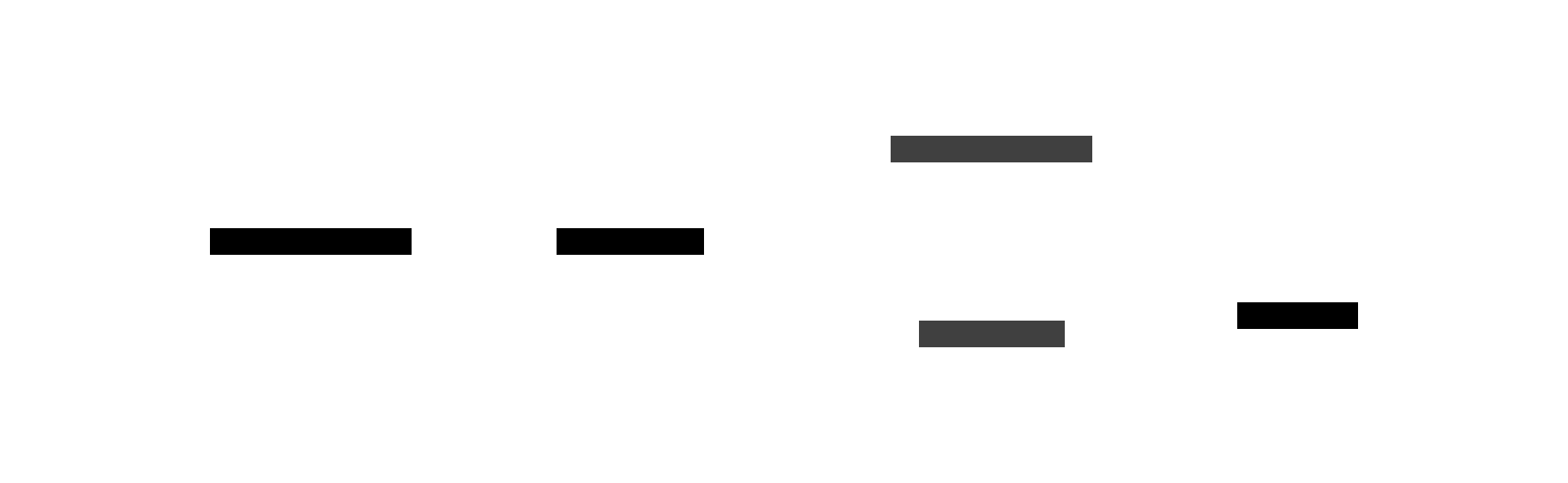
Feed generation presents a significant scalability challenge. The naive approach queries the database for all accounts that are followed. This query is too slow for a user following thousands of accounts. The preferred approach is fan-out on write. The system pushes the post ID to followers’ feed lists when a user posts. The feed is already built when the follower opens the app.
The fan-out on write model fails for celebrities with millions of followers. Updating millions of feed lists simultaneously causes a backlog. We use a hybrid approach to solve this. We use the push model for standard users. We use a pull model for users with high follower counts. The system loads the pre-computed feed and merges it with recent celebrity posts.
| Strategy | Mechanism | Pros | Cons |
|---|---|---|---|
| Pull (fan-out on read) | Query DB when user opens app | Simple implementation, real-time data | High read latency, computationally expensive |
| Push (fan-out on write) | Pre-compute feeds on post creation | Instant read speeds, decoupled load | “Thundering herd” for celebrities, storage heavy |
| Hybrid | Push for normal, Pull for VIPs | Balances read/write load, scalable | Complex architecture to maintain |
The social graph defines the relationships that populate the feed.
Step 7: Social graph and engagement
The Social Graph Service manages user relationships. This graph is too large for a single database server at scale. We must shard the data by user ID. A sharded relational database with an adjacency list is often sufficient. The list of people a user follows is often cached in Redis. This speeds up feed generation.
Engagement features like likes require high write throughput. Consistency can be relaxed for these counters. It is acceptable if a like count is slightly inaccurate for a few seconds. We can use a message queue like Kafka to handle viral posts. Like events are aggregated in a buffer and written to the database in batches. This prevents the database from being overwhelmed by individual write transactions.
Users need to be alerted when these interactions happen.
Step 8: Notifications and discovery
The Notification Service connects user actions to user attention. It subscribes to events from the Feed and Engagement services. The service must implement deduplication and batching logic. This prevents spamming users if a celebrity likes many photos quickly. The system sends one summary instead of multiple alerts. This service connects to third-party providers to deliver the final alert.
Search and Discovery allow users to find content outside their social graph. This requires a separate indexing pipeline. Posts are sent to a search service, which indexes captions. We utilize machine learning models to generate vector embeddings for the Explore page. A nearest-neighbor search algorithm identifies content that is similar to the user’s preferences. This creates a personalized discovery stream.

Step 9: Scalability and reliability
The system must be distributed across multiple data centers to operate globally. Geo-routing directs users to the nearest data center. We typically use a primary-replica model for databases. Writes go to a primary region and are replicated asynchronously. Traffic can be rerouted to another region if a data center fails. Users might see slightly stale data during this transition.
Reliability also relies on graceful degradation. The application should not crash if the Feed Service fails. It should serve a cached version of the feed. The core experience should remain unaffected if the Notification Service stops. Implementing circuit breakers prevents cascading failures. This ensures one struggling service does not take down the entire platform.
Conclusion
Designing a platform like Instagram requires balancing conflicting requirements. We defined the core constraints of storage and latency. We moved through a microservices architecture and tackled hybrid feed generation. The key takeaway is the need to separate read and write paths. We optimize media storage for durability and the feed for fast retrieval.
Systems are moving toward real-time and video-heavy experiences. Future designs will lean heavier on AI-driven recommendations. This requires robust vector search and real-time stream processing capabilities. The success of such a system lies in its ability to remain invisible. It delivers content so seamlessly that the user does not notice the engineering.