

When you start preparing for system design interviews, you quickly realize that some problems appear repeatedly because they reflect real-world engineering challenges. Fraud detection is one of those problems, as it combines streaming data, real-time decision-making, and complex trade-offs. This makes it a favorite among interviewers who want to evaluate both your technical depth and your practical thinking.
The Real-World Relevance Of Fraud Detection
Fraud detection systems are used in industries like banking, payments, e-commerce, and cybersecurity, where every transaction carries risk. These systems must operate continuously, analyzing user behavior and transaction patterns to detect suspicious activity.
When you design such a system, you are not just building infrastructure but protecting financial assets and user trust. This adds a business-critical dimension to your design, which is why interviewers take this problem seriously.
What Interviewers Are Evaluating
In fraud detection system design interviews, the goal is not to test your knowledge of specific algorithms but to understand how you approach complex systems. Interviewers want to see whether you can design a system that balances speed, accuracy, and scalability.
If your solution only focuses on detecting fraud without considering latency or user experience, it signals an incomplete understanding. On the other hand, when you naturally incorporate trade-offs and real-world constraints, your design becomes much more compelling.
Why This Problem Is Challenging
Fraud detection is inherently difficult because it involves uncertainty and constantly evolving patterns. Unlike deterministic systems, where outcomes are predictable, fraud detection relies on probabilities and risk assessment.
| Challenge | Description | Impact On Design |
|---|---|---|
| Real-Time Decisions | Must evaluate transactions instantly | Requires low-latency systems |
| Evolving Fraud Patterns | Fraudsters adapt quickly | Requires continuous updates |
| Data Volume | High transaction throughput | Demands scalable architecture |
Understanding these challenges helps you approach the problem with the right mindset.
From Simple Validation To Intelligent Systems
In simpler systems, validation might involve checking whether inputs meet certain criteria. Fraud detection goes far beyond this by analyzing behavior, history, and patterns to make decisions.
When you design fraud detection systems, you move from static rules to dynamic decision-making. This shift is what makes the problem both interesting and valuable in interviews.
Understanding The Core Goals Of A Fraud Detection System
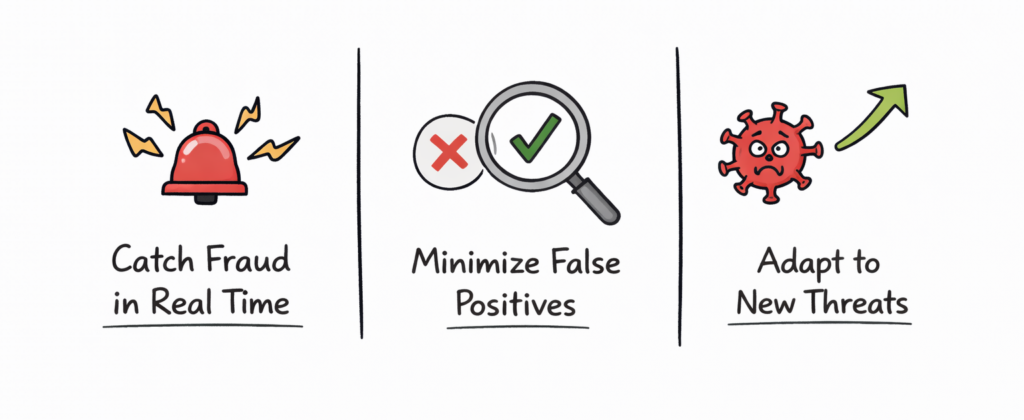
Before you start designing the architecture, you need to clearly understand what the system is trying to achieve. Many candidates jump straight into components without defining goals, which leads to unfocused designs.
Detecting Fraud Without Disrupting Users
The primary goal of a fraud detection system is to identify suspicious activity and prevent fraudulent transactions. However, this must be done without negatively impacting legitimate users.
If your system blocks too many genuine transactions, it creates friction and damages user experience. This balance between security and usability is a central challenge in fraud detection.
Minimizing False Positives And False Negatives
A key aspect of fraud detection is managing errors, which are categorized as false positives and false negatives. False positives occur when legitimate transactions are flagged as fraud, while false negatives occur when fraudulent transactions are missed.
| Error Type | Meaning | Business Impact |
|---|---|---|
| False Positive | Legitimate activity flagged as fraud | Poor user experience |
| False Negative | Fraud not detected | Financial loss |
Designing a system that minimizes both types of errors requires careful consideration of thresholds and decision logic.
Supporting Investigation And Feedback
Fraud detection systems are not standalone solutions, as they often involve human analysts who review flagged cases. This means your system should support investigation workflows and provide relevant data for decision-making.
Feedback from these investigations is also critical because it helps improve the system over time. This creates a feedback loop that enhances both rules and models.
Balancing Accuracy And Performance
Another important goal is balancing accuracy with system performance. High accuracy often requires more complex analysis, which can increase latency and cost.
When you design your system, you need to decide how much complexity is acceptable for real-time decision-making. This trade-off is a key discussion point in interviews.
Interview Insight: Starting With Clear Objectives
In interviews, starting with clear goals helps you structure your answer effectively. It shows that you understand the problem before attempting to solve it.
This approach also makes it easier to justify your design decisions later, as they are aligned with defined objectives.
Key Components Of A Fraud Detection Architecture
Once you understand the goals, the next step is breaking the system into components. A well-structured architecture makes it easier to explain your design and ensures that all aspects of the system are covered.
Thinking In Layers And Components
Fraud detection systems are typically composed of multiple layers that work together to process data and make decisions. Each layer has a specific role, and understanding these roles helps you design a cohesive system.
When you organize your system into components, you create clarity in both design and communication. This is especially important in interviews where structure matters.
Core Architectural Components
A typical fraud detection system includes several key components that handle different stages of the workflow.
| Component | Role | Example Function |
|---|---|---|
| Event Ingestion | Captures incoming data | Transaction or login events |
| Feature Store | Stores historical data | User behavior history |
| Rules Engine | Applies deterministic logic | Threshold checks |
| ML Scoring Service | Evaluates risk | Fraud probability scoring |
| Decision Engine | Determines action | Approve or block transaction |
Each of these components contributes to the overall system and must be designed to work seamlessly together.
How Components Interact
The interaction between components defines how the system processes events. Data flows from ingestion to feature extraction, then through rules and models, before reaching a decision.
This flow creates a pipeline that needs to be optimized for speed and accuracy. When you explain these interactions clearly, you demonstrate a strong understanding of system design.
The Role Of Feature Stores
Feature stores play a crucial role in fraud detection because they provide the historical context needed for decision-making. Without this context, the system would rely only on the current transaction, which limits its effectiveness.
By storing and retrieving features efficiently, you enable both rules and models to make more informed decisions. This component is often a key differentiator in advanced designs.
Interview Insight: Structuring Your Architecture
In interviews, clearly defining components helps you guide the conversation and avoid confusion. It shows that you can break down complex systems into manageable parts.
This structured approach makes your design easier to understand and more convincing.
Real-Time Vs Batch Fraud Detection Pipelines
Fraud detection systems typically use a combination of real-time and batch processing to achieve both speed and accuracy. Understanding these two approaches and their trade-offs is essential for designing effective systems.
What Real-Time Detection Involves
Real-time detection focuses on evaluating transactions as they occur, allowing the system to take immediate action. This is critical for scenarios like payment processing or login verification, where delays are not acceptable.
In real-time systems, latency is a primary concern because decisions must be made within milliseconds. This requires highly optimized pipelines and efficient data access.
The Role Of Batch Processing
Batch processing, on the other hand, analyzes data in bulk to identify patterns and trends over time. This approach is useful for detecting sophisticated fraud schemes that may not be apparent in individual transactions.
Batch systems allow for more complex analysis because they are not constrained by strict latency requirements. This makes them complementary to real-time systems.
Comparing Real-Time And Batch Approaches
Both approaches have distinct advantages and limitations, which means they are often used together in production systems.
| Approach | Strength | Limitation |
|---|---|---|
| Real-Time | Immediate decision-making | Limited complexity |
| Batch | Deep analysis and pattern detection | Delayed response |
Understanding these differences helps you design systems that leverage the strengths of both approaches.
Why Most Systems Use A Hybrid Model
In practice, fraud detection systems combine real-time and batch pipelines to achieve optimal results. Real-time systems handle immediate decisions, while batch systems provide insights that improve future detection.
This hybrid approach allows you to balance speed and accuracy, which is essential for effective fraud detection.
Interview Insight: Explaining Pipeline Trade-Offs
In interviews, discussing both real-time and batch processing shows that you understand the full spectrum of system design. It demonstrates that you are not limited to a single approach.
When you explain how these pipelines work together, you provide a more complete and realistic solution, which is exactly what interviewers are looking for.
Designing The Event Ingestion And Streaming Layer
Once you have defined the high-level architecture, the next critical piece is how data enters your system. In fraud detection, everything starts with events, which include transactions, login attempts, device signals, and behavioral activity. Designing an efficient ingestion layer ensures that your system receives and processes these events reliably and at scale.
What Event Ingestion Means In Fraud Systems
Event ingestion refers to capturing and processing incoming data in real time as users interact with your system. This data forms the foundation for all fraud detection logic, as every decision depends on the quality and timeliness of these inputs.
If your ingestion layer is unreliable or slow, your entire fraud detection system becomes ineffective. This is why ingestion is treated as a first-class component in system design.
Types Of Events You Need To Handle
Fraud detection systems rely on multiple types of signals, each contributing to the overall risk assessment. These signals can come from different sources and need to be unified into a consistent format.
| Event Type | Example | Why It Matters |
|---|---|---|
| Transaction Events | Payment attempts | Core fraud detection signal |
| Device Signals | Device ID, OS, browser | Detect suspicious devices |
| Location Data | IP address, geolocation | Identify anomalies |
| Behavioral Events | Click patterns, typing speed | Detect unusual behavior |
Handling these diverse event types requires a flexible and scalable ingestion system.
Using Streaming Systems And Message Queues
To process events at scale, fraud detection systems typically rely on streaming platforms such as Kafka or managed queue services. These systems allow you to decouple event producers from consumers, ensuring smooth data flow even under high load.
Streaming systems also provide durability and fault tolerance, which are essential for maintaining data integrity. When you mention these technologies in interviews, it shows that you understand real-world system design practices.
Handling Ordering, Duplication, And Reliability
One of the key challenges in event ingestion is ensuring that data is processed correctly despite issues like duplication or out-of-order events. Fraud detection decisions often depend on accurate sequencing, such as detecting rapid transactions within a short time window.
Designing mechanisms to handle these challenges, such as idempotent processing and event timestamps, ensures that your system remains reliable. This level of detail demonstrates strong engineering thinking.
Interview Insight: Building A Strong Foundation
In interviews, the ingestion layer sets the stage for the rest of your design. When you clearly explain how events are captured and processed, you create a strong foundation for discussing downstream components.
This shows that you understand how systems operate from the ground up rather than focusing only on high-level logic.
Building Features And Using Historical Context
Fraud detection systems rely heavily on historical data to make accurate decisions. A single transaction rarely provides enough information, which is why feature engineering and context management are critical components of the system.
Why Historical Context Is Essential
Fraud patterns often emerge over time rather than in isolated events. For example, a sudden increase in transaction frequency or a change in location can indicate suspicious activity.
By incorporating historical context, your system can identify patterns that would otherwise go unnoticed. This significantly improves detection accuracy.
Types Of Features Used In Fraud Detection
Features are derived data points that represent meaningful information about user behavior and transactions. These features are used by both rules engines and machine learning models.
| Feature Type | Example | Purpose |
|---|---|---|
| Velocity Features | Transactions per minute | Detect rapid activity |
| Behavioral Features | Login patterns | Identify anomalies |
| Device Features | Device reuse | Spot suspicious devices |
| Location Features | Country changes | Detect unusual movement |
These features provide a richer understanding of user activity, enabling more informed decisions.
Online Vs Offline Feature Computation
Features can be computed in real time or precomputed in batch processes. Real-time features are used for immediate decision-making, while offline features are used for deeper analysis and model training.
Balancing these two approaches is essential because real-time computation must be fast, while offline computation can be more complex. This distinction is often discussed in system design interviews.
Feature Freshness And Consistency
For fraud detection, the freshness of features is critical because outdated data can lead to incorrect decisions. For example, using stale transaction data might cause the system to miss a sudden spike in activity.
At the same time, maintaining consistency across distributed systems is challenging. Designing mechanisms to ensure both freshness and consistency is a key part of advanced system design.
Interview Insight: Designing With Memory
When you include historical context in your design, you show that you understand the importance of memory in fraud detection systems. This goes beyond simple request processing and demonstrates deeper system awareness.
It also signals that your design is capable of handling real-world scenarios where patterns evolve over time.
Rules Engine Design For Fast Fraud Checks
The rules engine is one of the fastest and most reliable components in a fraud detection system. It applies deterministic logic to quickly identify suspicious activity, making it essential for real-time decision-making.
Why Rules Engines Are Still Important
Even with advanced machine learning models, rules engines remain a critical part of fraud detection systems. They provide immediate and explainable decisions, which are important for both performance and transparency.
Rules engines are particularly useful for capturing known fraud patterns that can be expressed as clear conditions. This makes them an effective first line of defense.
Types Of Rules Used In Fraud Detection
Rules can be designed to capture various types of suspicious behavior, ranging from simple thresholds to more complex patterns.
| Rule Type | Example | Purpose |
|---|---|---|
| Threshold Rules | Transaction > $5000 | Flag large transactions |
| Velocity Rules | 5 transactions in 1 minute | Detect rapid activity |
| Geo Rules | Login from different countries | Identify anomalies |
| Device Rules | New device usage | Detect unfamiliar access |
These rules allow the system to quickly filter out high-risk activities.
Advantages And Limitations Of Rules
Rules engines are fast and easy to implement, but they have limitations. They rely on predefined conditions, which means they cannot adapt to new or evolving fraud patterns.
This makes them less effective against sophisticated fraud schemes that require more dynamic analysis. Understanding this limitation helps you design systems that combine rules with other approaches.
Combining Rules With Other Components
In most systems, the rules engine works alongside machine learning models and feature stores. Rules provide quick decisions, while models handle more complex patterns.
This layered approach ensures that your system is both efficient and adaptable. It also reflects how real-world fraud detection systems are designed.
Interview Insight: Explainability And Speed
In interviews, mentioning rules engines shows that you value both speed and explainability. This is important because businesses often need to justify decisions, especially when blocking transactions.
When you include rules in your design, you demonstrate a practical understanding of system requirements.
Machine Learning In Fraud Detection Systems
While rules engines provide a strong foundation, machine learning adds the ability to detect complex and evolving fraud patterns. This is where fraud detection systems become truly intelligent.
Why Machine Learning Is Needed
Fraudsters continuously adapt their strategies, which makes static rules insufficient over time. Machine learning models can learn patterns from data and adapt to new behaviors, making them essential for modern systems.
These models analyze multiple features simultaneously, allowing them to detect subtle patterns that would be difficult to capture with rules alone.
Types Of Models Used In Fraud Detection
Different types of machine learning models are used depending on the problem and data available.
| Model Type | Use Case | Benefit |
|---|---|---|
| Supervised Models | Known fraud patterns | High accuracy |
| Unsupervised Models | Unknown anomalies | Detect new fraud |
| Behavioral Models | User activity patterns | Context-aware detection |
Each type contributes to a more comprehensive fraud detection system.
Risk Scoring And Decision Support
Machine learning models typically output a risk score that represents the likelihood of fraud. This score is then used by the decision engine to determine the appropriate action.
This approach allows for more nuanced decisions compared to binary rule-based systems. It also enables dynamic thresholding based on risk levels.
Combining ML With Rules
In practice, fraud detection systems combine machine learning with rules to achieve the best results. Rules handle known patterns quickly, while models provide deeper analysis.
This hybrid approach ensures that the system is both fast and adaptive. It also reflects the complexity of real-world fraud detection.
Interview Insight: Moving Beyond Static Logic
When you include machine learning in your design, you demonstrate that you understand the need for adaptability. This shows that your system can evolve as fraud patterns change.
In interviews, this signals that you are capable of designing systems that remain effective over time, which is a key expectation for modern engineers.
Decisioning, Risk Scoring, And Action Flows
Once your system has evaluated a transaction using rules and machine learning models, the next step is deciding what action to take. This is where fraud detection becomes a product decision as much as a technical one, because every action impacts both security and user experience. Designing this layer correctly is essential for building a practical and effective system.
From Risk Score To Decision
Most modern fraud detection systems rely on a risk score rather than a binary decision. This score represents the likelihood that a transaction is fraudulent, allowing the system to apply different actions based on risk levels.
Instead of simply approving or rejecting a transaction, the system can take more nuanced actions. This flexibility improves both accuracy and user experience.
Defining Decision Thresholds
To convert risk scores into actions, you need to define thresholds that determine how the system responds. These thresholds are typically configurable and can be adjusted based on business requirements.
| Risk Level | Action | Purpose |
|---|---|---|
| Low Risk | Approve | Ensure smooth user experience |
| Medium Risk | Challenge | Add verification step |
| High Risk | Block | Prevent fraud |
These thresholds allow the system to balance security with usability.
Handling User Challenges And Verification
For medium-risk cases, the system often introduces additional verification steps such as OTPs or multi-factor authentication. This reduces false positives while still protecting against potential fraud.
This step is critical because it provides a middle ground between approval and rejection. It also ensures that legitimate users are not unnecessarily blocked.
Integrating Human Review Systems
In some cases, automated systems may not have enough confidence to make a decision. These cases are escalated to human analysts who review the transaction manually.
This requires a case management system that provides all relevant data to the analyst. Including this component in your design shows that you understand real-world workflows.
Interview Insight: Balancing Security And Experience
In interviews, decisioning is where you demonstrate product thinking. When you explain how your system balances fraud prevention with user experience, you show that you are not just building a technical solution but a practical one.
This ability to connect technical decisions with user impact is highly valued.
Scaling Fraud Detection Systems In Production
As your system moves from prototype to production, scaling becomes a critical concern. Fraud detection systems must handle large volumes of transactions while maintaining low latency and high accuracy.
Why Scaling Is Challenging In Fraud Detection
Unlike traditional systems, fraud detection requires real-time analysis for every transaction. This means your system must process high volumes of data without delays.
At the same time, you need to maintain accuracy and consistency, which adds complexity to scaling decisions.
Scaling The Ingestion And Processing Layers
The ingestion layer must handle a continuous stream of events, which requires horizontal scaling and efficient load distribution. Stream processing systems are often used to ensure that data is processed in real time.
| Component | Scaling Approach | Benefit |
|---|---|---|
| Ingestion Layer | Partitioned streams | Handles high throughput |
| Feature Store | Distributed storage | Fast data access |
| Scoring Service | Stateless scaling | Low latency |
Each component must scale independently to ensure overall system performance.
Handling Peak Traffic And Spikes
Fraud detection systems often experience traffic spikes during events like sales or peak business hours. Your system must be able to handle these spikes without degrading performance.
Auto-scaling mechanisms and buffering strategies help manage these fluctuations. Designing for peak traffic ensures that your system remains reliable under stress.
Multi-Region Deployment And Availability
For global systems, deploying across multiple regions improves both latency and availability. This ensures that users receive fast responses regardless of their location.
However, multi-region deployments introduce challenges such as data consistency and increased costs. Being able to explain these trade-offs is important in interviews.
Interview Insight: Designing For Scale
In interviews, scaling discussions are often where candidates demonstrate their depth of understanding. When you explain how your system handles growth and high traffic, you show that you can design systems for real-world conditions.
This is a key indicator of strong system design skills.
Monitoring, Feedback Loops, And Model Improvement
A fraud detection system is never static, as fraud patterns evolve continuously. This makes monitoring and feedback essential for maintaining system effectiveness over time.
Why Continuous Monitoring Is Necessary
Without monitoring, you have no way of knowing whether your system is performing correctly. Metrics such as detection accuracy and latency provide insights into system behavior.
Monitoring allows you to identify issues early and make adjustments before they impact users or business outcomes.
Key Metrics For Fraud Detection Systems
To evaluate performance, you need to track specific metrics that reflect both accuracy and efficiency.
| Metric | What It Measures | Importance |
|---|---|---|
| Precision | Correct fraud detections | Reduces false positives |
| Recall | Fraud cases detected | Prevents missed fraud |
| Latency | Decision time | Ensures real-time response |
| False Positive Rate | Incorrect flags | Impacts user experience |
These metrics help you understand how well your system is performing.
Building Feedback Loops
Feedback loops are critical for improving both rules and machine learning models. Data from human reviews and confirmed fraud cases can be used to refine detection logic.
This continuous learning process ensures that your system adapts to new fraud patterns. It also improves accuracy over time.
Handling Model Drift And Changing Patterns
Fraud patterns change as attackers adapt to detection methods. This can lead to model drift, where the model’s performance degrades over time.
Regular retraining and updating of models help address this issue. Including this in your design shows that you understand long-term system maintenance.
Interview Insight: Designing For Evolution
In interviews, discussing monitoring and feedback demonstrates that you are thinking beyond initial deployment. It shows that your system is designed to evolve and improve over time.
This forward-thinking approach is a strong signal of engineering maturity.
How To Answer Fraud Detection System Design Questions In Interviews
Understanding the system is only part of the challenge, as you also need to communicate your design effectively. Structuring your answer clearly is key to making a strong impression.
Starting With Requirements And Constraints
A strong answer begins with clarifying the problem and understanding requirements. This includes identifying the type of fraud, expected traffic, and latency constraints.
By starting with requirements, you ensure that your design is aligned with the problem. This also demonstrates a structured approach to problem-solving.
Defining The System Architecture
Once you understand the requirements, you should outline the main components of your system. This includes ingestion, feature computation, rules, machine learning, and decisioning layers.
Explaining how these components interact helps the interviewer follow your thought process. It also ensures that your design is complete.
Incorporating Optimization And Scaling
After presenting the basic design, you should discuss how your system handles scaling and optimization. This includes strategies for managing high traffic and maintaining low latency.
This step shows that you are thinking beyond the initial design and considering real-world challenges.
Explaining Trade-Offs Clearly
One of the most important parts of your answer is explaining trade-offs. This includes balancing speed, accuracy, and user experience.
When you articulate these trade-offs clearly, you demonstrate strong decision-making skills. This is often what distinguishes top candidates.
Interview Insight: Structured Thinking Wins
In interviews, your goal is to show how you think rather than just what you know. A clear and structured approach makes your answers more compelling.
When you guide the interviewer through your design logically, you create a strong impression.
Using structured prep resources effectively
Use Grokking the System Design Interview on Educative to learn curated patterns and practice full System Design problems step by step. It’s one of the most effective resources for building repeatable System Design intuition.
You can also choose the best System Design study material based on your experience:
Final Thoughts
Fraud detection system design is one of the most practical and insightful problems you can encounter in system design interviews. It combines real-time processing, data analysis, and decision-making into a single system that reflects real-world challenges.
As you practice, you will notice that the key to mastering this topic is understanding trade-offs and thinking in terms of pipelines and components. Instead of focusing on individual techniques, you begin to see the system as a whole.
If you carry this mindset into your interviews, your answers will stand out because they reflect real-world engineering thinking. You will not just design systems that detect fraud, but systems that are scalable, efficient, and adaptable to changing conditions.