

Google Pay System Design is a common interview question because payment systems represent one of the hardest categories of distributed systems to get right. When money is involved, mistakes are not just bugs. They are trust-breaking failures with real financial consequences.
Interviewers like Google Pay because it forces you to think about correctness before optimization. Unlike many consumer-facing systems, you cannot afford to lose data, process a transaction twice, or give ambiguous outcomes. This immediately tests whether you understand strong consistency, idempotency, and failure handling.
Another reason this question appears frequently is that it combines multiple dimensions of System Design. You must reason about user experience, backend orchestration, integration with external systems, and operational resilience. Payments touch banks, networks, merchants, and regulators, even if those details are abstracted in the interview.
Google Pay System Design also tests judgment under pressure. You need to decide where latency matters, where safety matters more, and how to balance user convenience with security. Interviewers are not looking for a perfect solution. They are looking for disciplined thinking.
If you can explain how a payment system behaves predictably under failure and scale, you demonstrate a level of engineering maturity that Google values highly.
Understanding Google Pay As A Financial Distributed System
To design Google Pay correctly, you must first change how you think about it. Google Pay is not just a mobile app that sends money. It is a distributed financial system that coordinates multiple independent parties.
On the client side, users initiate payments through phones, browsers, or merchant terminals. These clients are responsible for authentication and user intent, but they do not execute transactions themselves.
On the backend, Google Pay operates orchestration services that validate requests, enforce business rules, and interact with external financial systems. These services must handle retries, timeouts, and partial failures safely.
Beyond Google’s infrastructure, the system integrates with banks, card networks, and merchants. These external systems introduce uncertainty. Responses can be slow, inconsistent, or unavailable. Designing Google Pay means designing around those realities.
Why Payments Systems Are Fundamentally Different
Payment systems differ from many other distributed systems because correctness is binary. A transaction either happened or it did not. There is no acceptable middle state from a user’s perspective.
This means you must design around atomicity, durability, and auditability from the beginning. Observability is not optional. Every transaction must be traceable and explainable.
The table below summarizes the key participants in the Google Pay ecosystem.
| Participant | Role In The System |
|---|---|
| User Client | Initiates payment |
| Google Pay Backend | Orchestrates transaction |
| Payment Network | Routes authorization |
| Bank Or Issuer | Approves funds |
| Merchant | Receives payment |
Framing Google Pay this way helps interviewers see that you understand the broader system context.
Defining The Problem And Setting the Scope For the Google Pay System Design
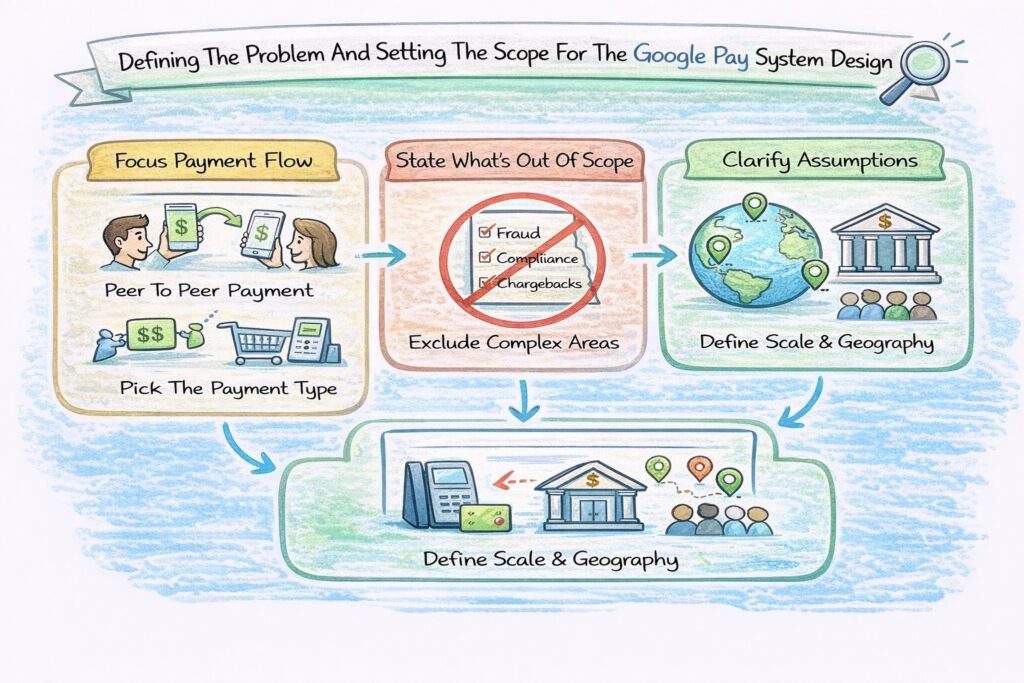
Scope control is especially important in Google Pay System Design interviews. Payment systems can quickly become overwhelming if you try to design everything at once.
Your first step should be to clearly define which payment flow you are designing. For example, you might focus on peer-to-peer payments between users or merchant checkout payments. Picking one flow allows you to go deep rather than wide.
You should explicitly state what is out of scope. Fraud detection models, regulatory compliance workflows, and chargeback resolution can be deferred unless the interviewer asks. This is not avoidance. It is a disciplined System Design.
You should also clarify assumptions about scale and geography. You can assume millions of users, global usage, and integration with existing banking infrastructure. Exact numbers are not required, but your assumptions should be realistic.
Establishing Clear Success Criteria
You should define what success looks like for the system. In Google Pay, success usually means that transactions are processed correctly, users receive clear outcomes, and failures are handled transparently.
Latency matters, but correctness matters more. It is better to be slightly slower than wrong.
The table below shows how good scope-setting improves the interview.
| Scope Decision | Interview Benefit |
|---|---|
| Single Payment Flow | Focused depth |
| Explicit Non-Goals | Reduced complexity |
| Realistic Assumptions | Credible design |
| Clear Success Criteria | Correct priorities |
Clear scope allows the rest of your design to feel intentional and confident.
Core Functional Requirements Of Google Pay
Once the scope is defined, you can describe the core functional requirements of Google Pay. These requirements describe what the system must do from a user and system perspective.
At a high level, users must be able to authenticate securely, initiate a payment, and receive confirmation of the transaction outcome. The system must validate requests, process transactions, and persist results reliably.
You should emphasize that every transaction must have a clear lifecycle. A payment is initiated, authorized, completed, or failed. Ambiguity is unacceptable.
You should also explain that the system must provide transparency. Users need to see transaction status, and the system must generate records that can be audited later.
Mapping User Actions To System Responsibilities
Strong System Design answers connect user actions to backend responsibilities. When a user initiates a payment, the system validates identity and intent. When funds are transferred, the system records ledger entries. When the transaction completes, notifications are sent.
This mapping naturally sets the stage for discussing architecture and consistency.
The table below summarizes core functional responsibilities.
| User Action | System Responsibility |
|---|---|
| Authenticate | Verify identity |
| Initiate Payment | Validate request |
| Process Transaction | Coordinate execution |
| Persist Result | Record ledger entry |
| Notify User | Communicate outcome |
By clearly defining these functional requirements, you create a solid foundation for discussing non-functional constraints, architecture, and trade-offs in the rest of the Google Pay System Design interview.
Non-Functional Requirements And Key Constraints
Non-functional requirements dominate Google Pay System Design. While functional requirements describe what the system does, non-functional requirements describe how safely, reliably, and predictably it must behave under all conditions.
Security is the most critical constraint. Payment systems handle sensitive financial data and must prevent fraud, unauthorized access, and data leakage. Authentication, authorization, encryption, and secure key management are foundational rather than optional.
Correctness and consistency come next. A transaction must be processed exactly once. Duplicate charges, lost payments, or ambiguous outcomes are unacceptable. This requirement shapes nearly every architectural decision.
Availability is also essential. Users expect Google Pay to work anytime and anywhere. Even during partial outages or external dependency failures, the system should fail gracefully and communicate clearly.
Latency matters, but it is secondary to correctness. Users tolerate slight delays if the outcome is clear and trustworthy. A fast but incorrect payment is worse than a slow but correct one.
Compliance and auditability are implicit constraints. Even if not discussed in depth, your design should make it clear that transactions are traceable and explainable.
The table below summarizes the most important non-functional constraints.
| Constraint | Why It Matters |
|---|---|
| Security | Protect financial data |
| Correctness | Prevent double or lost payments |
| Availability | Always-on usage |
| Latency | User experience |
| Auditability | Trust and compliance |
| Cost | Sustainable operation |
Calling out these constraints early signals that you understand payment systems deeply.
High-Level Architecture Of Google Pay System Design
With constraints established, you can introduce the high-level architecture. Google Pay is built as a layered, service-oriented System Designed to isolate risk and manage complexity.
At the edge, client applications handle user interaction and authentication. These clients never perform financial operations directly. They act as secure request initiators.
Backend services orchestrate payment flows. These services validate requests, enforce business rules, and coordinate with external payment networks and banks. They are stateless, and wherever possible to allow horizontal scaling.
A core ledger system records all financial state changes. This system is highly consistent, durable, and carefully controlled. Other services rely on the ledger as the source of truth.
Integration layers communicate with external banks, card networks, and merchants. These integrations are isolated to prevent external failures from propagating internally.
Why Layering Matters In Payments Systems
Layered architecture allows Google Pay to control blast radius. A failure in an external bank integration should not corrupt the internal state. A client-side error should not affect ledger integrity.
Clear boundaries also support auditing and observability. Each layer has defined responsibilities and traceable behavior.
The table below summarizes core architectural components.
| Component | Primary Responsibility |
|---|---|
| Client Apps | User interaction |
| Auth Services | Identity verification |
| Payment Orchestrator | Flow coordination |
| Ledger Service | Financial source of truth |
| Integration Layer | External communication |
| Notification Service | User updates |
Presenting architecture in layers demonstrates disciplined System Design.
Payment Flow And Transaction Lifecycle
The payment flow is the heart of the Google Pay System Design. Walking through it clearly is one of the most important parts of the interview.
The flow begins when a user initiates a payment. The client authenticates the user and sends a signed request to the backend. The backend validates the request, checks the balance or funding source, and assigns a unique transaction identifier.
Next, the system attempts authorization through the appropriate payment network or bank. This step may involve retries, timeouts, or asynchronous responses.
Once authorization succeeds, the system records the transaction in the ledger. This step must be atomic and durable. Only after the ledger is updated does the system confirm success to the user.
If any step fails, the system must ensure that partial progress does not result in an inconsistent state. Clear failure responses are essential.
Why Idempotency Is Critical
Network retries are inevitable. Clients may resend requests. External systems may respond slowly. Idempotency ensures that repeated requests do not cause duplicate transactions.
Transaction identifiers allow the system to recognize and safely handle retries.
The table below summarizes the transaction lifecycle.
| Stage | System Responsibility |
|---|---|
| Initiation | Validate intent |
| Authorization | Check funds |
| Ledger Update | Record transaction |
| Confirmation | Notify user |
| Failure Handling | Preserve consistency |
Clear lifecycle explanation signals strong payment-system understanding.
Data Modeling, Ledgers, And Consistency Guarantees
Data modeling in Google Pay revolves around the ledger. The ledger is the authoritative record of all financial activity. Every balance change is represented as a durable entry.
You should explain that ledger entries are immutable. Instead of updating balances directly, the system appends new records. This approach supports auditability and simplifies reasoning about the state.
Consistency guarantees must be strong. Ledger updates require atomic writes and strict ordering. Eventual consistency is not acceptable for core financial records.
Other systems may maintain derived views of ledger data for reporting or user interfaces. These views can be eventually consistent as long as the ledger remains authoritative.
Designing For Auditability And Recovery
Auditability is a natural byproduct of append-only ledgers. Every transaction can be traced, replayed, and verified.
Recovery is also simplified. In the event of failure, the system can rebuild the derived state from the ledger.
The table below highlights key data design principles.
| Data Aspect | Design Choice |
|---|---|
| Ledger Entries | Append-only |
| Balances | Derived state |
| Consistency | Strong guarantees |
| Ordering | Deterministic |
| Recovery | Replayable history |
When you explain data modeling this way, you demonstrate that you understand why financial systems are designed conservatively and deliberately.
Scalability, Load Handling, And Peak Traffic Events
Scalability in Google Pay System Design must be approached carefully because financial systems cannot trade correctness for performance. While user-facing systems often scale aggressively with caching and eventual consistency, payment systems require a more disciplined approach.
Google Pay must handle large volumes of transactions during peak events such as holidays, promotions, or global sales. The system achieves this by horizontally scaling stateless components like authentication, request validation, and orchestration services.
Stateful components, especially the ledger, scale through partitioning strategies that preserve ordering guarantees. Sharding is typically based on user or account identifiers to ensure consistent transaction sequencing.
Rate limiting also plays an important role. During extreme load, the system may throttle non-critical requests to protect core transaction processing.
The table below summarizes scalability strategies.
| Scalability Challenge | Design Strategy |
|---|---|
| High Request Volume | Stateless scaling |
| Ledger Throughput | Partitioned writes |
| Traffic Spikes | Rate limiting |
| Global Usage | Regional deployment |
Explaining scalability with safety in mind demonstrates maturity in payment-System Design.
Reliability, Fault Tolerance, And Failure Recovery
Reliability is non-negotiable in Google Pay. Users trust the system with their money, and failures must be handled predictably and transparently.
The system is designed to tolerate partial failures. External bank services may be slow or unavailable. Network partitions may occur. Google Pay must continue operating without corrupting the state.
Retries are carefully controlled. Automatic retries are safe only when operations are idempotent. For non-idempotent steps, the system waits for definitive outcomes rather than guessing.
Failure recovery is built around the ledger. Because all state changes are recorded durably, the system can recover by replaying ledger entries and reconciling pending transactions.
Communicating Failures Clearly
From a user perspective, clarity matters more than speed. If a transaction is pending, the system should say so explicitly rather than leaving users uncertain.
Notification systems are integrated into the flow to keep users informed of success, failure, or delays.
The table below highlights reliability mechanisms.
| Failure Scenario | System Response |
|---|---|
| Network Timeout | Safe retry |
| Bank Unavailable | Pending state |
| Service Crash | Replay ledger |
| Duplicate Request | Idempotent handling |
Clear failure handling is a strong signal of production readiness.
Trade-Offs And Design Decisions In Google Pay
Every major decision in Google Pay System Design involves trade-offs. Interviewers want to see whether you recognize and justify these decisions thoughtfully.
One common trade-off is latency versus correctness. Google Pay prioritizes correctness even if it introduces slight delays. This is the right choice for financial systems.
Another trade-off involves synchronous versus asynchronous processing. Synchronous flows provide immediate feedback but increase coupling. Asynchronous flows improve resilience but complicate user experience. Google Pay typically combines both approaches carefully.
Security versus convenience is another important consideration. Strong authentication improves safety but can introduce friction. Balancing these concerns requires judgment rather than rigid rules.
Cost is also a factor. Highly durable, strongly consistent systems are expensive. Google Pay must balance infrastructure cost with reliability and trust.
The table below summarizes key trade-offs.
| Trade-Off | Design Consideration |
|---|---|
| Latency Vs Correctness | Financial safety |
| Sync Vs Async | Resilience |
| Security Vs Convenience | User friction |
| Reliability Vs Cost | Sustainability |
Explicit trade-off discussion is one of the strongest interview signals.
How To Approach Google Pay System Design In Interviews
Approaching a Google Pay System Design interview requires discipline and clarity. You should start by defining the scope and clarifying which payment flow you are designing.
Next, explain core functional and non-functional requirements, emphasizing correctness and security. This frames the rest of the design.
You should then present the high-level architecture and walk through the payment lifecycle step by step. This allows you to explain interactions naturally.
Throughout the interview, proactively discuss failure scenarios, idempotency, and consistency guarantees. Interviewers appreciate candidates who anticipate risks.
Communication matters. Speak clearly, explain your reasoning, and adjust depth based on feedback. Treat the interviewer as a collaborator rather than a critic.
The table below shows a typical interview flow.
| Interview Phase | Focus Area |
|---|---|
| Scope Definition | Shared understanding |
| Requirements | Safety and correctness |
| Architecture | Layered design |
| Payment Flow | Transaction lifecycle |
| Trade-Offs | Judgment |
This structured approach aligns closely with Google’s interview expectations.
Using structured prep resources effectively
Use Grokking the System Design Interview on Educative to learn curated patterns and practice full System Design problems step by step. It’s one of the most effective resources for building repeatable System Design intuition.
You can also choose the best System Design study material based on your experience:
Final Thoughts
Google Pay System Design interviews test more than technical knowledge. They test whether you can design systems that people trust with their money. Correctness, clarity, and discipline matter more than cleverness.
If you approach the interview with a clear scope, strong guarantees, and thoughtful trade-offs, you demonstrate the qualities Google values in engineers working on critical systems. Mastering this approach prepares you not only for Google Pay interviews but for any System Design challenge involving correctness, reliability, and trust.