
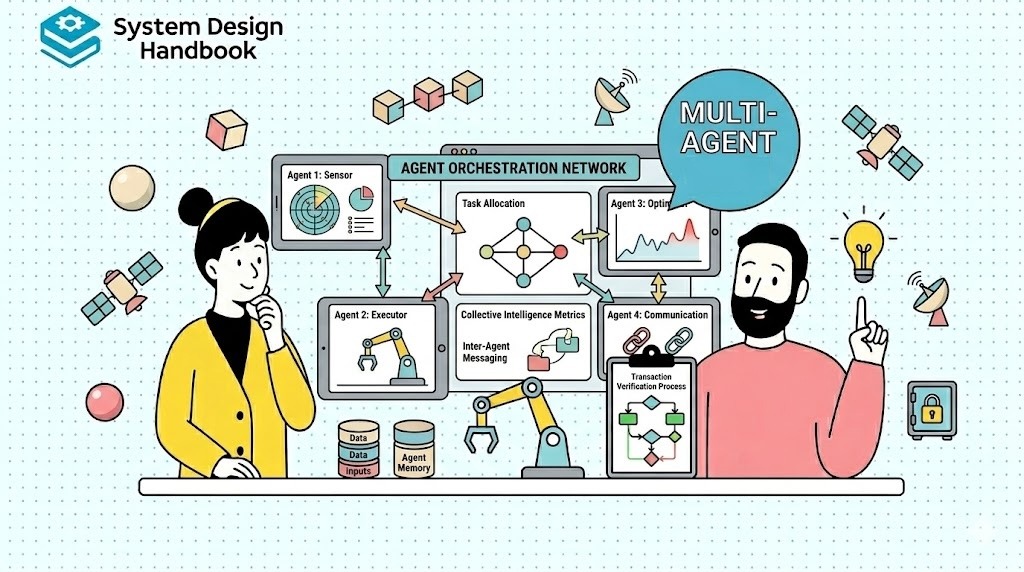
As you prepare for modern system design interviews, you will notice that expectations have evolved beyond traditional backend systems. Companies are now building AI-powered products that require coordination between multiple intelligent components rather than a single model call. This is why multi-agent system design has become an increasingly important topic in interviews.
The Rise Of Multi-Agent AI Systems
In real-world applications such as research assistants, coding copilots, and enterprise automation tools, a single agent is often not sufficient to handle complex workflows. These systems require multiple agents that specialize in different tasks, such as planning, retrieval, execution, and validation.
When you design such systems, you are essentially building a coordinated network of agents that work together toward a common goal. This adds a layer of complexity that goes beyond traditional system design problems.
What Interviewers Are Evaluating
In interviews, you are not just being tested on your knowledge of AI or system components. Instead, interviewers want to see whether you can design systems that coordinate multiple moving parts effectively while maintaining clarity and efficiency.
If your design relies on a single agent for everything, it often signals a lack of depth. On the other hand, when you break down responsibilities and introduce coordination logic, it shows that you understand how complex systems operate in production.
The Shift From Single-Agent To Collaborative Systems
Traditional AI applications often relied on a single model handling all tasks. Multi-agent systems distribute responsibilities across specialized agents, which improves scalability and modularity.
| System Type | Approach | Limitation |
|---|---|---|
| Single-Agent System | One model handles all tasks | Limited flexibility and scalability |
| Multi-Agent System | Multiple agents collaborate | Increased coordination complexity |
This shift requires you to think differently about system design, focusing on collaboration rather than centralization.
From Simple Automation To Intelligent Coordination
Early AI systems focused on automating specific tasks, but modern systems aim to solve complex problems that require multiple steps and decisions. Multi-agent architectures enable this by breaking tasks into manageable pieces and assigning them to specialized agents.
When you approach interviews with this mindset, your designs become more realistic and aligned with industry practices. This is exactly what interviewers are looking for.
Understanding What A Multi-Agent System Actually Is
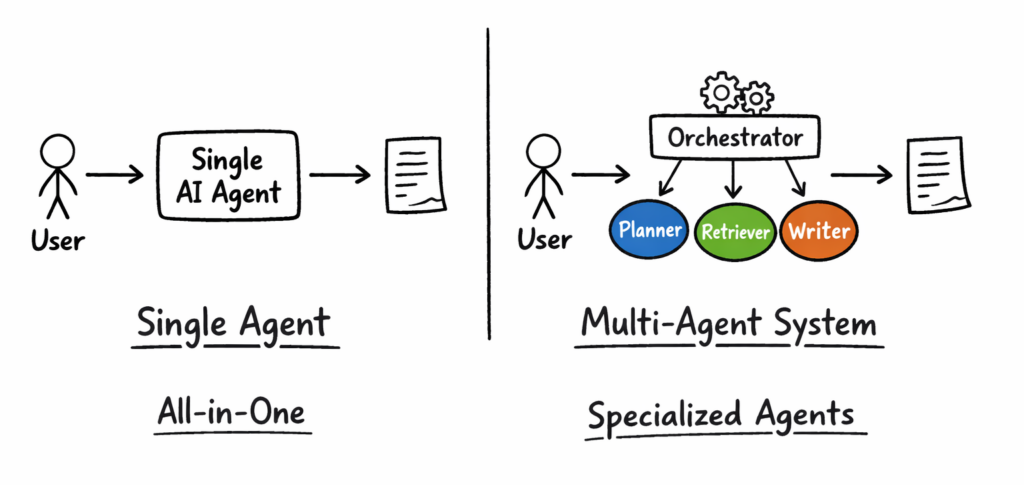
Before you can design a multi-agent system, you need to clearly understand what it is and how it differs from simpler architectures. Many candidates struggle because they use the term without fully grasping its implications.
Defining A Multi-Agent System
A multi-agent system consists of multiple independent or semi-independent agents that collaborate to achieve a shared objective. Each agent is responsible for a specific role, and together they form a coordinated system.
These agents can operate sequentially or in parallel, depending on the task. The key idea is that no single agent handles everything, which allows for greater flexibility and specialization.
How Multi-Agent Systems Differ From Single-Agent Systems
In a single-agent system, all logic is centralized within one component, which simplifies design but limits scalability. Multi-agent systems distribute logic across multiple components, which introduces coordination but enables more complex workflows.
| Aspect | Single-Agent System | Multi-Agent System |
|---|---|---|
| Responsibility | Centralized | Distributed |
| Complexity | Lower | Higher |
| Flexibility | Limited | High |
| Scalability | Constrained | Improved |
Understanding this distinction helps you choose the right architecture for different use cases.
Why Specialization Improves System Design
When you assign specific roles to different agents, each agent can focus on a narrow task and perform it more effectively. For example, one agent can handle planning while another retrieves information, and another generates responses.
This specialization reduces cognitive load on each agent and improves overall system performance. It also makes the system easier to maintain and extend.
The Role Of Coordination In Multi-Agent Systems
While specialization provides benefits, it also introduces the need for coordination. Agents must communicate, share context, and align their actions to achieve the desired outcome.
This coordination layer is what makes multi-agent systems both powerful and challenging. When you understand this balance, you can design systems that leverage the strengths of multiple agents effectively.
Interview Insight: Clarity In Definition
In interviews, clearly defining what a multi-agent system is sets the foundation for your entire answer. It shows that you understand the concept before diving into implementation details.
This clarity helps you guide the conversation and build a structured response.
Core Goals Of A Multi-Agent Architecture
Once you understand what a multi-agent system is, the next step is identifying its core goals. Without clear objectives, it becomes difficult to justify architectural decisions or evaluate trade-offs.
Distributing Work Through Task Decomposition
One of the primary goals of a multi-agent system is to break down complex tasks into smaller, manageable subtasks. Each agent handles a specific part of the workflow, which makes the system more efficient and easier to reason about.
This approach allows you to tackle problems that would be difficult for a single agent to handle effectively. It also improves modularity and scalability.
Enabling Specialization And Expertise
Multi-agent systems allow you to assign specialized roles to different agents, which improves the quality of outputs. Each agent can be optimized for its specific task, whether it is planning, retrieval, or execution.
| Goal | Description | Benefit |
|---|---|---|
| Task Decomposition | Break complex tasks into subtasks | Simplifies workflows |
| Specialization | Assign roles to agents | Improves accuracy |
| Coordination | Align agent outputs | Ensures consistency |
These goals define the structure and behavior of your system.
Improving Reliability And Maintainability
By separating responsibilities, multi-agent systems become more robust and easier to maintain. If one agent fails or needs to be updated, it does not necessarily affect the entire system.
This modularity allows you to iterate and improve individual components without disrupting the overall architecture. It also makes debugging and monitoring more manageable.
Balancing Efficiency And Complexity
While multi-agent systems provide flexibility and scalability, they also introduce additional complexity. You need to manage communication, synchronization, and resource allocation across agents.
This creates a trade-off between efficiency and complexity, which you must address in your design. Understanding this balance is critical for building effective systems.
Interview Insight: Designing With Purpose
In interviews, explaining the goals of your architecture helps you justify your design choices. It shows that your decisions are driven by clear objectives rather than arbitrary preferences.
This approach makes your answers more structured and persuasive.
Key Components Of A Multi-Agent System
To design a multi-agent system effectively, you need to identify its core components and understand how they interact. This structured approach helps you create a clear and comprehensive architecture.
Breaking The System Into Components
A multi-agent system is composed of several interconnected components, each responsible for a specific function. These components work together to process requests, coordinate agents, and produce results.
When you break the system into components, you make it easier to design, explain, and optimize. This is especially important in interviews where clarity is key.
Core Architectural Components
Most multi-agent systems include a set of fundamental components that define their structure.
| Component | Role | Example Function |
|---|---|---|
| Orchestrator | Coordinates agents | Task routing and control |
| Agents | Perform specialized tasks | Planning, retrieval, execution |
| Memory Layer | Stores context | Shared knowledge and history |
| Tool Layer | External integrations | APIs, databases, services |
| Communication Layer | Enables interaction | Messaging and data exchange |
Each of these components plays a critical role in the system’s operation.
How Components Work Together
The orchestrator receives a user request and determines how to break it down into subtasks. These tasks are then assigned to appropriate agents, which may interact with the memory and tool layers to complete their work.
The results are combined and returned to the user, completing the workflow. This coordinated process is what defines a multi-agent system.
The Importance Of The Orchestrator
The orchestrator is often considered the central component because it manages the flow of tasks and ensures that agents work together effectively. It acts as the decision-making layer that keeps the system organized.
Without a well-designed orchestrator, the system can become chaotic and inefficient. This is why it is often a focal point in system design discussions.
Interview Insight: Structuring Your Architecture Clearly
In interviews, clearly identifying components helps you present a well-organized design. It allows you to guide the interviewer through your system step by step.
This structured approach not only improves communication but also demonstrates your ability to handle complex systems effectively.
Designing The Orchestration And Control Layer
Once you have defined the core components of your multi-agent system, the next step is designing how those components are coordinated. The orchestration layer acts as the control center of your system, ensuring that agents work together in a structured and efficient way. Without this layer, even well-designed agents can become disorganized and ineffective.
What The Orchestration Layer Actually Does
The orchestration layer receives the initial user request and determines how to process it. It breaks the request into smaller tasks, assigns those tasks to appropriate agents, and manages the flow of information between them.
This layer is not just about routing requests but about making decisions that shape the entire workflow. It ensures that the system behaves predictably and efficiently, even as complexity increases.
Centralized Vs Decentralized Orchestration
There are different approaches to orchestration, each with its own advantages and trade-offs. A centralized orchestrator manages all decisions, while a decentralized approach allows agents to coordinate among themselves.
| Approach | Advantage | Trade-Off |
|---|---|---|
| Centralized Orchestration | Clear control and easier debugging | Single point of failure |
| Decentralized Coordination | More flexibility and resilience | Higher complexity |
Choosing the right approach depends on the scale and requirements of your system.
Task Routing And Workflow Management
One of the key responsibilities of the orchestrator is deciding which agent should handle each part of the task. This involves understanding the capabilities of each agent and matching them to the requirements of the request.
In more advanced systems, the orchestrator may dynamically adjust workflows based on intermediate results. This adds flexibility but also increases complexity, which needs to be managed carefully.
Handling Failures And Retries
The orchestration layer also plays a critical role in handling failures. If an agent fails or produces an invalid result, the orchestrator must decide whether to retry, switch to another agent, or return an error.
Including these mechanisms ensures that your system remains robust under real-world conditions. It also demonstrates that you are thinking about reliability, not just functionality.
Interview Insight: The System’s Control Center
In interviews, the orchestration layer is often where strong candidates differentiate themselves. When you clearly explain how tasks are coordinated and managed, you show that you understand the system at a deeper level.
This is a key signal that you can design systems that are both complex and well-organized.
Agent Roles, Specialization, And Task Decomposition
Once you have an orchestration layer in place, the next step is defining how work is distributed across agents. This involves assigning roles, designing specialization, and breaking tasks into manageable pieces.
Why Specialization Matters
In multi-agent systems, each agent is designed to perform a specific function. This specialization allows agents to operate more efficiently and produce higher-quality results.
For example, one agent may focus on planning tasks, while another retrieves data and another generates responses. This division of responsibilities improves both performance and maintainability.
Designing Agent Roles
Defining clear roles for agents is essential for avoiding overlap and confusion. Each agent should have a well-defined purpose and set of capabilities.
| Agent Role | Responsibility | Example |
|---|---|---|
| Planner Agent | Breaks tasks into subtasks | Creates execution plan |
| Retrieval Agent | Fetches relevant data | Queries database or APIs |
| Execution Agent | Performs actions | Generates responses |
| Validator Agent | Checks output quality | Ensures correctness |
This structure allows the system to handle complex workflows more effectively.
Task Decomposition Strategies
Task decomposition involves breaking a complex request into smaller, independent tasks that can be handled by different agents. This process is often guided by the orchestrator and depends on the nature of the problem.
By decomposing tasks, you reduce complexity and make it easier for each agent to perform its role. This approach also enables parallel processing, which can improve performance.
Balancing Granularity And Efficiency
While decomposition is useful, breaking tasks into too many small pieces can introduce overhead and coordination challenges. You need to find the right balance between granularity and efficiency.
When you design your system, consider how tasks can be grouped logically without creating unnecessary complexity. This balance is an important part of system design.
Interview Insight: Designing With Roles In Mind
In interviews, clearly defining agent roles shows that you understand how to structure complex systems. It demonstrates that you are not just adding agents but organizing them in a meaningful way.
This level of clarity makes your design more convincing and easier to follow.
Communication Patterns Between Agents
Once agents are defined, the next challenge is enabling them to communicate effectively. Communication is what allows agents to share information, coordinate actions, and produce coherent results.
Why Communication Design Is Critical
In a multi-agent system, poor communication can lead to inconsistent outputs, duplicated work, or system inefficiencies. This makes communication patterns a critical part of your design.
When you design communication carefully, you ensure that agents can collaborate seamlessly. This improves both performance and reliability.
Types Of Communication Patterns
There are several ways agents can communicate, each suited to different scenarios.
| Communication Type | Description | Use Case |
|---|---|---|
| Direct Messaging | Agents communicate directly | Simple workflows |
| Shared Memory | Agents access common data store | Context sharing |
| Message Queues | Asynchronous communication | Scalable systems |
| Event-Driven | Trigger-based interactions | Complex workflows |
Understanding these patterns helps you choose the right approach for your system.
Synchronous Vs Asynchronous Communication
Communication can be synchronous, where agents wait for responses, or asynchronous, where they proceed independently. Each approach has its own trade-offs.
Synchronous communication is simpler but can increase latency, while asynchronous communication improves scalability but adds complexity. Choosing between them depends on your system’s requirements.
Avoiding Bottlenecks And Conflicts
As systems grow, communication can become a bottleneck if not designed properly. For example, too many agents accessing shared resources simultaneously can lead to contention.
Designing mechanisms such as rate limiting, caching, and efficient messaging helps mitigate these issues. This ensures that your system remains scalable and efficient.
Interview Insight: Thinking About Collaboration
In interviews, discussing communication patterns shows that you understand how agents work together. It demonstrates that you are thinking about the system as a collaborative network rather than isolated components.
This perspective is essential for designing effective multi-agent systems.
Memory And Context Management In Multi-Agent Systems
Memory and context management is one of the most challenging aspects of multi-agent system design. Since multiple agents are working together, they need access to shared and consistent information to perform their tasks effectively.
Why Memory Is Essential
Agents rely on context to make decisions and produce meaningful outputs. Without proper memory management, agents may operate with incomplete or inconsistent information.
This can lead to errors, inefficiencies, and poor user experience. Designing a robust memory system ensures that agents have the information they need when they need it.
Types Of Memory In Multi-Agent Systems
Memory in multi-agent systems can be categorized based on its scope and persistence.
| Memory Type | Description | Example |
|---|---|---|
| Short-Term Memory | Temporary task context | Current workflow state |
| Long-Term Memory | Persistent knowledge | Historical data |
| Shared Memory | Accessible by all agents | Common context store |
Each type plays a role in ensuring that the system operates effectively.
Using Vector Databases And Context Stores
Vector databases are commonly used to store embeddings, which allow agents to retrieve relevant information based on similarity. This enables efficient context retrieval in complex systems.
In addition to vector databases, traditional data stores can be used to maintain structured information. Combining these approaches provides a comprehensive memory solution.
Managing Context Consistency
One of the biggest challenges is ensuring that all agents operate with a consistent context. In distributed systems, maintaining consistency can be difficult due to latency and synchronization issues.
Designing mechanisms for updating and sharing context ensures that agents remain aligned. This is critical for producing coherent outputs.
Context Summarization And Optimization
As workflows become more complex, the amount of context can grow significantly. Summarizing context helps reduce overhead and improve efficiency without losing essential information.
This approach is particularly useful in long-running workflows where context needs to be managed carefully. It also helps reduce computational costs.
Interview Insight: Designing With Memory Awareness
In interviews, addressing memory and context management shows that you understand one of the most complex aspects of multi-agent systems. It demonstrates that your design is capable of handling real-world scenarios where information must be shared and maintained.
This level of depth often distinguishes strong candidates from others who focus only on high-level components.
Tool Use, External Integrations, And Execution Safety
As your multi-agent system evolves, agents often need to interact with external systems to complete tasks. This includes calling APIs, querying databases, executing code, or triggering workflows. Designing this layer correctly ensures that your system is both powerful and safe.
Why Tool Integration Is Essential
Agents are most useful when they can act beyond pure reasoning and interact with real-world systems. For example, a retrieval agent may need to query a database, while an execution agent may need to call an external API.
This ability to use tools transforms your system from a passive assistant into an active problem-solving system. However, it also introduces risks that must be carefully managed.
Types Of Tools And Integrations
Multi-agent systems typically interact with a variety of external tools, each serving a different purpose.
| Tool Type | Function | Example |
|---|---|---|
| APIs | Fetch or send data | Payment or search APIs |
| Databases | Retrieve structured data | User profiles or logs |
| Code Execution | Perform computations | Running scripts |
| Workflow Systems | Trigger actions | Sending emails or alerts |
Understanding these integrations helps you design systems that are both functional and extensible.
Ensuring Safe Execution
When agents interact with external systems, there is always a risk of unintended actions. This makes execution safety a critical concern in multi-agent architectures.
You need to define clear boundaries around what each agent can do and validate all inputs and outputs. This ensures that your system behaves predictably and avoids harmful actions.
Validation And Permission Layers
To maintain safety, you can introduce validation layers that check whether actions are allowed before execution. This includes verifying inputs, enforcing permissions, and monitoring outputs.
These safeguards prevent misuse and ensure that agents operate within defined constraints. This is especially important in systems that handle sensitive data or critical operations.
Interview Insight: Designing For Safety And Control
In interviews, discussing execution safety shows that you understand the risks associated with powerful systems. It demonstrates that your design is not only functional but also responsible.
This level of awareness is a strong signal of engineering maturity.
Reliability, Observability, And Failure Handling
As your system becomes more complex, ensuring reliability becomes a top priority. Multi-agent systems involve multiple components interacting with each other, which increases the likelihood of failures. Designing for reliability ensures that your system remains stable and dependable.
Why Reliability Is Challenging In Multi-Agent Systems
In multi-agent systems, failures can occur at multiple points, including individual agents, communication channels, or external integrations. These failures can propagate through the system if not handled properly.
This makes it essential to design mechanisms that detect and mitigate failures quickly. Without these mechanisms, your system may produce inconsistent or incorrect results.
Observability And Monitoring
Observability allows you to understand how your system behaves in real time. By tracking metrics and logs, you can identify issues and optimize performance.
| Monitoring Area | What You Track | Why It Matters |
|---|---|---|
| Task Execution | Agent workflows | Detect bottlenecks |
| Errors | Failed operations | Improve reliability |
| Latency | Response times | Ensure performance |
| Resource Usage | System load | Optimize efficiency |
These insights help you maintain control over your system.
Designing For Failure Handling
Failure handling involves creating strategies to manage errors without disrupting the entire system. This includes retry mechanisms, fallback strategies, and timeouts.
For example, if one agent fails, the orchestrator can reroute the task to another agent or return a partial result. This ensures that the system remains functional even under adverse conditions.
Preventing Infinite Loops And Deadlocks
Multi-agent systems can sometimes enter loops where agents repeatedly call each other without making progress. This can lead to inefficiencies and system instability.
Designing safeguards, such as iteration limits and state tracking, helps prevent these issues. This ensures that your system remains efficient and predictable.
Interview Insight: Designing For Real-World Conditions
In interviews, discussing reliability and failure handling shows that you are thinking beyond ideal scenarios. It demonstrates that your system is designed to operate under real-world conditions.
This level of detail often distinguishes strong candidates from others.
Scaling Multi-Agent Systems In Production
Once your system is reliable, the next challenge is scaling it to handle real-world workloads. Multi-agent systems can become resource-intensive, especially as the number of agents and tasks increases.
Why Scaling Multi-Agent Systems Is Complex
Scaling multi-agent systems involves managing both computational resources and coordination complexity. As more agents are added, communication overhead and synchronization challenges increase.
This means you need to design systems that can scale efficiently without becoming overly complex or expensive.
Scaling The Orchestration Layer
The orchestrator is a critical component that must scale to handle incoming requests. This often involves making the orchestrator stateless and distributing it across multiple instances.
| Component | Scaling Strategy | Benefit |
|---|---|---|
| Orchestrator | Stateless replication | Handles high request volume |
| Agents | Independent scaling | Flexible resource allocation |
| Communication Layer | Distributed messaging | Improved throughput |
This approach ensures that your system can handle increased demand.
Managing Concurrent Workflows
In production systems, multiple workflows may be executed simultaneously. This requires careful management of resources to avoid contention and ensure fair usage.
Techniques such as task scheduling and prioritization help manage concurrency effectively. This ensures that your system remains responsive under load.
Balancing Cost And Performance
Scaling often increases costs, which means you need to balance performance improvements with financial constraints. Efficient resource utilization and optimization strategies are essential for maintaining sustainability.
When you design with cost in mind, you create systems that are both scalable and economically viable.
Interview Insight: Thinking At Scale
In interviews, scaling discussions are a key indicator of your system design skills. When you can explain how your system handles growth and increased complexity, you demonstrate a deep understanding of real-world challenges.
This ability to think at scale is essential for designing modern AI systems.
How To Answer Multi-Agent System Design Questions In Interviews
Understanding multi-agent systems is important, but being able to communicate your design effectively is what ultimately determines your success in interviews. Structuring your answer clearly helps you convey your ideas with confidence.
Starting With Requirements And Use Case
A strong answer begins with understanding the problem and clarifying requirements. This includes identifying the type of application, expected workflows, and performance constraints.
By starting with requirements, you ensure that your design is aligned with the problem. This also demonstrates a structured approach to problem-solving.
Defining Components And Architecture
Once you understand the requirements, you should outline the main components of your system. This includes the orchestrator, agents, memory, and communication layers.
Explaining how these components interact helps the interviewer follow your thought process. It also ensures that your design is comprehensive.
Explaining Task Flow And Coordination
After defining components, you should describe how tasks flow through the system. This includes how the orchestrator assigns tasks and how agents collaborate to complete them.
This step shows that you understand the dynamic behavior of the system, not just its static structure.
Discussing Trade-Offs And Optimization
Finally, you should address trade-offs such as latency, complexity, and cost. This demonstrates that you are thinking critically about your design.
When you explain these trade-offs clearly, you show that you can make informed decisions in real-world scenarios.
Interview Insight: Clarity And Structure Win
In interviews, your goal is to show how you think rather than just what you know. A clear and structured approach makes your answers more compelling and easier to understand.
This ability to communicate effectively is just as important as your technical knowledge.
Using structured prep resources effectively
Use Grokking the System Design Interview on Educative to learn curated patterns and practice full System Design problems step by step. It’s one of the most effective resources for building repeatable System Design intuition.
You can also choose the best System Design study material based on your experience:
Final Thoughts
Multi-agent system design represents the next evolution of AI architecture, where systems are no longer limited to single models but instead rely on coordinated networks of specialized agents. This shift introduces new challenges but also unlocks powerful capabilities.
As you practice designing these systems, you will begin to see patterns in orchestration, communication, and memory management. These patterns help you approach complex problems with confidence and clarity.
If you carry this mindset into your interviews, your answers will stand out because they reflect real-world engineering thinking. You will not just design systems that work, but systems that are scalable, reliable, and capable of handling complex workflows.