

Designing Slack is a popular System Design interview problem because it tests a candidate’s ability to reason about real-time systems at scale. Unlike simpler CRUD-based applications, Slack introduces challenges such as low-latency message delivery, ordering guarantees, fan-out to many recipients, and high availability under constant load.
Interviewers favor this problem because it reflects modern collaboration tools that engineers interact with daily. It also allows interviewers to evaluate how candidates balance correctness, performance, and scalability without requiring deep domain-specific knowledge. A strong answer demonstrates comfort with distributed systems concepts while remaining grounded in practical product behavior.

What Interviewers Are Evaluating
When interviewers ask candidates to design Slack, they are not looking for an exact replica of the production system. Instead, they are evaluating how candidates structure open-ended problems, clarify requirements, and reason about architectural tradeoffs.
Interviewers pay close attention to how candidates think about real-time communication, data durability, and system reliability. They also evaluate communication skills, particularly how clearly candidates explain message flow, failure handling, and consistency expectations.
Expected Scope In Interviews
In a typical interview setting, the scope is intentionally constrained. Candidates are expected to focus on core messaging features such as channels, direct messages, and message delivery. Advanced features like file sharing, third-party integrations, or workflow automation are usually considered out of scope unless explicitly introduced.
Recognizing and articulating this scope early helps candidates stay focused and prevents unnecessary complexity, which is a common pitfall in System Design interviews.
Clarifying Requirements And Scope
A strong answer to designing Slack always begins with clarifying requirements. Real-time messaging systems have many implicit assumptions, and failing to surface them early can lead to incorrect architectural choices.
Interviewers expect candidates to ask questions before proposing solutions. This demonstrates structured thinking and shows that the candidate understands that System Design is driven by requirements rather than tools or patterns.
Core Functional Requirements
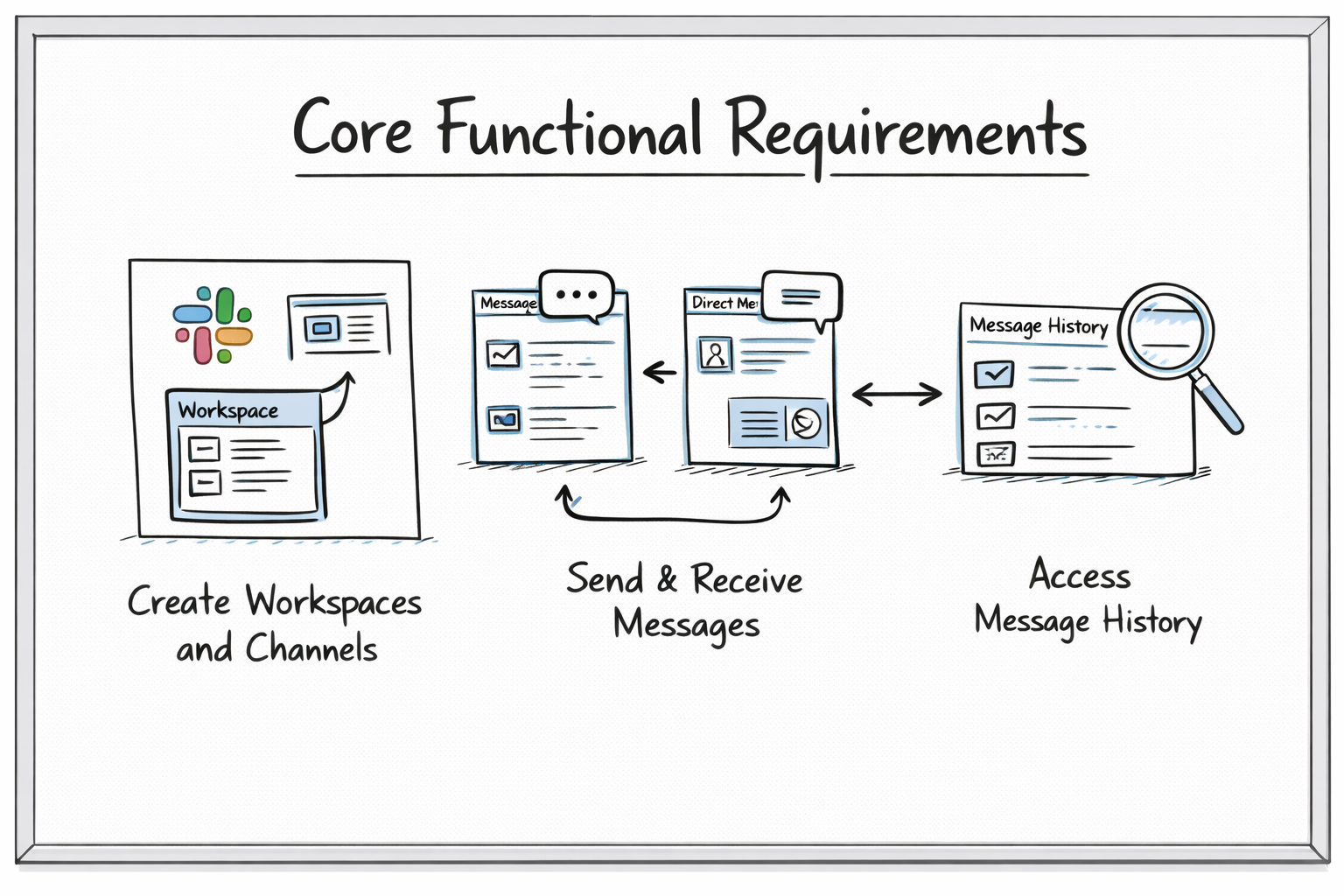
At a functional level, Slack exists to enable communication within teams. In interviews, candidates are expected to focus on fundamental interactions rather than edge cases.
Core functionality typically includes creating workspaces and channels, sending messages to channels or individual users, and receiving messages in near real time. Message history should be accessible so users can view past conversations even after reconnecting.
Non-Functional Requirements And Constraints
Non-functional requirements are especially important in real-time systems. Interviewers want candidates to acknowledge expectations around low latency, high availability, and reasonable message ordering.
Slack-like systems must handle large numbers of concurrent connections while remaining responsive. Candidates should also consider scalability across many organizations and geographic regions.
Defining What Is Out Of Scope
Clearly defining what is not included helps keep the discussion focused. Features such as advanced analytics, enterprise compliance tooling, or AI-driven summarization are typically out of scope unless explicitly requested.
Calling out exclusions demonstrates good judgment and allows the interview to focus on core architectural challenges rather than peripheral features.
High-Level System Architecture
After clarifying requirements, candidates should move to a high-level architectural overview. This step establishes the foundation for deeper discussion and allows interviewers to assess whether the candidate can reason about the system holistically.
At a high level, Slack consists of client applications, backend messaging services, and persistent storage systems. Each component has a clear responsibility, and a clean separation of concerns is essential for scalability and maintainability.
Client, Messaging, And Storage Layers
Client applications include web, desktop, and mobile clients responsible for rendering the user interface and maintaining real-time connections. These clients communicate with backend services using persistent connections such as WebSockets.
The messaging layer handles message ingestion, ordering, and fan-out. It acts as the central coordination point for real-time communication. The storage layer ensures that messages are durably stored and can be retrieved later for history and search.
The table below summarizes the responsibilities of each layer.
| Layer | Responsibility |
| Client Layer | User Interaction And Real-Time Connections |
| Messaging Services | Message Routing And Delivery |
| Storage Layer | Durable Message Persistence |
High-Level Message Flow
A typical message flow begins when a user sends a message from a client. The message is transmitted to a backend service, validated, and persisted. Once stored, it is delivered to all relevant recipients who are currently connected.
Interviewers expect candidates to explain this flow clearly before diving into optimizations or failure scenarios. A clear end-to-end explanation demonstrates strong system-level understanding.
API Design And Core Endpoints
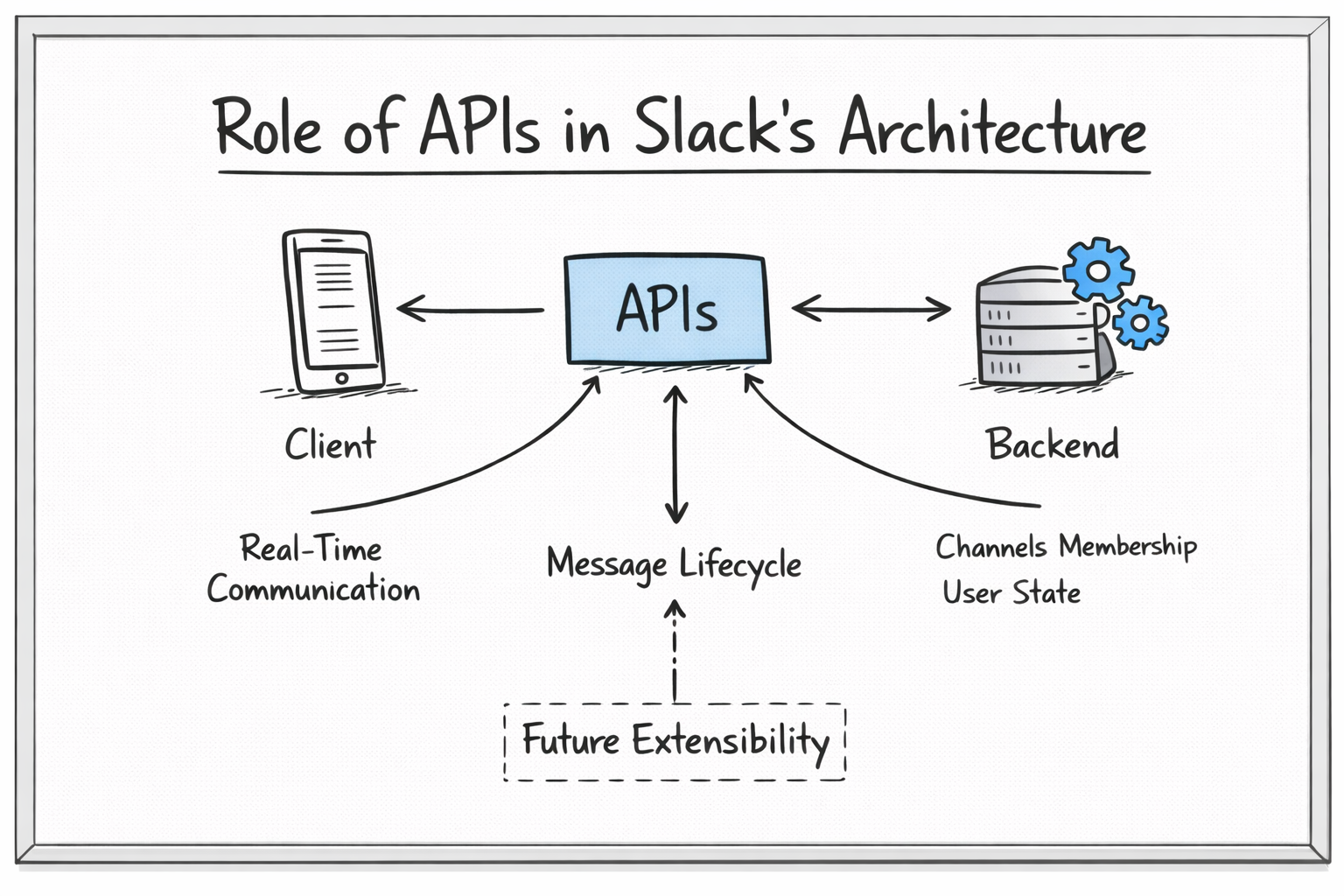
APIs define how clients interact with the backend and are a critical part of the design of Slack. Interviewers look for APIs that support real-time communication while remaining simple and scalable.
Good API design reflects a clear understanding of message lifecycle, channel membership, and user state. It also supports future extensibility without tightly coupling clients to backend internals.
Messaging APIs
Messaging APIs allow clients to send and receive messages. In interviews, candidates should explain how messages are sent to the server and how clients subscribe to message streams.
Interviewers often probe how APIs handle acknowledgments, retries, and idempotency, especially under unreliable network conditions.
Channel And Workspace APIs
Channel and workspace APIs manage metadata such as channel creation, membership, and permissions. These APIs are typically less latency-sensitive than messaging APIs but must remain consistent and reliable.
Candidates should explain how these APIs support large organizations with many users and channels.
Presence And Notification APIs
Presence APIs allow clients to track whether users are online or offline. Notification APIs support alerting users when messages arrive, and they are not actively connected.
These APIs often involve tradeoffs between accuracy and scalability, which interviewers may explore in follow-up questions.
The table below summarizes the core API categories discussed in Slack System Design interviews.
| API Category | Purpose |
| Messaging APIs | Send And Receive Messages |
| Channel APIs | Manage Conversations And Membership |
| Presence APIs | Track User Availability |
| Notification APIs | Deliver Alerts |
Data Modeling And Storage Design
When you design Slack, data modeling plays a central role because the system must support extremely high write throughput while still allowing fast reads for message history and search. Interviewers closely examine how candidates structure data to support these competing demands.
Messaging systems differ from typical CRUD applications because data is append-heavy. Messages are rarely updated or deleted, but they are written constantly and read frequently. Strong candidates design data models that reflect this reality rather than forcing traditional relational patterns.
Core Data Entities And Relationships
At a minimum, the system revolves around users, workspaces, channels, and messages. Messages belong to channels or direct conversations, channels belong to workspaces, and users can participate in many channels across multiple workspaces.
Interviewers expect candidates to describe these relationships clearly and explain how they influence storage decisions. For example, message data is often partitioned by channel to preserve ordering and improve write scalability.
Schema Design For High Write Volume
Because messages are immutable, schemas are typically optimized for sequential writes. Each message includes metadata such as sender, timestamp, and channel identifier, which enables efficient retrieval of message history.
Candidates should explain how indexing is minimized on write-heavy paths and shifted toward read-heavy secondary systems such as search indexes. This demonstrates an understanding of performance tradeoffs at scale.
Storage Technology Choices
Designing Slack typically involves multiple storage systems rather than a single database. Interviewers value candidates who choose storage technologies based on access patterns rather than convenience.
The table below illustrates how different data types are commonly stored.
| Data Type | Storage Choice | Reason |
| Messages | Distributed Log Or Database | High Write Throughput |
| Channels | Relational Store | Structured Metadata |
| Users | Relational Or Document Store | Consistency And Lookup |
| Search Index | Search Engine | Fast Text Queries |
Real-Time Messaging And Delivery
Real-time messaging is the defining challenge of designing Slack. Users expect messages to appear almost instantly, even when thousands of people are active simultaneously.
Interviewers want candidates to explain why maintaining low latency at scale is difficult. Factors such as network variability, connection management, and fan-out complexity all contribute to these challenges.
Persistent Connections And Message Delivery
Clients typically maintain persistent connections to backend services to receive messages in real time. Candidates should explain how these connections enable push-based delivery rather than constant polling.
Interviewers often probe how the system handles reconnects, dropped connections, and message resynchronization. Strong answers explain how message offsets or timestamps allow clients to recover missed messages.
Fan-Out Strategies
When a message is sent to a channel, it may need to be delivered to many recipients. Candidates should explain how the system avoids sending duplicate messages inefficiently.
Fan-out can occur at write time or read time, and interviewers often ask candidates to compare these approaches. Discussing these tradeoffs demonstrates an understanding of scalability challenges.
Ordering Guarantees
Maintaining message order within a channel is important for user experience. Candidates should explain how ordering is preserved logically, even if messages are processed by distributed systems behind the scenes.
Interviewers do not expect formal proofs but do expect awareness that ordering constraints influence partitioning and storage decisions.
Presence, Notifications, And User Experience
Presence indicates whether a user is online, offline, or idle. When you design Slack, presence must update frequently while remaining scalable across millions of users.
Interviewers want candidates to recognize that perfect accuracy is not always achievable. Presence is often approximate, and slight delays are acceptable if they improve system stability.
Presence State Propagation
Candidates should explain how presence updates are propagated to other users. Broadcasting every state change to all clients is not scalable, so updates are typically scoped to relevant channels or conversations.
This discussion allows interviewers to assess whether candidates understand selective data distribution and load reduction techniques.
Notification Delivery
Notifications ensure that users are alerted to new messages when they are not actively viewing a channel. Candidates should explain how notifications differ from real-time message delivery.
Interviewers often explore how notification systems integrate with messaging systems without becoming bottlenecks. Explaining asynchronous notification delivery demonstrates sound architectural thinking.
Tradeoffs Between Accuracy And Scalability
Presence and notifications both involve tradeoffs. Highly accurate systems generate significant load, while scalable systems accept small inaccuracies.
The table below summarizes these tradeoffs.
| Feature | Design Priority | Accepted Tradeoff |
| Presence | Scalability | Approximate State |
| Notifications | Reliability | Delivery Delay |
| Real-Time UI | Responsiveness | Occasional Reconnect |
Scalability And Performance Optimization
When you are designing Slack, traffic patterns are continuous and bursty. Message traffic is spread across many channels, but popular channels can generate sudden spikes.
Interviewers expect candidates to recognize these patterns and explain how architecture adapts to uneven load.
Partitioning And Load Distribution
Partitioning is essential for scalability. Candidates should explain how messages are partitioned, often by channel or workspace, to distribute load evenly across servers.
Interviewers may ask how the system handles hot channels. Strong candidates discuss techniques such as dynamic rebalancing or isolating high-traffic channels.
Caching And Reuse Of Metadata
While messages themselves are write-heavy, metadata such as channel membership and user profiles is read frequently. Caching this data reduces load on primary storage systems.
Candidates should explain how caches are kept reasonably up to date without becoming consistency bottlenecks.
Avoiding Common Performance Bottlenecks
Interviewers look for awareness of bottlenecks such as connection limits, hot partitions, and slow consumers. Strong candidates explain how monitoring and incremental tuning help identify and resolve these issues over time.
The table below summarizes common scalability challenges and corresponding optimizations.
| Challenge | Optimization Approach |
| High Message Volume | Partitioned Storage |
| Fan-Out Load | Asynchronous Processing |
| Hot Channels | Load Isolation |
| Connection Scale | Stateless Services |
Consistency, Reliability, And Fault Tolerance
In design Slack, consistency requirements vary depending on the type of data. Interviewers expect candidates to recognize that messages within a channel should appear in order, but global strong consistency across all users and devices is not strictly required.
Strong candidates explain that eventual consistency is acceptable for most reads, especially when it improves availability and scalability. They also clarify which operations require stronger guarantees, such as confirming that a message has been durably stored before acknowledging it to the sender.
Handling Partial Failures
Partial failures are common in distributed messaging systems. Interviewers want to see how candidates design systems that degrade gracefully rather than failing completely.
For example, if a messaging node becomes unavailable, users should still be able to send messages through other nodes. Temporary delays in message delivery are preferable to message loss. Explaining how the system isolates failures demonstrates production-level thinking.
Data Replication And Durability
Message durability is critical because users expect their conversations to persist. Candidates should explain how messages are replicated across multiple storage nodes to prevent data loss.
Interviewers do not expect low-level replication algorithms but do expect an understanding of why redundancy and backups are necessary to meet reliability goals.
The table below summarizes reliability-related design choices.
| Aspect | Design Choice | Rationale |
| Message Writes | Acknowledge After Persistence | Prevent Data Loss |
| Reads | Eventually Consistent | Improve Availability |
| Storage | Replicated Data | Fault Tolerance |
Search And Message History
Search is a core feature in Slack-like systems because conversations accumulate quickly. Interviewers expect candidates to explain how search is supported without slowing down the primary messaging path.
Strong candidates treat search as a secondary system that consumes message data asynchronously rather than blocking real-time delivery.
Indexing Messages For Efficient Retrieval
Messages are indexed for text search using specialized search systems. Candidates should explain how messages are written to storage first and then indexed in the background.
This approach ensures that messaging performance remains fast even if the search system experiences delays.
Tradeoffs In Search Freshness
Interviewers often ask whether newly sent messages appear immediately in search results. Strong candidates explain that slight delays are acceptable and common.
This demonstrates an understanding that search freshness can be traded for system stability and throughput.
The table below highlights search-related tradeoffs.
| Concern | Design Decision |
| Search Latency | Asynchronous Indexing |
| Freshness | Near-Real-Time |
| Messaging Performance | Prioritized Over Search |
Bottlenecks, Tradeoffs, And Alternative Designs
Interviewers often ask candidates to identify where the system might fail under load. In Slack design, common bottlenecks include hot channels with heavy activity, connection limits, and message fan-out pressure.
Strong candidates proactively discuss these issues and explain how they are mitigated.
Tradeoff Analysis In Key Architectural Decisions
Every design choice involves tradeoffs. Interviewers value candidates who clearly articulate what they gain and what they sacrifice.
For example, pushing messages in real time improves user experience but increases server load. Explaining why this tradeoff is acceptable shows thoughtful decision-making.
Alternative Designs Under Different Constraints
Candidates may be asked how the design would change if constraints shift. Supporting significantly larger workspaces or stricter ordering guarantees would require different architectural choices.
Discussing alternatives shows adaptability and depth rather than rigid thinking.
The table below summarizes tradeoffs in major design areas.
| Decision Area | Primary Approach | Alternative | Tradeoff |
| Message Delivery | Push-Based | Polling | Latency Vs Simplicity |
| Storage | Partitioned | Centralized | Scale Vs Ease |
| Consistency | Eventual | Strong | Availability Vs Correctness |
How To Answer Design Slack In Interviews
A strong answer to design Slack follows a clear and logical structure. Candidates start with requirements, move to high-level architecture, and then dive into the most challenging components, such as real-time delivery and scalability.
Interviewers appreciate candidates who guide the conversation and make their reasoning easy to follow.
Common Interview Mistakes
One common mistake is overfocusing on implementation details or naming specific technologies too early. Interviewers care more about architectural reasoning than tool selection.
Another mistake is trying to cover too many features. Depth in core areas is more impressive than shallow coverage of everything.
What A Strong Answer Signals To Interviewers
A strong answer signals that you can reason about distributed systems, communicate clearly, and design for real-world constraints. It demonstrates readiness for roles where architectural decisions have long-term impact.
Using structured prep resources effectively
Use Grokking the System Design Interview on Educative to learn curated patterns and practice full System Design problems step by step. It’s one of the most effective resources for building repeatable System Design intuition.
You can also choose the best System Design study material based on your experience:
Final Thoughts
Design Slack is a powerful System Design interview problem because it captures the complexity of real-time collaboration systems while remaining approachable. Success does not depend on memorizing architectures but on demonstrating structured thinking, clear communication, and thoughtful tradeoff analysis.
Candidates who perform well treat the interview as a collaborative design discussion. They clarify assumptions, prioritize core requirements, and explain decisions with confidence. Mastering this approach prepares you not only for design Slack but for a wide range of System Design interviews involving real-time, scalable systems.