

As databases grow from thousands of rows to millions or even billions, retrieving data efficiently becomes increasingly challenging. A query that performs well on a small dataset can become painfully slow when the database must examine every row before finding the requested information. Database indexing solves this problem by creating additional data structures that allow the database to locate records much more efficiently than scanning an entire table.
An index works much like the index at the back of a book. Instead of reading every page to find a specific topic, you first consult the index, which points you directly to the relevant pages. Similarly, a database index helps the query engine locate matching rows without inspecting every record stored in the table.
Understanding Database Indexes
A database index is a specialized data structure that stores selected column values together with references to the corresponding rows in the table. When a query filters or searches using indexed columns, the database can navigate the index first before retrieving only the rows that satisfy the query.
Without an index, the database often performs a full table scan, examining every row individually. As datasets become larger, these scans consume more CPU time, disk I/O, and memory, significantly increasing query latency.
Indexes Improve Reads
The primary purpose of an index is to accelerate data retrieval. Queries that search for specific values, filter results, perform range lookups, or sort records often execute dramatically faster when appropriate indexes are available.
Because indexes reduce the amount of data the database must examine, they improve response times while lowering resource consumption for many read-heavy workloads.
Indexes Are Not Free
Although indexes improve query performance, they also introduce additional costs. Every index consumes storage space, and every insert, update, or delete operation requires the database to maintain those indexes alongside the underlying table.
Effective indexing requires balancing faster reads against increased storage usage and slower write performance rather than indexing every column indiscriminately.
| Concept | Responsibility |
|---|---|
| Table | Stores the actual application data |
| Index | Accelerates data retrieval |
| Query | Uses indexes when beneficial |
| Full Table Scan | Examines every row sequentially |
Why Database Indexing Matters
Database indexing is one of the most important techniques for improving application performance because almost every software system depends on retrieving data efficiently. Whether users are searching products, loading dashboards, viewing social media feeds, or accessing banking transactions, the speed of database queries directly affects the overall user experience. As data volumes continue growing, properly designed indexes become essential for maintaining acceptable performance.
Rather than increasing server capacity indefinitely, engineers often achieve significant performance improvements simply by designing indexes that match application query patterns.
The Full Table Scan Problem
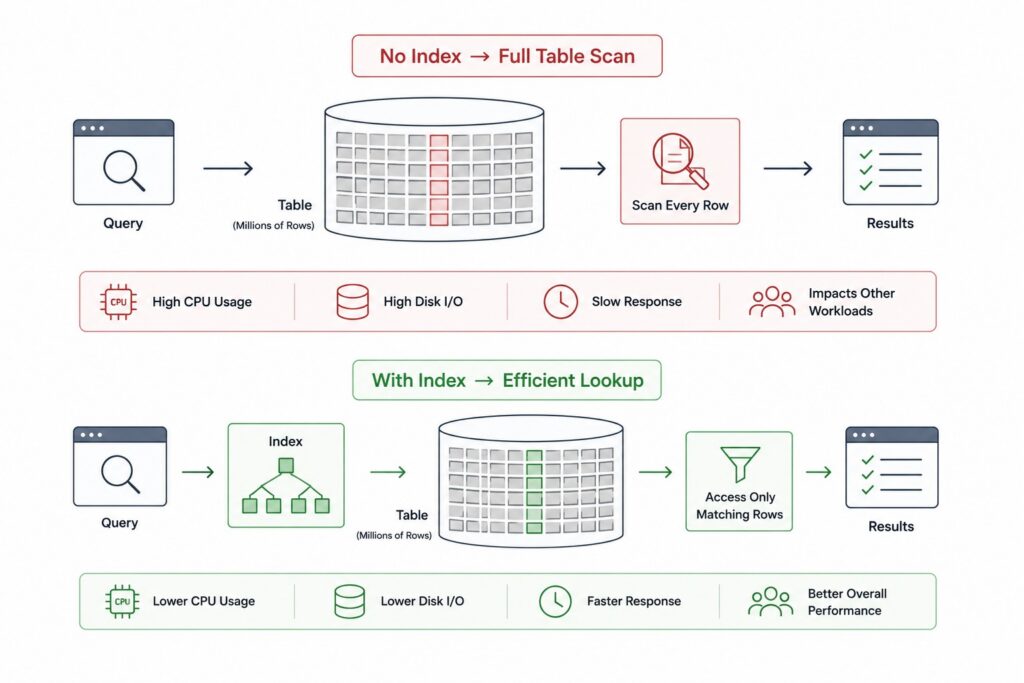
Without an appropriate index, databases frequently perform full table scans. During a scan, every row is examined until matching records are found. This process may appear acceptable when a table contains only a few thousand rows, but it becomes increasingly expensive as datasets grow into the millions.
Large scans increase CPU utilization, consume disk bandwidth, and delay responses for both the current query and other workloads sharing the same database resources.
Faster Data Retrieval
Indexes reduce the amount of data the database must inspect before finding matching rows. Instead of checking every record, the database navigates the index to locate only the relevant portion of the dataset before retrieving the corresponding table rows.
This approach significantly improves equality lookups, filtering, sorting, joins, and range queries while reducing unnecessary disk operations.
Scaling Read-Heavy Applications
Many production systems perform far more reads than writes. E-commerce websites, SaaS platforms, banking systems, social media applications, and analytics dashboards continuously retrieve information for users throughout the day.
Well-designed indexes allow these systems to support increasing query volumes without requiring proportionally larger hardware investments.
| Without Indexes | With Indexes |
|---|---|
| Frequent full table scans | Direct index lookups |
| Higher disk I/O | Fewer disk reads |
| Slower queries | Faster retrieval |
| Poor scalability | Efficient read performance |
How Database Indexes Work
Although indexes appear simple conceptually, several internal components cooperate whenever the database executes an indexed query. The database first evaluates the query, determines whether an index should be used, navigates the index structure, retrieves the corresponding rows, and finally returns the requested results. Understanding this process helps explain why indexes improve performance while also introducing additional maintenance costs.
Every database engine performs these steps somewhat differently, but the overall workflow remains remarkably consistent.
Index Lookup
When a query references indexed columns, the database first searches the index rather than scanning the table directly. Instead of examining every row, it traverses the index structure until it locates the entries matching the search criteria.
Because indexes are organized for efficient navigation, this lookup generally requires far fewer operations than a sequential scan across the entire table.
Row Pointers and Primary Keys
Indexes typically do not contain complete copies of every table row. Instead, they store indexed values together with references that identify where the corresponding records are located within the table.
Depending on the database engine, these references may consist of physical row identifiers, tuple pointers, or clustered primary keys used to locate the actual data efficiently.
Query Optimizer
Databases include sophisticated query optimizers responsible for selecting the most efficient execution strategy. Before executing a query, the optimizer estimates whether using an index will require fewer resources than performing a full table scan.
If a large percentage of the table must be read anyway, the optimizer may intentionally ignore available indexes because sequential scanning becomes more efficient than repeated index lookups.
Index Maintenance
Indexes must remain synchronized with the underlying table. Whenever rows are inserted, updated, or deleted, the database updates every affected index so future queries continue returning accurate results.
Although this maintenance introduces additional write overhead, it ensures indexed queries remain both fast and correct.
| Query Stage | Responsibility |
|---|---|
| Query Submitted | Database receives SQL request |
| Optimizer | Chooses execution strategy |
| Index Lookup | Locate matching index entries |
| Row Retrieval | Fetch actual table records |
| Results Returned | Send matching rows to application |
Common Types of Database Indexes
Modern database systems provide multiple index types because different workloads require different optimization strategies. Some indexes excel at exact-match lookups, while others support range searches, text search, geographical queries, or analytical workloads. Choosing the appropriate index depends on both the structure of the data and the queries the application executes most frequently.
Understanding these index types helps architects match database structures to real application requirements instead of relying on default indexing behavior.
B-Tree and B+ Tree Indexes
B-Tree and B+ Tree indexes are the most widely used index structures in relational databases. They maintain values in sorted order, allowing databases to perform equality lookups, range scans, sorting operations, and ordered traversals efficiently.
Because these trees remain balanced as data changes, search performance stays predictable even as tables grow substantially larger.
Hash Indexes
Hash indexes organize values using hash functions rather than sorted ordering. They are extremely efficient for exact-match lookups because the database can calculate the location of a value directly instead of traversing a tree.
However, hash indexes generally cannot support range queries or ordered scans effectively because the underlying values are not stored in sorted order.
Bitmap Indexes
Bitmap indexes are particularly effective for columns containing relatively few distinct values, such as status fields, categories, genders, or boolean flags. Instead of storing row references individually, bitmap indexes represent matching rows using compact bit arrays.
Analytical databases often benefit from bitmap indexes because they accelerate filtering across low-cardinality columns while consuming relatively little storage.
Full-Text and Geospatial Indexes
Not every query involves simple numeric or textual equality comparisons. Full-text indexes support natural language search across documents, allowing databases to locate words, phrases, and linguistic variations efficiently.
Geospatial indexes optimize location-based queries involving coordinates, distances, polygons, or nearby objects, making them essential for mapping applications, ride-sharing platforms, and logistics systems.
| Index Type | Best Use Case |
|---|---|
| B-Tree / B+ Tree | Equality, sorting, and range queries |
| Hash | Exact-match lookups |
| Bitmap | Low-cardinality analytical filtering |
| Full-Text | Document and keyword search |
| Geospatial | Location-based queries |
Clustered vs Non-Clustered Indexes
One of the most important distinctions in relational database indexing is the difference between clustered and non-clustered indexes. Although both improve query performance, they organize data differently and therefore influence storage layout, retrieval speed, and maintenance costs. Understanding this distinction helps engineers choose indexes that align with application access patterns.
The exact implementation varies across database engines, but the underlying architectural concepts remain similar.
Clustered Indexes
A clustered index determines how table data is organized logically or physically, depending on the database engine. Since the table itself follows the ordering established by the clustered index, rows containing similar key values are stored close together.
This organization makes clustered indexes particularly efficient for range queries, sequential scans, and ordered retrieval because the required rows are often located near one another on disk or within storage pages.
Non-Clustered Indexes
A non-clustered index stores indexed values separately from the underlying table while maintaining references back to the corresponding rows. Multiple non-clustered indexes can exist on the same table because they do not determine the table’s primary storage order.
These indexes provide flexible optimization for different query patterns without reorganizing the table itself.
Choosing Between Them
Clustered indexes generally perform best on columns frequently used for primary key lookups, range filtering, or sequential ordering. Non-clustered indexes are typically added to support additional search patterns involving other frequently queried columns.
Database architects usually select clustered indexes carefully because changing them later often requires substantial data reorganization.
| Clustered Index | Non-Clustered Index |
|---|---|
| Organizes table storage | Stored separately from the table |
| Usually one per table | Multiple per table |
| Excellent for range queries | Excellent for targeted lookups |
| Often built on primary keys | Built on frequently queried columns |
Composite and Covering Indexes
As applications become more sophisticated, queries often filter or sort using multiple columns simultaneously. Simple single-column indexes may no longer provide sufficient performance because the database must still examine many unnecessary rows. Composite and covering indexes address these scenarios by optimizing indexes around real query patterns rather than individual columns in isolation.
Designing these indexes effectively requires understanding how the database evaluates search conditions and retrieves data.
Composite Indexes
A composite index includes multiple columns within a single index structure. Instead of indexing customer ID and order date separately, for example, a composite index may store both values together to optimize queries filtering by both attributes simultaneously.
Composite indexes are especially useful for queries involving multiple equality conditions, sorting operations, or joins across frequently combined columns.
Leftmost Prefix Rule
Many database engines evaluate composite indexes according to the leftmost prefix rule. The optimizer can efficiently use the leading columns of a composite index, but later columns generally become useful only when the earlier indexed columns are also included in the query.
Because of this behavior, choosing the correct column order is one of the most important aspects of composite index design.
Covering Indexes
A covering index contains every column required to answer a particular query. Since all necessary information already exists inside the index, the database does not need to access the underlying table after locating matching index entries.
Avoiding additional table lookups often reduces query latency significantly, particularly for frequently executed read operations.
Tradeoffs
Although composite and covering indexes improve query performance, they also consume additional storage and increase write overhead because more index data must be maintained whenever rows change.
Architects should therefore design these indexes around frequently executed production queries rather than attempting to optimize every possible search pattern.
| Index Strategy | Primary Benefit |
|---|---|
| Composite Index | Optimize multi-column queries |
| Leftmost Prefix | Efficient use of leading indexed columns |
| Covering Index | Eliminate additional table lookups |
| Careful Column Order | Maximize optimizer effectiveness |
Selectivity, Cardinality, and Index Design
Creating an index does not automatically improve query performance. The effectiveness of an index depends heavily on the characteristics of the underlying data and the types of queries the application executes. Columns with different value distributions produce very different indexing results, which is why experienced database engineers design indexes around real workload patterns rather than simply indexing frequently used columns.
Understanding concepts such as selectivity and cardinality helps explain why some indexes dramatically improve performance while others are rarely used by the query optimizer.
Selectivity
Selectivity measures how effectively an indexed column narrows the result set. A highly selective index matches only a small percentage of rows, allowing the database to eliminate large portions of the table quickly.
Columns such as email addresses, order IDs, or usernames usually have high selectivity because each value identifies relatively few rows. These columns often make excellent index candidates because the database retrieves only a small subset of records during each lookup.
Cardinality
Cardinality refers to the number of distinct values contained within a column. High-cardinality columns contain many unique values, while low-cardinality columns contain only a small number of repeated values.
Indexes generally perform best on high-cardinality columns because they narrow the search space effectively. Columns such as status or active flags often have low cardinality, making standalone indexes less useful unless combined with other filtering conditions.
Query Patterns
Indexes should always reflect the queries an application actually executes rather than every possible access path. An index on a rarely queried column provides little benefit regardless of how selective that column may be.
Analyzing production query logs allows engineers to identify the filtering, sorting, and joining patterns that deserve optimization through carefully designed indexes.
Column Order
For composite indexes, column order significantly influences effectiveness. Equality filters are typically placed before range filters, while frequently sorted or joined columns should be positioned according to the application’s most common query patterns.
Choosing an appropriate ordering allows the database optimizer to maximize index usage across many related queries.
| Design Factor | Why It Matters |
|---|---|
| Selectivity | Reduces the number of matching rows |
| Cardinality | Determines how unique indexed values are |
| Query Patterns | Align indexes with real workloads |
| Column Order | Improves composite index utilization |
The Cost of Database Indexes
Indexes improve read performance, but they are far from free. Every additional index consumes storage, increases memory usage, and requires maintenance whenever application data changes. As databases grow larger, these costs become increasingly significant, making thoughtful index design just as important as creating indexes in the first place.
Successful database optimization is therefore about balancing faster reads against additional operational overhead rather than maximizing the number of indexes on every table.
Storage Overhead
Each index stores additional metadata alongside indexed values and row references. Depending on the size of the indexed columns and the number of rows, indexes may consume a substantial amount of disk space beyond the base table itself.
Large databases often contain indexes whose combined storage approaches or even exceeds the size of the underlying application data, making storage planning an important architectural consideration.
Write Amplification
Whenever rows are inserted, updated, or deleted, the database must modify every affected index in addition to updating the table itself. As the number of indexes grows, each write operation becomes more expensive because multiple index structures require maintenance.
Write-heavy applications require careful indexing strategies that accelerate critical queries without unnecessarily slowing transactional workloads.
Memory Pressure
Frequently accessed indexes are cached in memory to avoid repeated disk access. Large indexes compete for this limited buffer cache alongside application data, meaning unnecessary indexes can reduce the effectiveness of database caching.
Well-designed indexes improve cache utilization, while redundant or rarely used indexes waste valuable memory resources.
Maintenance Overhead
Indexes gradually become fragmented as data changes over time. Database administrators often rebuild or reorganize indexes periodically to maintain efficient access patterns. Statistics must also remain current so the query optimizer can make accurate execution decisions.
These operational tasks consume time and computing resources, making index maintenance an ongoing responsibility rather than a one-time activity.
| Cost | Impact |
|---|---|
| Storage | Additional disk usage |
| Write Amplification | Slower inserts, updates, and deletes |
| Memory Usage | Increased buffer cache consumption |
| Maintenance | Rebuilding, statistics, and monitoring |
Indexing in Distributed Databases
Indexing becomes considerably more challenging once data is distributed across multiple servers. In a single database instance, an index simply points to rows stored locally. In distributed databases, however, data may be partitioned across many nodes, requiring the indexing strategy to account for network communication, partition boundaries, and distributed query execution.
These additional considerations influence both query performance and operational complexity as systems scale horizontally.
Local Indexes
Local indexes are maintained independently within each partition or shard. Every node stores indexes only for the data it owns, allowing lookups to remain efficient as long as queries can be routed directly to the appropriate partition.
Because local indexes avoid cross-node coordination, they are generally easier to maintain and scale alongside the underlying data.
Global Indexes
Global indexes span multiple partitions, allowing queries to locate data regardless of where individual records are stored. While this simplifies certain search operations, maintaining a globally consistent index requires additional synchronization whenever data moves between partitions.
As distributed systems grow, global indexes often become operationally more expensive than local alternatives.
Secondary Indexes in NoSQL Databases
Many NoSQL databases support secondary indexes, but their implementation differs significantly from traditional relational databases. Systems such as MongoDB, DynamoDB, Cassandra, and Elasticsearch make different tradeoffs between consistency, scalability, storage overhead, and query flexibility.
Architects should understand these tradeoffs before assuming indexing behaves identically across different database technologies.
Indexing and Partitioning
Partition keys influence which node stores a particular record, making partition-aware indexing especially important. Queries that align with the partitioning strategy usually perform efficiently because only one partition must be searched.
Queries that ignore partition keys may require scanning multiple nodes, reducing the effectiveness of otherwise well-designed indexes.
| Distributed Strategy | Characteristics |
|---|---|
| Local Index | Exists within each partition |
| Global Index | Spans multiple partitions |
| Secondary Index | Additional access paths for NoSQL systems |
| Partition-Aware Design | Minimizes cross-node lookups |
Common Indexing Mistakes
Many database performance problems stem not from missing indexes but from poorly designed ones. Adding indexes without understanding workload characteristics often increases storage consumption and write latency while delivering little measurable improvement. Effective indexing requires deliberate analysis of application behavior rather than relying on general rules or assumptions.
Avoiding these common mistakes helps maintain databases that remain efficient as both data volume and application traffic increase.
Indexing Every Column
A common misconception is that more indexes always improve performance. In reality, every additional index increases storage requirements and write costs, even if the index is rarely used.
Indexes should exist only when they support meaningful production queries rather than being added preemptively to every frequently updated column.
Ignoring Query Patterns
Indexes should optimize real application workloads instead of hypothetical future requirements. Creating indexes without analyzing production queries often results in structures that consume resources while providing little practical benefit.
Monitoring query execution plans and workload statistics provides much better guidance than guessing which indexes might become useful.
Poor Composite Index Order
Composite indexes are only effective when their column order matches application access patterns. Placing less selective or rarely filtered columns first often prevents the optimizer from taking full advantage of the index.
Carefully analyzing filtering, sorting, and join conditions helps determine the most appropriate column ordering.
Indexing Low-Selectivity Columns Incorrectly
Columns containing only a few distinct values often produce weak standalone indexes because they still match a large percentage of the table. Status fields, boolean flags, and category values frequently perform better when included within composite indexes instead of being indexed individually.
Understanding selectivity prevents unnecessary indexes that contribute little to query performance.
Forgetting Write Costs
Read performance is only one part of database performance. Applications processing large numbers of inserts or updates may experience noticeable slowdowns when excessive indexes require continuous maintenance.
Architects should always evaluate the overall read-to-write ratio before introducing additional indexes.
| Common Mistake | Better Practice |
|---|---|
| Index every column | Index only valuable query paths |
| Ignore workload analysis | Design around production queries |
| Poor composite ordering | Match index order to access patterns |
| Index low-selectivity columns blindly | Combine them appropriately |
| Ignore write overhead | Balance reads and writes |
Database Indexing in System Design Interviews
Database indexing appears in almost every System Design interview because efficient data retrieval is fundamental to building scalable software systems. Interviewers rarely expect candidates to memorize every index type, but they do expect an understanding of when indexing becomes necessary, how it improves performance, and what tradeoffs accompany additional indexes.
Strong candidates treat indexing as part of overall database design rather than mentioning it only after performance problems arise.
When to Discuss Indexing
Indexing becomes an important discussion whenever applications support searching, filtering, sorting, pagination, joins, or high-volume read traffic. E-commerce platforms, social media feeds, SaaS dashboards, payment systems, and analytics applications all rely heavily on well-designed indexes to maintain responsive user experiences.
Explaining how indexes support expected query patterns demonstrates practical database knowledge during architectural discussions.
What Interviewers Evaluate
Interviewers look for an understanding of access patterns rather than generic statements such as “add an index.” They want candidates to explain which columns deserve indexing, how those indexes improve query execution, and what effect they have on storage, write performance, and operational complexity.
Reasoning about workload characteristics generally carries more weight than naming advanced indexing techniques.
Common Candidate Mistakes
A frequent mistake is recommending indexes without identifying the specific queries being optimized. Others assume indexes always improve performance while overlooking write amplification, storage overhead, or poor selectivity.
Strong candidates acknowledge that indexes introduce tradeoffs and explain why the proposed indexing strategy matches the application’s workload.
| Interview Topic | What Interviewers Evaluate |
|---|---|
| Query Patterns | Understanding access paths |
| Index Selection | Appropriate columns and index types |
| Read/Write Tradeoffs | Balanced performance reasoning |
| Scalability | Efficient database access at scale |
| Communication | Clear explanation of indexing decisions |
Frequently Asked Questions About Database Indexing
Database indexing is one of the most important concepts in database engineering because it directly affects application performance, scalability, and resource utilization. Although the basic idea is straightforward, many practical questions arise when engineers begin designing indexes for production systems. Understanding these concepts helps connect indexing theory with real-world database optimization.
Like most performance techniques, successful indexing depends on workload characteristics rather than universal rules.
What is a database index?
A database index is a specialized data structure that accelerates data retrieval by allowing the database to locate matching rows efficiently instead of scanning an entire table.
Indexes improve query performance by reducing the amount of data the database must examine during execution.
Does indexing always improve performance?
No. Indexes usually improve read performance, but they also increase storage usage and slow inserts, updates, and deletes because every index must be maintained whenever data changes.
Whether an index is beneficial depends on the application’s read and write workload.
What is the best type of index?
There is no universally best index type. B-Tree indexes are suitable for many general-purpose workloads, while hash, bitmap, full-text, and geospatial indexes each solve different types of query problems.
The appropriate choice depends on both the data and the queries being executed.
What is the difference between clustered and non-clustered indexes?
A clustered index determines the logical or physical organization of table data, whereas a non-clustered index stores indexed values separately and references the corresponding table rows.
Most tables contain only one clustered index but can support multiple non-clustered indexes.
What is a composite index?
A composite index contains multiple columns within a single index structure. It is designed to optimize queries filtering, joining, or sorting using those columns together.
Column ordering plays a critical role in determining how effectively composite indexes support different query patterns.
What is a covering index?
A covering index contains every column required to satisfy a query, allowing the database to answer the request directly from the index without reading the underlying table.
Avoiding additional table lookups often produces significant performance improvements for frequently executed queries.
Why can too many indexes be bad?
Each additional index consumes storage, increases memory usage, and slows write operations because the database must maintain every affected index whenever data changes.
Indexes should therefore be added selectively rather than indiscriminately.
How do you choose which columns to index?
The best candidates are columns frequently used for filtering, joining, sorting, or searching within production workloads. Engineers should analyze real query patterns, selectivity, and workload characteristics before designing indexing strategies.
Production query analysis generally produces far better indexing decisions than assumptions alone.
| Question | Short Answer |
|---|---|
| What is a database index? | A structure that speeds data retrieval |
| Does indexing always help? | No, it improves reads but adds write costs |
| Best index type? | Depends on workload and query patterns |
| Composite index? | Multiple columns in one index |
| Covering index? | Answers queries directly from the index |
| Too many indexes? | Increase storage and write overhead |
Final Thoughts
Database indexing is one of the most effective tools available for improving query performance, but it works best when designed around real application behavior rather than theoretical possibilities. Well-designed indexes allow databases to retrieve information quickly, reduce unnecessary scans, and support growing workloads without requiring excessive hardware. At the same time, every index introduces additional storage requirements, write amplification, and ongoing maintenance, making thoughtful design essential for long-term performance.
Effective indexing is ultimately about understanding how applications access data. Engineers who analyze query patterns, select appropriate index types, consider data distribution, and balance read performance against operational costs build databases that remain efficient as systems scale. Whether you are optimizing production workloads or preparing for System Design interviews, mastering database indexing provides a strong foundation for designing high-performance data-intensive applications.