

As distributed systems grow, application servers rarely experience identical workloads. One server may be handling complex requests that consume significant CPU resources, while another processes lightweight requests with minimal effort. Simply distributing the same number of requests to every server no longer guarantees good performance because the actual load on each machine changes continuously. Dynamic load balancing addresses this challenge by making routing decisions based on the real-time condition of backend servers rather than following a fixed distribution strategy.
Unlike static routing algorithms, dynamic load balancing continuously adapts as workloads evolve. It monitors server health, resource utilization, response times, and other operational metrics before deciding where each incoming request should be sent.
Understanding Dynamic Load Balancing
Dynamic load balancing is a request routing strategy that continuously evaluates backend servers before forwarding traffic. Rather than assuming every server has identical capacity or workload, the load balancer considers current operating conditions when selecting the most appropriate destination.
These decisions allow the system to avoid overloaded servers while directing requests toward healthier and less busy instances. As workloads fluctuate throughout the day, routing decisions automatically adjust without requiring manual intervention.
Real-Time Decision Making
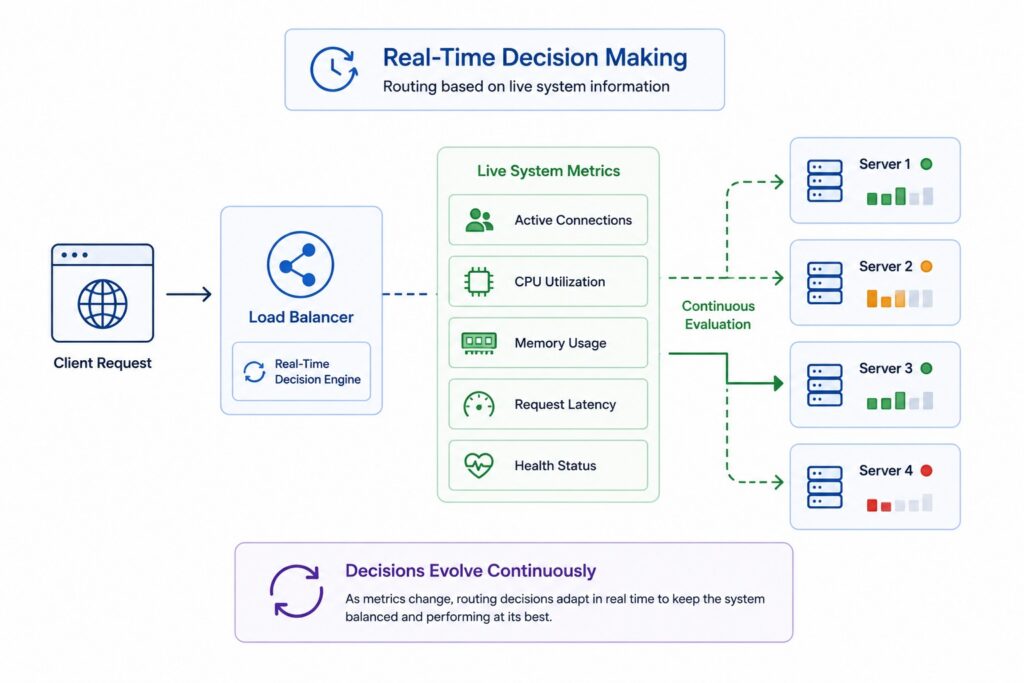
The defining characteristic of dynamic load balancing is that routing decisions are based on live system information instead of predetermined rules. Metrics such as active connections, CPU utilization, memory consumption, request latency, or custom application health indicators influence how traffic is distributed.
Because these metrics change constantly, routing decisions evolve continuously as the system operates.
Dynamic Load Balancing Is a Strategy
Dynamic load balancing is often associated with products such as NGINX, HAProxy, Envoy, AWS Application Load Balancer, or cloud-native service meshes. However, these technologies merely implement the underlying concept.
Dynamic load balancing itself is an architectural strategy that determines how requests should be routed based on changing system conditions rather than a specific software product.
| Concept | Responsibility |
|---|---|
| Load Balancer | Receives incoming requests |
| Dynamic Routing | Selects servers using live metrics |
| Backend Servers | Process application requests |
| Monitoring System | Supplies real-time health information |
Why Dynamic Load Balancing Matters
Modern distributed systems rarely operate under perfectly balanced conditions. Different requests require different amounts of processing, infrastructure changes continuously through autoscaling, and hardware resources fluctuate as applications consume CPU, memory, storage, and network bandwidth. Under these conditions, evenly distributing requests does not necessarily produce evenly distributed workloads. Dynamic load balancing exists because real production environments are constantly changing.
Rather than assuming all servers behave identically, dynamic routing adapts continuously to current operating conditions, allowing infrastructure to remain responsive even during unpredictable traffic patterns.
Uneven Workloads
Two servers receiving the same number of requests may experience completely different resource utilization. One server might process computationally intensive image processing tasks while another serves cached responses that complete almost instantly.
Because request complexity varies, distributing requests equally often results in unequal resource consumption across the infrastructure.
Adapting to Real-Time Conditions
Server health changes continuously throughout the day. CPU utilization increases during heavy processing, memory availability fluctuates, network latency varies, and new application instances appear as autoscaling adds capacity.
Dynamic load balancers monitor these changing conditions and adjust routing decisions accordingly, preventing overloaded servers from receiving additional requests while directing traffic toward healthier instances.
Improving Reliability and Performance
Routing requests according to current system conditions improves application responsiveness while increasing infrastructure utilization. Servers experiencing failures or degraded performance automatically receive less traffic, allowing healthier machines to continue serving users.
This adaptive behavior improves fault tolerance without requiring operators to manually modify routing rules whenever infrastructure conditions change.
| Static Routing | Dynamic Routing |
|---|---|
| Fixed request distribution | Adaptive request distribution |
| Ignores server health | Uses live health metrics |
| Equal requests | Balanced workload |
| Slower failure response | Automatic routing adjustments |
How Dynamic Load Balancing Works
Although dynamic load balancing continuously adapts to changing infrastructure conditions, its overall workflow follows a predictable sequence. Incoming requests first arrive at the load balancer, which evaluates the health and workload of available backend servers before selecting the most appropriate destination. After forwarding the request, monitoring systems continue collecting operational metrics so future routing decisions reflect the latest state of the infrastructure.
This continuous feedback loop allows the routing strategy to evolve automatically as servers become busier, recover from failures, or new instances join the system.
Client Request
Every request begins by reaching a load balancer positioned between clients and backend services. Instead of exposing individual application servers directly to users, the load balancer becomes the single entry point responsible for deciding where requests should be processed.
This abstraction allows backend infrastructure to change without affecting client applications.
Health Monitoring
Before forwarding requests, the load balancer continuously collects health information from backend servers. Active probes, heartbeat messages, monitoring agents, or service discovery platforms provide metrics describing server availability and operational status.
Unhealthy servers can therefore be removed from request routing automatically before users experience widespread failures.
Load Evaluation
Once health information becomes available, the load balancer evaluates current operating conditions using metrics such as active connections, CPU utilization, request latency, queue depth, or application-specific telemetry.
Different routing algorithms prioritize different metrics, but they all share the goal of selecting the server most capable of handling the next request efficiently.
Request Routing
After selecting the most appropriate backend instance, the load balancer forwards the request and records updated workload information. As new requests arrive, the evaluation process repeats continuously using the latest monitoring data.
Because routing decisions are recalculated repeatedly, the system naturally adapts to changing workloads throughout normal operation.
| Request Stage | Responsibility |
|---|---|
| Client Request | Arrives at load balancer |
| Health Monitoring | Evaluate backend availability |
| Load Evaluation | Analyze server metrics |
| Request Routing | Forward request to selected server |
| Continuous Monitoring | Update routing decisions |
Static vs Dynamic Load Balancing
Both static and dynamic load balancing distribute requests across multiple backend servers, but they differ significantly in how routing decisions are made. Static algorithms follow predetermined rules regardless of current infrastructure conditions, whereas dynamic algorithms continuously adapt based on real-time server behavior. Understanding this distinction helps architects select the appropriate routing strategy for different application workloads.
Neither approach is universally superior. The most appropriate choice depends on workload variability, infrastructure complexity, and operational requirements.
Static Load Balancing
Static load balancing distributes requests using predefined algorithms such as round robin or weighted round robin. These algorithms assume that server capacity and workload remain relatively stable, making routing decisions without considering real-time performance metrics.
Static routing works well when backend servers have similar hardware, process similar requests, and experience relatively predictable traffic patterns.
Dynamic Load Balancing
Dynamic load balancing evaluates server health and workload before routing every request. Rather than assuming equal capacity, it continuously adjusts traffic distribution according to observed operating conditions.
This adaptive behavior makes dynamic routing particularly effective for heterogeneous environments where servers experience varying workloads or hardware capabilities.
Advantages of Dynamic Routing
By monitoring infrastructure continuously, dynamic load balancing improves resource utilization while reducing the likelihood that overloaded servers receive additional requests. Applications generally experience lower latency and greater resilience because traffic automatically shifts away from degraded instances.
This flexibility becomes increasingly valuable as distributed systems scale and infrastructure changes more frequently.
Tradeoffs
Dynamic routing introduces additional complexity because monitoring systems, health checks, and telemetry collection become essential components of the architecture. Every routing decision also requires additional computation compared to simple static algorithms.
Organizations must therefore balance improved routing quality against increased operational overhead.
| Static Load Balancing | Dynamic Load Balancing |
|---|---|
| Fixed routing decisions | Adaptive routing decisions |
| Minimal monitoring | Continuous monitoring |
| Lower operational complexity | Higher operational complexity |
| Best for predictable workloads | Best for changing workloads |
Common Dynamic Load Balancing Algorithms
Dynamic load balancing is not a single algorithm but a family of routing strategies that evaluate different aspects of backend server performance. Some algorithms focus on active connections, others prioritize response time, while more advanced approaches consider resource utilization or predictive workload analysis. Choosing the appropriate algorithm depends on application behavior, infrastructure characteristics, and the operational goals of the system.
Although implementations differ, every algorithm attempts to direct requests toward the server most capable of processing them efficiently.
Least Connections
The least connections algorithm routes incoming requests to the backend server currently handling the fewest active client connections. This strategy assumes that servers with fewer active sessions have more available capacity to process additional work.
Least connections performs particularly well when requests remain active for different lengths of time because it balances ongoing workload rather than simply counting incoming requests.
Least Response Time
Some applications prioritize latency instead of connection count. Least response time algorithms monitor how quickly servers respond to requests and prefer instances consistently demonstrating lower response times.
This approach naturally directs traffic away from slower servers even if they are processing relatively few concurrent requests.
Resource-Based Routing
Resource-based algorithms evaluate infrastructure metrics such as CPU utilization, memory usage, network bandwidth, or disk activity before selecting a destination server. Instead of relying on connection counts alone, they consider how heavily each machine is actually being utilized.
These algorithms are especially valuable when requests consume highly variable computing resources.
Adaptive and Predictive Load Balancing
Adaptive algorithms continuously modify routing behavior as infrastructure conditions evolve. Some advanced systems also incorporate predictive models that anticipate future demand using historical traffic patterns, allowing routing decisions to respond proactively rather than reactively.
Although predictive routing is becoming more common in very large platforms, most production systems still rely primarily on deterministic algorithms combined with real-time monitoring.
| Algorithm | Primary Decision Metric |
|---|---|
| Least Connections | Active client connections |
| Least Response Time | Observed request latency |
| Resource-Based Routing | CPU, memory, and resource usage |
| Adaptive Routing | Real-time telemetry |
| Predictive Routing | Forecasted workload patterns |
Health Checks and Service Discovery
Dynamic load balancing depends on accurate information about backend services. Without reliable monitoring, the load balancer cannot distinguish healthy servers from overloaded or failed ones, making intelligent routing impossible. Health checks and service discovery provide the information needed to maintain an accurate view of the infrastructure and ensure requests are sent only to available application instances.
Together, these supporting systems allow dynamic routing to respond automatically as infrastructure changes over time.
Active Health Checks
Active health checks periodically probe backend servers using protocols such as HTTP, TCP, or gRPC. The load balancer sends requests at regular intervals and evaluates the responses to determine whether each server remains healthy and capable of handling client traffic.
If a server fails multiple health checks consecutively, it is typically removed from the routing pool until it recovers.
Passive Health Checks
Passive health checks rely on actual production traffic rather than dedicated monitoring requests. The load balancer observes failed connections, timeouts, or application errors while processing client requests and uses this information to identify unhealthy backend instances.
Because passive monitoring reflects real application behavior, it complements active probing by detecting failures that synthetic health checks might miss.
Service Discovery
Modern distributed systems frequently create and remove application instances through autoscaling or container orchestration. Service discovery platforms such as Kubernetes Services, Consul, etcd, or cloud service registries maintain an up-to-date inventory of available backend instances.
The load balancer consults these registries so routing decisions always reflect the current infrastructure.
Automatic Failover
When health monitoring detects failures, dynamic load balancers automatically stop sending requests to affected servers. Once those servers recover and pass subsequent health checks, they are gradually reintroduced into the routing pool without requiring manual intervention.
This automatic failover significantly improves application availability while reducing operational effort during infrastructure failures.
| Infrastructure Component | Responsibility |
|---|---|
| Active Health Checks | Periodically verify server health |
| Passive Health Checks | Detect failures through production traffic |
| Service Discovery | Track available backend instances |
| Automatic Failover | Remove and restore unhealthy servers |
Dynamic Load Balancing in Cloud-Native Systems
Modern cloud-native platforms are highly dynamic by design. Containers are created and terminated automatically, autoscaling continuously changes infrastructure capacity, and services communicate across distributed environments where workloads fluctuate constantly. Under these conditions, static routing quickly becomes inefficient because the set of available backend servers changes throughout the day. Dynamic load balancing has therefore become a core component of cloud-native architecture.
Rather than relying on fixed infrastructure assumptions, cloud-native platforms continuously monitor services and adapt routing decisions in response to changing application behavior.
Kubernetes Services
Kubernetes includes built-in load balancing capabilities through Services, EndpointSlices, and kube-proxy. As pods are created, terminated, or rescheduled, Kubernetes automatically updates the available backend endpoints so incoming requests are always directed toward healthy application instances.
Ingress controllers further extend these capabilities by providing Layer 7 routing, SSL termination, traffic splitting, and application-aware request distribution across Kubernetes clusters.
Service Meshes
As microservice architectures become more complex, service meshes such as Istio, Linkerd, and Envoy introduce intelligent service-to-service routing. Instead of relying solely on external load balancers, every service participates in dynamic request routing using continuously collected telemetry.
Service meshes can route requests according to latency, failure rates, retries, circuit breakers, or traffic policies, allowing routing decisions to evolve continuously as application conditions change.
Cloud Load Balancers
Public cloud providers offer managed load-balancing services that incorporate dynamic routing capabilities without requiring organizations to operate the infrastructure themselves. Services such as AWS Application Load Balancer, Google Cloud Load Balancing, and Azure Load Balancer continuously monitor backend resources while automatically distributing traffic across healthy instances.
These managed services simplify deployment while integrating closely with cloud-native networking and autoscaling features.
Auto Scaling Integration
Dynamic load balancing and autoscaling solve related but distinct problems. Autoscaling adjusts the number of available servers, while dynamic load balancing decides how requests should be distributed across those servers.
Together they create highly adaptive infrastructure that both expands capacity during periods of high demand and routes traffic efficiently as the infrastructure changes.
| Cloud Component | Dynamic Load Balancing Role |
|---|---|
| Kubernetes Services | Route traffic across healthy pods |
| Service Mesh | Intelligent service-to-service routing |
| Cloud Load Balancers | Managed adaptive request routing |
| Auto Scaling | Provide new instances for routing |
Benefits and Tradeoffs
Dynamic load balancing provides significant advantages for modern distributed systems, particularly when workloads fluctuate continuously or infrastructure changes frequently. At the same time, these benefits come with additional architectural complexity because intelligent routing depends on accurate monitoring, telemetry collection, and health evaluation. Understanding both sides of this tradeoff allows architects to determine when adaptive routing is justified.
Like many distributed systems techniques, dynamic load balancing should be adopted because it solves a real operational problem rather than simply because it is available.
Better Resource Utilization
Traditional routing algorithms may continue sending requests to overloaded servers while healthier machines remain underutilized. Dynamic load balancing continuously adjusts traffic distribution according to current resource availability, allowing infrastructure to be used more efficiently.
This improved utilization often delays the need for additional hardware while improving overall application responsiveness.
Improved Availability
Dynamic routing continuously monitors backend health and automatically removes unhealthy servers from the request path. Users experience fewer failures because traffic is redirected toward functioning instances whenever infrastructure problems occur.
Automatic recovery also allows previously failed servers to return to service without manual operational intervention.
Lower Latency
Routing requests toward less congested or more responsive servers reduces overall application latency. Instead of distributing requests equally, the system directs traffic toward servers capable of producing the fastest responses under current conditions.
This adaptive behavior becomes particularly valuable during traffic spikes or partial infrastructure failures.
Increased Complexity
The primary drawback of dynamic load balancing is the supporting infrastructure it requires. Monitoring systems, service discovery, health checks, telemetry pipelines, and routing algorithms all introduce operational overhead that must be deployed, monitored, and maintained.
Organizations should therefore ensure the performance benefits justify this additional complexity before adopting dynamic routing.
| Benefit or Tradeoff | Impact |
|---|---|
| Better Resource Utilization | More balanced infrastructure usage |
| Improved Availability | Automatic failure handling |
| Lower Latency | Faster user responses |
| Increased Complexity | More operational infrastructure |
When to Use Dynamic Load Balancing
Dynamic load balancing is most valuable when workloads are unpredictable, backend servers differ in capacity, or infrastructure changes frequently through autoscaling and distributed deployments. Applications operating under these conditions benefit from adaptive routing because fixed request distribution often leads to uneven resource utilization and degraded performance.
Understanding the characteristics of the workload helps determine whether the additional complexity of dynamic routing is justified.
High-Traffic Web Applications
Large-scale web applications often experience rapidly changing traffic patterns throughout the day. User activity varies by geography, time zone, marketing campaigns, and seasonal events, making static request distribution increasingly inefficient.
Dynamic load balancing allows these systems to adapt continuously as server utilization changes, helping maintain responsive user experiences during unpredictable demand.
Microservices
Microservice architectures consist of many independently deployed services that frequently scale, restart, or experience varying workloads. Since different services may process requests with dramatically different computational costs, adaptive routing helps distribute traffic more effectively than static algorithms.
Dynamic routing also complements service discovery by automatically incorporating newly deployed service instances.
AI and Machine Learning Serving
AI inference workloads often consume highly variable computing resources depending on model size, request complexity, and available GPU capacity. Routing requests solely according to connection count may overload specialized inference servers while other hardware remains underutilized.
Dynamic load balancing allows routing decisions to incorporate GPU utilization, inference latency, and model availability before selecting a destination.
Multi-Region Architectures
Global applications frequently operate across multiple regions or data centers. Dynamic routing allows requests to be directed toward healthy regions while automatically avoiding locations experiencing elevated latency or infrastructure failures.
This capability improves both performance and resilience for globally distributed applications.
| Application Type | Dynamic Load Balancing Suitability |
|---|---|
| High-Traffic Web Applications | High |
| Microservices | High |
| AI and ML Serving | High |
| Multi-Region Platforms | High |
Common Misconceptions About Dynamic Load Balancing
Dynamic load balancing is often described using simplified explanations that overlook the operational realities of distributed systems. These misconceptions can lead to unrealistic expectations or unnecessarily complex architectures. Understanding what dynamic routing actually provides helps architects deploy it effectively while avoiding unnecessary infrastructure.
Successful implementations depend on combining appropriate routing algorithms with accurate monitoring and operational discipline.
Dynamic Load Balancing Always Uses AI
Although machine learning and predictive routing are becoming more common in some very large systems, the vast majority of production load balancers rely on deterministic algorithms such as least connections, least response time, or resource-based routing.
These algorithms provide excellent performance without requiring sophisticated predictive models.
Dynamic Load Balancing Eliminates Bottlenecks
Load balancing distributes requests across backend servers, but it cannot eliminate bottlenecks that exist elsewhere in the system. Databases, caches, storage systems, message queues, or downstream APIs may still become performance constraints regardless of how efficiently requests are routed.
Load balancing improves one layer of the architecture rather than solving every scalability challenge.
More Metrics Always Produce Better Decisions
Collecting additional telemetry may improve routing quality, but excessive monitoring also increases computation, storage, and network overhead. Routing decisions should rely on metrics that meaningfully improve request distribution rather than gathering every available measurement.
Effective monitoring balances routing accuracy against operational efficiency.
Dynamic Routing Is Always Better
For many small or stable applications, simple algorithms such as round robin provide excellent performance while remaining much easier to operate. Introducing dynamic routing where workloads remain predictable often increases complexity without producing measurable benefits.
Architectural decisions should reflect workload characteristics rather than assuming adaptive systems are always preferable.
Load Balancing and Auto Scaling Are the Same
Load balancing determines where requests should be sent, whereas autoscaling determines how many backend instances should exist. Although the two technologies work closely together, they solve different infrastructure problems.
Confusing these responsibilities often leads to incomplete System Designs.
| Misconception | Reality |
|---|---|
| Dynamic load balancing requires AI | Most systems use deterministic algorithms |
| It removes every bottleneck | Other system components can still limit performance |
| More metrics are always better | Useful metrics matter more than quantity |
| Dynamic routing is always superior | Static routing is sufficient for many workloads |
| Load balancing equals autoscaling | They solve different problems |
Dynamic Load Balancing in System Design Interviews
Dynamic load balancing appears frequently in System Design interviews because request routing directly affects scalability, availability, and resilience. Interviewers are generally less interested in memorizing algorithm names than in understanding when adaptive routing provides meaningful architectural value. Candidates who explain why dynamic routing is appropriate for a specific workload typically demonstrate stronger engineering judgment than those who simply recommend advanced algorithms.
The discussion should always begin with workload characteristics before introducing routing strategies.
When to Introduce Dynamic Routing
Dynamic load balancing becomes relevant when backend servers experience uneven workloads, autoscaling changes infrastructure frequently, request processing costs vary significantly, or high availability is essential. Explaining these architectural signals helps justify why adaptive routing is preferable to static algorithms.
Candidates should connect routing decisions directly to the application’s operational requirements rather than introducing dynamic load balancing by default.
What Interviewers Evaluate
Interviewers typically assess whether candidates understand routing algorithms, health monitoring, service discovery, observability, scalability, and failure handling. They also evaluate whether candidates recognize the operational complexity introduced by dynamic routing.
A balanced explanation of benefits and tradeoffs usually demonstrates deeper architectural understanding than focusing exclusively on performance improvements.
Common Candidate Mistakes
Many candidates recommend least connections or least response time without explaining why those algorithms fit the workload. Others overlook health checks, ignore service discovery, or confuse dynamic load balancing with autoscaling.
Strong candidates explain not only how requests are routed but also how the routing system remains accurate as infrastructure changes.
| Interview Topic | What Interviewers Evaluate |
|---|---|
| Routing Strategy | Appropriate algorithm selection |
| Health Monitoring | Reliable failure detection |
| Scalability | Efficient request distribution |
| Tradeoff Analysis | Complexity versus performance |
| Communication | Clear architectural reasoning |
Frequently Asked Questions About Dynamic Load Balancing
Dynamic load balancing is one of the most widely used techniques for improving the reliability and efficiency of distributed systems because server workloads constantly change over time. As applications scale across multiple machines, engineers naturally encounter questions about how dynamic routing works, when it should be used, and how it differs from simpler routing approaches.
Understanding these common questions helps connect the underlying concepts to real production architectures.
What is dynamic load balancing?
Dynamic load balancing is a request routing strategy that distributes traffic according to the real-time condition of backend servers rather than using fixed routing rules. Routing decisions may consider server health, active connections, response time, or resource utilization.
Its objective is to keep workloads balanced as infrastructure conditions change.
How is it different from static load balancing?
Static load balancing follows predefined routing rules regardless of current server conditions. Dynamic load balancing continuously evaluates backend metrics and adapts request distribution as workloads evolve.
Dynamic routing responds more effectively to changing infrastructure conditions.
Which algorithm is best?
There is no universally best algorithm. Least connections works well for long-lived sessions, least response time prioritizes low latency, and resource-based routing is useful when workloads consume varying amounts of CPU or memory.
The appropriate choice depends on application behavior and infrastructure characteristics.
Does dynamic load balancing improve performance?
Yes, when workloads fluctuate significantly or backend servers experience uneven utilization. By directing requests toward healthier servers, dynamic routing often improves response times and infrastructure efficiency.
However, the additional monitoring infrastructure introduces its own operational overhead.
Does it work with Kubernetes?
Yes. Kubernetes Services, Ingress controllers, and service meshes all incorporate forms of dynamic load balancing while automatically adapting to changes in pod availability and cluster topology.
These capabilities are fundamental to cloud-native application deployment.
How do health checks affect routing?
Health checks determine whether backend servers should continue receiving requests. Unhealthy instances are removed from the routing pool, while recovered servers are automatically reintroduced after passing subsequent health checks.
Accurate health monitoring is therefore essential for effective dynamic routing.
Is dynamic load balancing required for microservices?
Not always, but it is often highly beneficial. Microservices frequently experience changing workloads, autoscaling, and independent deployments that make adaptive routing more effective than static request distribution.
Smaller or more predictable systems may still perform well using simpler algorithms.
How does it work with auto scaling?
Autoscaling adjusts the number of available backend servers, while dynamic load balancing distributes requests across those servers. Together they create adaptive infrastructure capable of responding automatically to changing traffic patterns.
Each technology complements the other without replacing its responsibilities.
| Question | Short Answer |
|---|---|
| What is dynamic load balancing? | Adaptive request routing |
| Static vs dynamic? | Fixed rules versus real-time decisions |
| Best algorithm? | Depends on the workload |
| Works with Kubernetes? | Yes |
| Health checks matter? | They determine routing eligibility |
| Auto scaling relationship? | Autoscaling adds servers; load balancing routes traffic |
Final Thoughts
Dynamic load balancing recognizes that modern distributed systems operate in constantly changing environments where server workloads, resource utilization, and application health fluctuate continuously. Instead of relying on fixed routing strategies, it adapts request distribution using real-time operational data, allowing applications to improve resource utilization, reduce latency, and recover automatically from infrastructure failures. As cloud-native platforms, microservices, and autoscaling become increasingly common, adaptive routing has become a foundational component of scalable System Design.
At the same time, dynamic load balancing introduces additional architectural complexity because it depends on accurate health monitoring, service discovery, telemetry collection, and operational observability. Successful implementations balance these costs against the benefits of improved performance and resilience. Understanding the routing algorithms is only one part of the picture; equally important is understanding how monitoring, failure detection, and infrastructure automation work together to keep distributed systems responsive under changing conditions.