
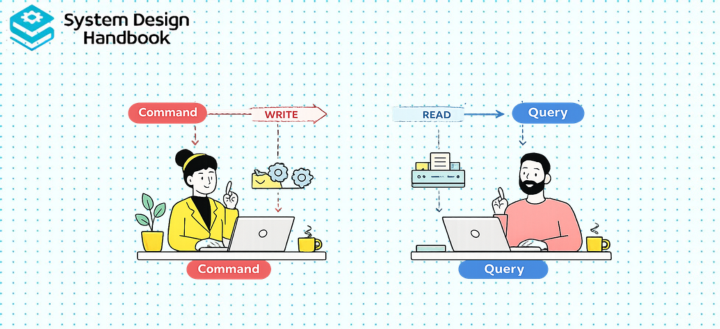
As applications grow, the way they handle reading data often becomes very different from the way they handle writing data. Creating a new order may require validation, business rules, inventory checks, and transactional guarantees, while viewing that same order may simply require retrieving information as quickly as possible. Treating both operations identically can make applications unnecessarily complex. The Command Query Responsibility Segregation (CQRS) pattern addresses this problem by separating write operations from read operations.
CQRS is an architectural pattern that divides the system into two logical responsibilities. Commands modify application state, while queries retrieve information without changing it. This separation allows each side of the system to evolve independently according to its own performance and business requirements.
Understanding Commands
Commands represent requests that change application state. Examples include creating an account, updating a customer profile, placing an order, or cancelling a reservation. A command expresses an intention to perform an action rather than asking for information.
Before a command succeeds, it typically passes through validation, authorization, business rules, and transactional processing. The system ensures that every change preserves data consistency and maintains domain invariants.
Understanding Queries
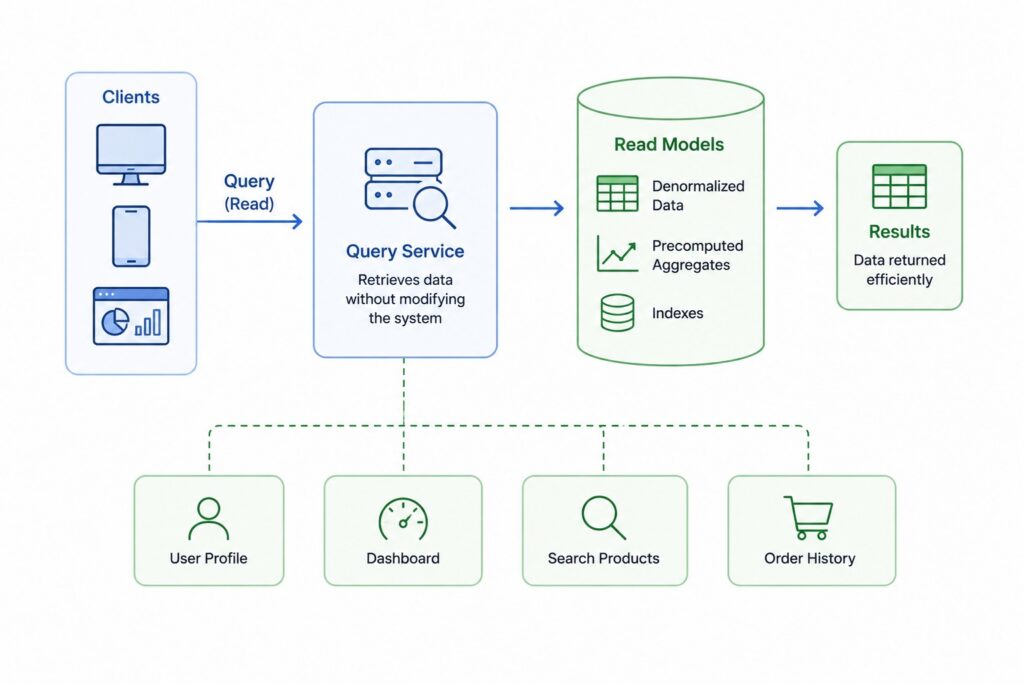
Queries retrieve information without modifying the system. Their primary objective is to return data efficiently, whether that involves displaying a user profile, generating a dashboard, searching products, or retrieving order history.
Because queries do not change state, they can often be optimized independently from the write side. Read models may include denormalized data, precomputed aggregates, or specialized indexes that improve retrieval performance.
CQRS Is a Design Pattern
CQRS is sometimes mistaken for a database technology or framework, but it is neither. It is simply an architectural pattern that changes how responsibilities are organized within an application. Some implementations use separate databases for reads and writes, while others use a single database with logically separated models.
The key idea is not physical separation but separating the responsibilities of modifying data and retrieving data.
| Concept | Responsibility |
|---|---|
| Command | Modify application state |
| Query | Retrieve application data |
| Write Model | Process business logic and persistence |
| Read Model | Optimize data retrieval |
Why CQRS Exists
Traditional CRUD architectures use the same domain model for both reading and writing data. While this approach works well for many applications, it becomes increasingly difficult to maintain when read and write workloads evolve differently. Business logic often grows more complex on the write side, while users expect fast, flexible, and highly optimized queries on the read side. CQRS exists to separate these competing concerns so each can be optimized independently.
Rather than forcing one model to satisfy every requirement, CQRS recognizes that modifying data and retrieving data often have fundamentally different goals.
Different Read and Write Needs
Write operations typically involve enforcing business rules, validating user input, maintaining consistency, and executing transactions. Creating an order, transferring money, or updating inventory requires careful processing to ensure the system remains in a valid state.
Read operations have very different priorities. Users usually care about fast searches, filtering, sorting, reporting, dashboards, and aggregated views rather than transactional processing. Optimizing one model for both responsibilities often leads to unnecessary complexity.
Reducing Model Complexity
As applications grow, a single domain model often becomes overloaded with responsibilities. The same entities must simultaneously enforce business rules while supporting many different query patterns. This makes the model difficult to understand, maintain, and extend.
CQRS separates these responsibilities into dedicated models. The write model focuses exclusively on business behavior, while the read model focuses entirely on efficient data retrieval.
Improving Scalability
Many production systems receive significantly more read requests than write requests. Social media feeds, e-commerce catalogs, analytics dashboards, and news websites may process thousands of reads for every write operation.
CQRS allows organizations to scale read infrastructure independently from write infrastructure, reducing operational costs while improving overall application scalability.
| Traditional CRUD | CQRS |
|---|---|
| Single model for reads and writes | Separate read and write models |
| Shared optimization strategy | Independent optimization |
| Reads and writes scale together | Read and write sides scale independently |
| Mixed responsibilities | Clear separation of concerns |
How CQRS Works
Although CQRS separates commands and queries, both sides still represent the same business system. The write side receives commands that modify application state, while the read side serves optimized queries. Information flows from the write model to the read model so users eventually see updated data after successful writes.
Understanding this lifecycle helps explain why CQRS improves scalability while also introducing concepts such as projections and eventual consistency.
Command Side
The lifecycle begins when a client sends a command to the application. The command handler validates the request, checks authorization, executes business rules, and applies any required domain logic before updating the write model.
Once the transaction completes successfully, the system records the change in persistent storage. Depending on the implementation, it may also publish an event describing what changed so that other parts of the system can react.
Query Side
Queries never interact directly with business logic responsible for modifying data. Instead, they retrieve information from dedicated read models specifically optimized for searching, filtering, aggregation, or reporting.
Because read models are designed around query requirements rather than transactional consistency, they can often answer requests much more efficiently than normalized transactional databases.
Synchronization Between Models
After the write model changes, the read model must eventually reflect those updates. Some systems synchronize changes immediately, while others use asynchronous messaging through event buses, message queues, background workers, or replication processes.
This synchronization process keeps read models up to date without coupling query performance to transactional processing.
Eventual Consistency
Since read models may be updated asynchronously, users might briefly observe stale information immediately after submitting a command. This temporary inconsistency is known as eventual consistency.
Rather than guaranteeing instant synchronization, CQRS guarantees that read models will eventually converge toward the correct state once synchronization completes.
| Lifecycle Stage | Responsibility |
|---|---|
| Command | Validate and execute business logic |
| Write Model | Persist application changes |
| Synchronization | Propagate updates to read models |
| Read Model | Serve optimized queries |
| Query | Retrieve application data |
Commands vs Queries
The central idea behind CQRS is that commands and queries represent fundamentally different responsibilities. Although both interact with application data, they have different objectives, different validation requirements, and different performance characteristics. Separating these responsibilities allows each side of the application to evolve according to its own requirements rather than forcing one model to satisfy conflicting goals.
This distinction may appear subtle initially, but it becomes increasingly valuable as applications grow in size and complexity.
Commands
Commands express an intention to change the state of the system. They typically represent business actions such as creating users, placing orders, updating inventory, approving payments, or cancelling reservations.
A command usually performs validation, checks permissions, executes business rules, updates domain entities, and persists changes within a transaction. The primary objective is maintaining correctness rather than maximizing execution speed.
Queries
Queries retrieve information without modifying application state. Examples include searching products, displaying account information, generating dashboards, or retrieving reporting data.
Because queries never change data, they can use denormalized schemas, caches, materialized views, search indexes, or other specialized data structures designed purely for fast retrieval.
Why This Separation Matters
Keeping commands and queries independent simplifies application development because each side can focus on a single responsibility. Business logic remains concentrated within the write model, while query optimization no longer risks affecting transactional behavior.
This separation also improves testing, maintenance, scalability, and long-term architectural flexibility as application requirements evolve.
| Commands | Queries |
|---|---|
| Change application state | Retrieve information |
| Execute business rules | Optimize retrieval speed |
| Require transactions | Focus on efficient access |
| Maintain consistency | Support filtering and aggregation |
| Update write model | Read from optimized read model |
CQRS Architecture Components
Although CQRS implementations vary considerably, most systems include a similar set of architectural components. Together these components separate business logic from query processing while ensuring that changes made on the write side eventually appear within optimized read models. Understanding these building blocks makes it easier to reason about CQRS implementations regardless of the underlying framework or programming language.
Each component performs a clearly defined responsibility within the overall architecture.
Command Handlers
Command handlers receive incoming commands and coordinate the execution of business operations. They validate requests, enforce business rules, invoke domain entities or aggregates, and persist successful changes to the write model.
Keeping command handling separate from query processing simplifies business logic while improving testability and maintainability.
Write Model
The write model represents the authoritative source of business state. It contains domain entities, aggregates, invariants, and transactional boundaries responsible for maintaining data consistency throughout the application.
Unlike read models, the write model is optimized for correctness rather than query performance.
Event Bus and Projection Handlers
After successful writes, many CQRS systems publish events describing the completed changes. Projection handlers consume these events and transform them into read models tailored for specific query patterns.
Using asynchronous messaging allows read models to evolve independently without affecting transactional processing on the write side.
Read Model
The read model stores data in forms specifically designed for efficient retrieval. Instead of preserving strict normalization, it often contains denormalized records, aggregated values, cached information, or specialized indexes that support particular application screens or reports.
Since the read model never performs transactional updates directly, it can be optimized aggressively for performance.
| Component | Responsibility |
|---|---|
| Command Handler | Process incoming commands |
| Write Model | Maintain business consistency |
| Event Bus | Propagate write-side changes |
| Projection Handler | Build optimized read models |
| Read Model | Serve efficient queries |
CQRS With and Without Event Sourcing
One of the most common misconceptions about CQRS is that it always requires event sourcing. Although these patterns are frequently discussed together, they solve different architectural problems and can be adopted independently. CQRS separates read and write responsibilities, while event sourcing changes how application state is stored by recording events instead of only the current data.
Understanding this distinction helps architects choose the appropriate level of complexity for their systems.
CQRS Without Event Sourcing
Many CQRS implementations use a traditional relational or transactional database on the write side. Commands update the current application state directly, and successful changes are propagated to read models through messaging systems, replication, or background synchronization.
This approach preserves the benefits of CQRS while avoiding the additional complexity of maintaining an event log.
CQRS With Event Sourcing
Event sourcing stores every state change as an immutable event rather than overwriting the current state. Instead of recording only the latest account balance or inventory quantity, the system stores every deposit, withdrawal, purchase, or adjustment that produced the current value.
Current state is reconstructed by replaying the sequence of historical events whenever necessary. This provides complete auditability while enabling powerful capabilities such as event replay and temporal analysis.
Choosing Between Them
Traditional CQRS implementations are generally simpler to understand, implement, and operate. They work well when organizations primarily need separated read and write models without requiring a complete history of every business event.
Event sourcing becomes attractive when historical reconstruction, auditing, debugging, regulatory compliance, or event replay provides significant business value. However, these benefits come with additional operational complexity that should be justified by the application’s requirements.
| Approach | Characteristics |
|---|---|
| CQRS Only | Separate read and write models using traditional persistence |
| CQRS + Event Sourcing | Store immutable events as the source of truth |
| Simplicity | Higher with traditional CQRS |
| Auditability | Stronger with event sourcing |
| Operational Complexity | Lower without event sourcing |
Benefits of the CQRS Pattern
When applied to the right problem, CQRS can significantly improve scalability, maintainability, and application performance. By separating reads from writes, architects are no longer forced to compromise between transactional correctness and query efficiency. Instead, each side of the application can evolve independently according to its own workload characteristics and business requirements.
These benefits become increasingly valuable as applications grow larger and read and write traffic begin exhibiting very different behavior. However, they are most noticeable in systems with complex business logic or highly asymmetric workloads rather than simple CRUD applications.
Independent Scaling
Many production systems process far more read requests than write requests. An e-commerce application, for example, may receive millions of product searches while processing only a fraction as many purchases. Scaling both workloads together wastes infrastructure resources because the write side often remains lightly utilized.
CQRS allows organizations to scale read infrastructure independently from write infrastructure. Read models can be replicated across multiple servers, cached aggressively, or distributed geographically without affecting transactional processing.
Optimized Data Models
Read and write operations typically require different data structures. The write model prioritizes consistency, validation, and transactional correctness, while the read model prioritizes fast retrieval, filtering, aggregation, and reporting.
By separating these models, architects can design each specifically for its intended purpose instead of forcing one schema to satisfy conflicting requirements.
Cleaner Domain Logic
Keeping business rules inside the write model produces a cleaner domain architecture. Command handlers, aggregates, and domain entities focus entirely on enforcing business behavior without becoming cluttered by reporting queries or user interface requirements.
This separation also simplifies testing because business logic and query logic can be validated independently.
Better Performance for Complex Reads
Applications containing dashboards, reporting systems, analytics, recommendation engines, or search functionality often benefit from dedicated read models. These models may contain denormalized data, precomputed calculations, or specialized indexes that dramatically reduce query execution time.
Optimizing the read side independently allows complex queries to remain fast without affecting transactional performance on the write side.
| Benefit | Why It Matters |
|---|---|
| Independent Scaling | Scale reads and writes separately |
| Optimized Read Models | Improve query performance |
| Cleaner Domain Logic | Simplify business rules |
| Faster Complex Queries | Support dashboards and reporting |
Tradeoffs and Challenges of CQRS
Although CQRS provides significant architectural advantages in certain systems, it also introduces additional complexity that should not be underestimated. Maintaining separate models, synchronization mechanisms, and deployment pipelines requires more engineering effort than a traditional CRUD architecture. For many small or moderately sized applications, these additional responsibilities outweigh the potential benefits.
CQRS should therefore be viewed as a specialized architectural tool rather than a default design pattern for every application.
Increased Architectural Complexity
Separating commands and queries naturally introduces additional components into the application. Instead of maintaining a single domain model, engineers must manage command handlers, query handlers, read models, synchronization processes, and supporting infrastructure.
This additional complexity increases development effort and requires stronger architectural discipline throughout the software lifecycle.
Eventual Consistency
Many CQRS implementations synchronize read models asynchronously. As a result, users may temporarily observe stale information immediately after completing a successful write operation.
Although this delay is often measured in milliseconds or seconds, architects must design user experiences that account for temporary inconsistencies instead of assuming every read immediately reflects the latest write.
Data Synchronization
Keeping read models synchronized introduces operational challenges. Projection failures, delayed messages, replaying events, rebuilding read models, and handling duplicate events all require careful engineering.
Successful CQRS implementations invest heavily in monitoring, retry mechanisms, idempotency, and operational tooling to ensure synchronization remains reliable.
Operational Overhead
Debugging CQRS systems can be more difficult because information flows across multiple components rather than through a single transactional path. Engineers often need to inspect commands, events, projections, queues, and read models before understanding why particular data appears incorrect.
Monitoring and observability become essential parts of any production CQRS implementation.
| Challenge | Impact |
|---|---|
| Architectural Complexity | More components to manage |
| Eventual Consistency | Temporary stale reads |
| Synchronization | Additional operational responsibilities |
| Monitoring | Greater debugging complexity |
When to Use CQRS
CQRS is most valuable when read and write workloads differ substantially in terms of scale, complexity, or performance requirements. Applying the pattern to simple CRUD applications often increases complexity without providing meaningful benefits. Successful architects evaluate workload characteristics carefully before deciding whether the additional architectural investment is justified.
Understanding when not to use CQRS is often just as important as understanding when it provides value.
Read-Heavy Systems
Applications where reads vastly outnumber writes frequently benefit from CQRS. Product catalogs, news websites, social media feeds, documentation platforms, and search systems often process thousands of queries for every state-changing operation.
Separating the read side allows these systems to optimize query performance while minimizing the impact on transactional processing.
Complex Business Domains
Domains containing sophisticated business workflows often benefit from dedicated write models. Banking systems, order processing platforms, healthcare applications, and booking systems frequently enforce complicated business rules that become easier to manage when isolated from reporting and query logic.
Keeping domain behavior separate from presentation concerns produces cleaner and more maintainable architectures.
Reporting and Dashboards
Reporting systems often require highly denormalized data that differs significantly from transactional schemas. Dashboards may aggregate information from multiple entities, precompute statistics, or maintain specialized indexes optimized for analytical queries.
CQRS allows these read models to evolve independently without affecting business logic or transactional consistency.
High-Scale Applications
Applications experiencing different scaling requirements for reads and writes benefit from independent infrastructure. Read models can be replicated globally, cached aggressively, or distributed across specialized storage systems while transactional processing remains centralized and strongly consistent.
This flexibility allows infrastructure investments to align more closely with actual workload characteristics.
| Application Type | CQRS Suitability |
|---|---|
| Read-heavy platforms | High |
| Complex business workflows | High |
| Analytics and dashboards | High |
| Simple CRUD applications | Usually low |
Common Misconceptions About CQRS
CQRS is frequently misunderstood because it is often discussed alongside other architectural patterns such as event sourcing, microservices, and domain-driven design. These technologies are commonly used together, but they remain independent concepts that solve different problems. Understanding these misconceptions helps architects evaluate CQRS based on actual requirements rather than popular assumptions.
Many unsuccessful CQRS implementations result from applying the pattern for the wrong reasons instead of solving a clearly identified architectural problem.
CQRS Requires Event Sourcing
Perhaps the most common misconception is that CQRS cannot exist without event sourcing. In reality, CQRS simply separates read and write responsibilities. Traditional transactional databases work perfectly well as write stores while separate read models handle queries independently.
Event sourcing can complement CQRS, but it is not a prerequisite for adopting the pattern.
CQRS Is Only for Microservices
CQRS is often associated with distributed systems, yet it works equally well inside modular monolithic applications. The pattern concerns logical separation of responsibilities rather than deployment architecture.
Many organizations introduce CQRS long before adopting microservices because the separation improves maintainability even within a single application.
CQRS Makes Every System Faster
CQRS improves performance only when read and write workloads differ enough to justify specialized optimization. Applications with simple query requirements often experience little measurable benefit while incurring significantly greater complexity.
Performance improvements depend on workload characteristics rather than the architectural pattern itself.
CQRS Means Two Databases Are Required
CQRS separates responsibilities logically, not necessarily physically. Many implementations use separate databases for operational reasons, but others successfully use a single database with separate read and write models.
The architectural pattern does not dictate the storage topology.
CQRS Should Replace CRUD Everywhere
CRUD remains the simplest and most appropriate solution for many business applications. Introducing CQRS before genuine scaling or domain complexity exists often creates unnecessary operational burden.
Architects should adopt CQRS only when its benefits clearly outweigh its additional complexity.
| Misconception | Reality |
|---|---|
| CQRS requires event sourcing | They are independent patterns |
| CQRS only works with microservices | It also works in monoliths |
| CQRS always improves performance | Benefits depend on workload |
| CQRS requires two databases | Logical separation is sufficient |
| CQRS replaces CRUD | CRUD remains appropriate for many systems |
CQRS Pattern in System Design Interviews
CQRS appears regularly in System Design interviews involving large-scale applications, particularly those with complex business workflows or highly asymmetric read and write traffic. Interviewers are generally less interested in whether candidates know the acronym than whether they understand the tradeoffs involved in separating commands from queries. Introducing CQRS appropriately often demonstrates strong architectural judgment.
Strong candidates recognize that CQRS is a specialized solution rather than presenting it as the default architecture for every system.
When to Introduce CQRS
CQRS becomes a reasonable architectural discussion when applications contain complicated write-side business logic, read-heavy workloads, extensive reporting requirements, or significantly different scalability needs for reads and writes.
Candidates should explain why a traditional CRUD architecture becomes limiting before recommending CQRS as an alternative.
What Interviewers Evaluate
Interviewers typically evaluate whether candidates understand consistency models, synchronization mechanisms, read model design, event propagation, scalability, and operational complexity. They expect candidates to justify architectural decisions rather than simply recommending popular design patterns.
Demonstrating awareness of both benefits and drawbacks usually creates stronger interview discussions than focusing exclusively on scalability advantages.
Common Candidate Mistakes
A common mistake is introducing CQRS unnecessarily for relatively simple applications. Others ignore eventual consistency, fail to explain how read models remain synchronized, or incorrectly assume CQRS always requires event sourcing.
Successful candidates explain both how the architecture works and why its additional complexity is justified for the particular problem.
| Interview Topic | What Interviewers Evaluate |
|---|---|
| Architecture Selection | Appropriate use of CQRS |
| Consistency | Understanding synchronization tradeoffs |
| Scalability | Independent read and write scaling |
| Tradeoff Analysis | Balanced architectural reasoning |
| Communication | Clear explanation of command and query separation |
Frequently Asked Questions About CQRS
CQRS is often introduced alongside event sourcing, domain-driven design, microservices, and event-driven architecture, making it easy to assume these concepts are inseparable. In reality, CQRS is an independent architectural pattern whose primary purpose is separating write behavior from read behavior. Understanding the following questions helps clarify where CQRS fits within modern software architecture.
Like many advanced architectural patterns, its value depends on the specific problem being solved rather than its popularity.
What does CQRS stand for?
CQRS stands for Command Query Responsibility Segregation. The pattern separates operations that modify application state from operations that retrieve information, allowing each side of the system to evolve independently.
This separation improves clarity by distinguishing commands that change data from queries that only read data.
Is CQRS the same as event sourcing?
No. Event sourcing determines how state is stored by recording immutable events, whereas CQRS determines how application responsibilities are organized. Although the patterns are frequently combined, they solve different architectural problems.
Either pattern can be implemented independently of the other.
Does CQRS require two databases?
No. CQRS requires logical separation between read and write responsibilities, not necessarily separate physical databases. Some implementations use different databases for operational reasons, while others successfully use one database with separate models.
The choice depends on scalability and operational requirements.
When should you use CQRS?
CQRS works best for applications with complex business rules, read-heavy workloads, reporting systems, or significantly different scaling requirements for reads and writes.
Simple CRUD applications often gain little benefit from the additional architectural complexity.
When should you avoid CQRS?
CQRS is usually unnecessary when business logic is straightforward, read and write traffic are similar, or the application can be managed effectively using a conventional CRUD architecture.
Introducing CQRS too early often increases maintenance costs without delivering measurable improvements.
Is CQRS useful in microservices?
Yes, but it is not limited to microservices. Many microservice architectures use CQRS because individual services often benefit from separate read and write models, yet the pattern works equally well inside modular monoliths.
Deployment architecture and application architecture remain separate concerns.
Does CQRS improve performance?
It can, particularly in systems with heavy read traffic or complex query requirements. Dedicated read models allow queries to be optimized independently, reducing response times for dashboards, search systems, and reporting applications.
Performance improvements depend on workload characteristics rather than CQRS itself.
How does CQRS handle consistency?
Many CQRS systems use asynchronous synchronization between write models and read models. This introduces eventual consistency, meaning updates may not appear immediately but will become consistent once synchronization completes.
Architects must account for this behavior when designing user experiences.
| Question | Short Answer |
|---|---|
| What does CQRS stand for? | Command Query Responsibility Segregation |
| Is CQRS the same as event sourcing? | No |
| Does CQRS require two databases? | No |
| When should CQRS be used? | Complex or read-heavy systems |
| Does CQRS improve performance? | Often, when workloads justify it |
| How is consistency maintained? | Usually through eventual consistency |
Final Thoughts
CQRS is a powerful architectural pattern that recognizes a simple but important reality: reading data and modifying data often have very different requirements. By separating commands from queries, architects can design write models that prioritize business correctness while building read models optimized specifically for performance, reporting, and scalability. This separation creates systems that are easier to evolve as application complexity and workload characteristics change over time.
At the same time, CQRS introduces additional architectural and operational complexity that should be justified by genuine business needs. Maintaining separate models, synchronizing data, and handling eventual consistency all require careful engineering. Rather than treating CQRS as a replacement for CRUD, successful architects evaluate the application’s domain complexity, scaling requirements, and operational constraints before adopting the pattern. Understanding these tradeoffs is essential for designing production systems and for confidently discussing CQRS in System Design interviews.