
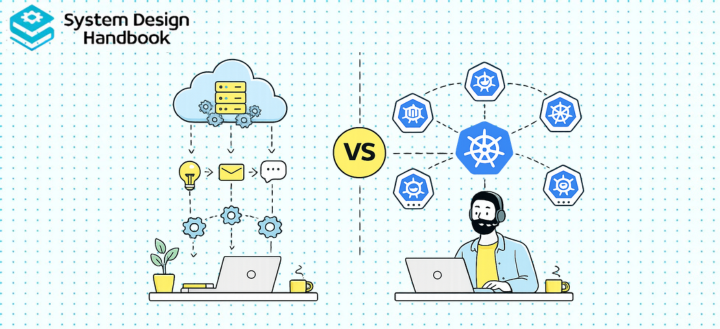
Cloud Foundry and Kubernetes are frequently mentioned together because both help organizations deploy and run applications in the cloud. At first glance, they appear to solve the same problem, leading many engineers to wonder whether one has replaced the other. In reality, these platforms operate at different layers of abstraction and are designed with different priorities in mind. Understanding those differences is far more valuable than simply comparing feature lists.
Cloud Foundry is a Platform as a Service (PaaS) that emphasizes developer productivity by hiding much of the underlying infrastructure. Kubernetes, on the other hand, is a container orchestration platform that gives engineering teams fine-grained control over how applications are deployed, scaled, and managed. Although both support cloud-native applications, they approach the problem from very different perspectives.
Understanding Cloud Foundry
Cloud Foundry was designed to simplify application deployment. Developers can push source code directly to the platform, which automatically detects the application type, builds it, deploys it, manages runtime environments, and monitors application health. Much of the infrastructure complexity is intentionally hidden from developers.
This opinionated approach allows development teams to focus primarily on writing application code instead of configuring servers, containers, or orchestration systems. Organizations benefit from standardized deployment processes and reduced operational overhead.
Understanding Kubernetes
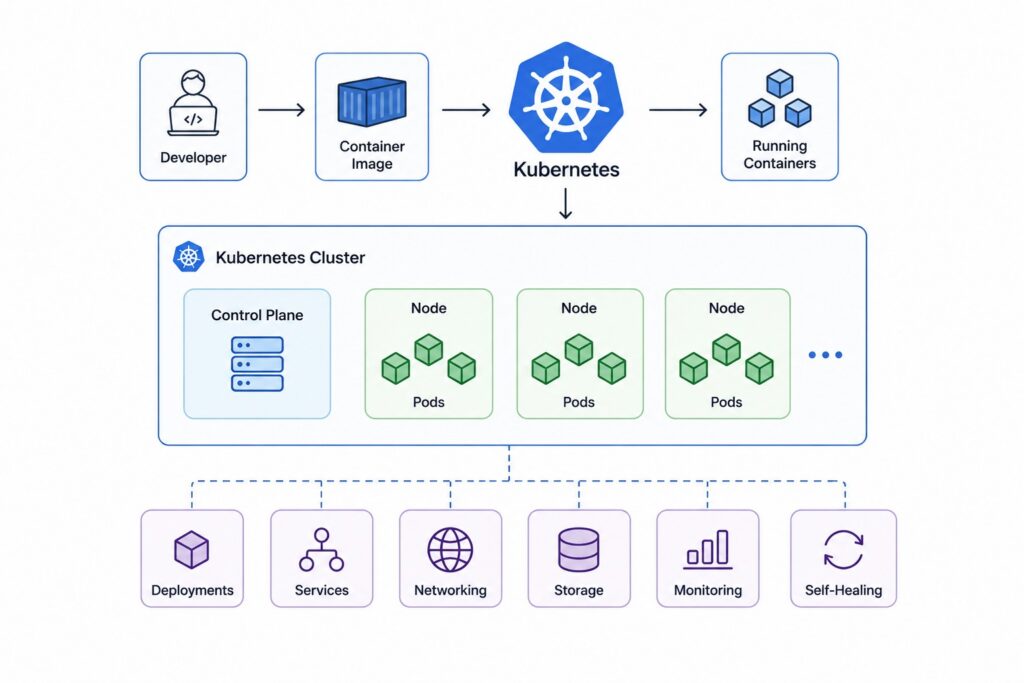
Kubernetes approaches application deployment differently. Rather than hiding infrastructure, it provides a platform for managing containers across clusters of machines. Developers package applications into container images, while Kubernetes schedules, scales, monitors, and recovers those containers automatically.
This flexibility makes Kubernetes suitable for a much broader range of workloads, but it also requires engineering teams to understand concepts such as pods, deployments, services, networking, storage, and cluster operations.
Different Goals, Not Direct Competitors
Although both platforms deploy applications, they optimize for different outcomes. Cloud Foundry prioritizes simplicity and consistency for developers, while Kubernetes prioritizes infrastructure flexibility and operational control. Many modern organizations even combine the two, running Cloud Foundry on top of Kubernetes to benefit from both approaches.
Understanding these architectural goals helps explain why the platforms continue to coexist rather than one completely replacing the other.
| Platform | Primary Focus |
|---|---|
| Cloud Foundry | Developer productivity and platform simplicity |
| Kubernetes | Container orchestration and infrastructure control |
| Cloud Foundry | Opinionated Platform as a Service |
| Kubernetes | Flexible cloud-native infrastructure platform |
Why This Comparison Matters
Organizations adopting cloud-native technologies often evaluate both Cloud Foundry and Kubernetes because each promises to simplify application deployment. However, comparing them purely as deployment tools overlooks the architectural philosophy behind each platform. The decision affects developer workflows, operational responsibilities, infrastructure management, and the overall engineering culture of an organization.
Rather than asking which platform is objectively better, architects should ask which platform aligns more closely with their team’s expertise, operational maturity, and business requirements.
The Evolution of Cloud Platforms
Application deployment has evolved significantly over the past two decades. Traditional applications were deployed directly onto physical servers or virtual machines, requiring engineers to manage operating systems, runtime environments, networking, and scaling manually. Platform as a Service solutions such as Cloud Foundry emerged to reduce this operational burden by automating much of the deployment lifecycle.
As containers became widely adopted, Kubernetes introduced a more flexible orchestration model that standardized how containerized workloads are deployed and managed across different environments. This evolution explains why both platforms remain relevant despite solving related problems.
Different Levels of Abstraction
One of the biggest differences between the two platforms is the level of abstraction they provide. Cloud Foundry intentionally hides many infrastructure details from developers, allowing applications to be deployed with minimal operational knowledge. Kubernetes exposes many of those underlying components so teams can customize infrastructure according to their specific requirements.
Neither philosophy is inherently superior. Higher abstraction improves developer productivity, while greater control supports more specialized workloads and operational flexibility.
Choosing the Right Platform
The appropriate choice depends on the organization’s priorities. Teams that value standardized deployments and minimal infrastructure management may benefit from Cloud Foundry, while organizations building complex cloud-native platforms often prefer Kubernetes because of its flexibility and extensive ecosystem.
Evaluating engineering skills, compliance requirements, workload diversity, and operational capabilities generally leads to better architectural decisions than comparing individual platform features.
| Consideration | Cloud Foundry | Kubernetes |
|---|---|---|
| Abstraction Level | High | Lower |
| Infrastructure Control | Limited | Extensive |
| Operational Complexity | Lower | Higher |
| Customization | Opinionated | Highly flexible |
| Best Fit | Developer-focused platforms | Cloud-native infrastructure |
How Cloud Foundry Works
Cloud Foundry provides developers with a complete application platform that automates much of the deployment process. Instead of manually creating containers, configuring networking, or managing orchestration systems, developers submit their application to the platform, which performs the remaining deployment steps automatically. This opinionated workflow reduces operational complexity while encouraging consistent deployment practices across engineering teams.
The platform manages much of the underlying infrastructure, allowing developers to concentrate primarily on application development rather than platform administration.
Developer Workflow
Deploying an application to Cloud Foundry is intentionally simple. Developers typically use the cf push command, providing application source code rather than pre-built container images. Cloud Foundry analyzes the application, prepares the runtime environment, deploys the application, and makes it available with minimal additional configuration.
This streamlined workflow shortens deployment time and reduces the number of infrastructure decisions developers must make during everyday development.
Buildpacks
One of Cloud Foundry’s defining features is its buildpack system. Buildpacks automatically detect the application’s programming language, install the required runtime, resolve dependencies, and package the application for deployment without requiring developers to manually create container images.
Because buildpacks standardize runtime environments, organizations achieve more consistent deployments while reducing differences between development and production environments.
Diego and Application Scheduling
Cloud Foundry uses Diego as its application scheduling and lifecycle management system. Diego continuously monitors deployed applications, ensuring that the desired number of application instances remain healthy and available. If an instance fails unexpectedly, the platform automatically replaces it without requiring manual intervention.
This self-healing behavior contributes to application reliability while allowing developers to focus less on operational management.
Routing and Service Binding
Cloud Foundry automatically handles request routing, assigning application URLs and directing incoming traffic toward healthy application instances. The platform also simplifies integration with databases, message queues, and other managed services through service binding, allowing applications to consume infrastructure services without embedding configuration directly into application code.
These capabilities significantly reduce the operational work required to deploy production-ready applications.
| Cloud Foundry Component | Responsibility |
|---|---|
| cf push | Deploy applications |
| Buildpacks | Detect language and prepare runtime |
| Diego | Schedule and manage application instances |
| Router | Direct incoming requests |
| Service Binding | Connect applications to managed services |
How Kubernetes Works
Kubernetes provides a platform for deploying and managing containerized applications across clusters of machines. Rather than automating every deployment decision, Kubernetes exposes powerful infrastructure primitives that allow engineering teams to describe the desired state of their applications declaratively. The platform continuously works to ensure the running system matches that desired configuration.
This declarative approach gives organizations considerable flexibility while requiring a deeper understanding of distributed systems and infrastructure management.
Containers and Pods
Applications running on Kubernetes are packaged as container images that include both application code and its runtime dependencies. Kubernetes schedules these containers inside pods, which represent the smallest deployable unit within the platform.
Pods provide networking, storage, and lifecycle management for one or more closely related containers, allowing applications to run consistently across different environments.
Deployments and ReplicaSets
Deployments define how applications should run within the cluster. Engineers specify the desired number of application replicas, update strategies, and container versions, while Kubernetes automatically creates ReplicaSets that maintain the requested number of healthy pods.
This declarative model simplifies scaling, rolling updates, and automatic recovery from failures.
Services and Networking
Because pods may be created or destroyed dynamically, Kubernetes introduces Services as stable networking endpoints that allow clients to communicate with applications regardless of where individual pods are running. Additional networking components such as Ingress controllers expose selected services externally while supporting routing, TLS termination, and load balancing.
These abstractions simplify communication within highly dynamic container environments.
Control Plane and Worker Nodes
Every Kubernetes cluster consists of a control plane and one or more worker nodes. The control plane manages scheduling, cluster state, and orchestration decisions, while worker nodes execute application workloads.
Controllers continuously compare the actual cluster state with the desired configuration, automatically correcting differences by creating, replacing, or rescheduling workloads whenever necessary.
| Kubernetes Component | Responsibility |
|---|---|
| Pod | Smallest deployable workload |
| Deployment | Define desired application state |
| ReplicaSet | Maintain application replicas |
| Service | Stable network endpoint |
| Control Plane | Manage cluster orchestration |
| Worker Node | Execute application workloads |
Cloud Foundry vs Kubernetes Architecture Comparison
Although both platforms deploy cloud applications, their internal architectures reflect fundamentally different philosophies. Cloud Foundry provides an opinionated application platform that abstracts away much of the infrastructure, while Kubernetes exposes the infrastructure components needed to manage containerized workloads directly. Understanding these architectural differences is more useful than comparing isolated features because they influence how applications are built, deployed, and operated.
The choice ultimately depends on how much infrastructure responsibility an organization wants developers to manage.
Infrastructure Abstraction
Cloud Foundry hides many operational concerns behind a simplified deployment interface. Developers interact primarily with the application platform while the system manages runtime environments, scheduling, networking, and application health automatically.
Kubernetes deliberately exposes infrastructure concepts such as pods, deployments, services, persistent storage, networking, and resource allocation. This provides greater flexibility but also increases the amount of infrastructure knowledge required.
Deployment Model
Cloud Foundry focuses on deploying applications directly from source code using buildpacks that prepare runtime environments automatically. Kubernetes generally expects applications to be packaged as container images before deployment, giving teams greater control over runtime configuration.
This difference significantly affects developer workflows as well as CI/CD pipeline design.
Operational Responsibilities
Cloud Foundry automates many operational tasks including routing, health management, and application lifecycle management. Kubernetes automates orchestration but expects operators to configure many supporting components such as ingress controllers, monitoring, logging, storage classes, and networking policies.
Organizations assume different operational responsibilities depending on the platform they adopt.
Extensibility
Kubernetes provides an extensive ecosystem of Custom Resource Definitions (CRDs), operators, controllers, and third-party integrations that allow organizations to customize nearly every aspect of cluster behavior. Cloud Foundry remains intentionally more opinionated, prioritizing consistency over unrestricted extensibility.
The result is greater flexibility in Kubernetes but greater standardization in Cloud Foundry.
| Architectural Area | Cloud Foundry | Kubernetes |
|---|---|---|
| Infrastructure Abstraction | High | Lower |
| Deployment Unit | Application source code | Container images |
| Runtime Management | Platform-managed | User-configurable |
| Extensibility | Opinionated platform | Highly extensible ecosystem |
| Operational Responsibility | Mostly platform-managed | Shared with platform operators |
Developer Experience Comparison
One of the most significant differences between Cloud Foundry and Kubernetes is the daily experience of application developers. Both platforms ultimately deploy applications, but the workflows, required knowledge, and operational responsibilities differ considerably. These differences influence developer productivity, onboarding time, CI/CD design, and long-term platform maintenance.
Understanding developer experience is therefore just as important as comparing infrastructure capabilities.
Application Deployment
Cloud Foundry emphasizes simplicity by allowing developers to deploy applications directly from source code using a single deployment command. The platform detects the application’s language, prepares the runtime environment, deploys the application, and exposes it through built-in routing with minimal manual configuration.
Kubernetes generally requires applications to be containerized first. Developers build container images, publish them to registries, and deploy them using declarative manifests that describe pods, deployments, services, and related resources.
Configuration Management
Both platforms support environment variables, secrets, and configuration management, but they expose these capabilities differently. Cloud Foundry centralizes much of the configuration process through platform-managed services, while Kubernetes provides ConfigMaps, Secrets, and other declarative configuration resources that offer greater flexibility.
This flexibility allows Kubernetes to support a wider variety of deployment scenarios but also introduces additional configuration complexity.
Scaling Applications
Scaling applications in Cloud Foundry typically involves adjusting the number of application instances through platform commands or autoscaling services. Kubernetes also supports horizontal scaling, but scaling behavior is configured through deployment specifications, Horizontal Pod Autoscalers, and custom metrics depending on workload requirements.
Both platforms provide automatic scaling capabilities, although Kubernetes generally offers more opportunities for customization.
Learning Curve
Cloud Foundry is often easier for application developers because much of the infrastructure complexity is hidden by the platform. Kubernetes provides considerably more control, but developers typically need to understand additional concepts such as containers, pods, networking, storage, resource management, and cluster operations before becoming productive.
Organizations often choose between these approaches based on whether they prioritize developer simplicity or infrastructure flexibility.
| Developer Workflow | Cloud Foundry | Kubernetes |
|---|---|---|
| Deployment | cf push from source code | Deploy container images |
| Runtime Preparation | Automatic buildpacks | User-managed container images |
| Configuration | Platform-managed | ConfigMaps, Secrets, manifests |
| Scaling | Simplified platform controls | Declarative autoscaling mechanisms |
| Learning Curve | Lower | Higher |
Scalability, Reliability, and Operations
Both Cloud Foundry and Kubernetes are designed to run production workloads at scale, but they take different approaches to operations. Cloud Foundry automates many operational responsibilities so application teams can focus primarily on development. Kubernetes provides powerful orchestration capabilities while allowing platform teams to customize nearly every aspect of how applications are deployed and managed. These differences influence not only scalability but also the operational maturity required to manage each platform successfully.
Organizations should therefore evaluate operational capabilities alongside technical features when comparing the two platforms.
High Availability
Cloud Foundry continuously monitors application health and automatically restarts failed instances when necessary. Much of this behavior is built into the platform, allowing engineering teams to benefit from high availability without configuring every operational detail manually.
Kubernetes also provides self-healing capabilities through controllers that monitor workloads and replace failed pods automatically. However, achieving complete platform availability often requires configuring multiple supporting components such as ingress controllers, storage systems, and highly available control planes.
Scaling Workloads
Both platforms support horizontal scaling, allowing additional application instances to be created as demand increases. Cloud Foundry provides a relatively straightforward scaling experience that abstracts much of the underlying infrastructure, while Kubernetes offers more granular control over autoscaling policies, resource allocation, and workload scheduling.
This flexibility makes Kubernetes well-suited for highly customized environments but introduces additional operational decisions that platform teams must manage.
Monitoring and Day-Two Operations
Operating production systems involves much more than deploying applications. Monitoring, logging, upgrades, backups, and ongoing maintenance become increasingly important as platforms grow. Cloud Foundry includes many operational capabilities as part of the platform experience, reducing the amount of infrastructure engineering required.
Kubernetes supports these same capabilities but generally relies on integrating specialized tools such as Prometheus, Grafana, Fluent Bit, or OpenTelemetry. This ecosystem provides tremendous flexibility while increasing operational complexity.
| Operational Area | Cloud Foundry | Kubernetes |
|---|---|---|
| Self-Healing | Built into the platform | Controller-driven recovery |
| Horizontal Scaling | Simplified platform scaling | Flexible autoscaling options |
| Monitoring | Platform-integrated capabilities | External ecosystem integrations |
| Operational Complexity | Lower | Higher |
Security Comparison
Security is a critical consideration for any platform that runs production applications. Both Cloud Foundry and Kubernetes provide strong security capabilities, but they distribute responsibilities differently. Cloud Foundry emphasizes secure defaults and platform-managed controls, while Kubernetes provides building blocks that allow organizations to implement security policies tailored to their own environments.
The choice between these approaches often depends on whether an organization values standardized security or extensive customization.
Identity and Access Management
Cloud Foundry provides centralized identity management that simplifies user authentication and application access across the platform. Administrators define organizational roles and permissions using platform-level controls, allowing development teams to focus less on infrastructure administration.
Kubernetes uses Role-Based Access Control (RBAC) to manage permissions throughout the cluster. RBAC offers extremely fine-grained authorization but typically requires more planning and operational expertise to configure correctly.
Network Security and Secrets
Cloud Foundry manages much of the networking configuration automatically, reducing the likelihood of accidental misconfiguration. Applications communicate through platform-managed routing while service bindings simplify secure connections to managed databases and other infrastructure services.
Kubernetes provides significantly more flexibility through network policies, service meshes, ingress controllers, and secret management. This flexibility enables sophisticated security architectures but requires platform operators to configure and maintain those components explicitly.
Multi-Tenancy and Compliance
Many enterprise organizations operate shared platforms supporting multiple development teams. Cloud Foundry includes strong multi-tenancy concepts through organizations and spaces that isolate workloads by default. Kubernetes also supports multi-tenancy through namespaces, RBAC, admission controllers, and network policies, although implementing robust tenant isolation generally requires additional architectural planning.
Organizations with strict regulatory requirements should evaluate not only the platform’s security capabilities but also the operational processes needed to maintain compliance over time.
| Security Area | Cloud Foundry | Kubernetes |
|---|---|---|
| Identity Management | Platform-managed access | RBAC-based authorization |
| Networking | Opinionated secure defaults | Highly configurable policies |
| Secrets | Service bindings and platform integration | Secrets and external secret managers |
| Multi-Tenancy | Organizations and spaces | Namespaces, RBAC, network policies |
When to Choose Cloud Foundry vs Kubernetes
Selecting between Cloud Foundry and Kubernetes is rarely about identifying a universally superior platform. Instead, the decision depends on organizational priorities, engineering expertise, workload characteristics, and operational goals. Understanding where each platform performs best helps architects choose technology that aligns with both current requirements and future growth.
In many enterprises, the answer is not choosing one over the other but determining where each platform provides the greatest value.
When Cloud Foundry Is the Better Choice
Cloud Foundry is well-suited for organizations that prioritize developer productivity and standardized application delivery. Enterprises with large development teams often benefit from its opinionated deployment model because it reduces operational complexity and creates consistent development workflows across multiple applications.
Organizations that want developers writing application code rather than managing infrastructure frequently find Cloud Foundry particularly valuable.
When Kubernetes Is the Better Choice
Kubernetes becomes the stronger choice when organizations require flexibility over how workloads are packaged, deployed, networked, and operated. It supports microservices, AI workloads, batch processing, containerized applications, and highly customized infrastructure while integrating with an enormous cloud-native ecosystem.
Engineering teams with strong platform expertise often prefer Kubernetes because it allows them to tailor infrastructure to the unique requirements of different applications.
When Organizations Use Both
Many enterprises combine both technologies instead of treating them as mutually exclusive. Modern Cloud Foundry deployments can run on Kubernetes, allowing organizations to preserve the Cloud Foundry developer experience while taking advantage of Kubernetes as the underlying orchestration platform.
This layered approach demonstrates that the two technologies often complement one another rather than compete directly.
| Scenario | Better Choice |
|---|---|
| Standardized enterprise development | Cloud Foundry |
| Cloud-native platform engineering | Kubernetes |
| Complex container orchestration | Kubernetes |
| Maximum developer simplicity | Cloud Foundry |
| Enterprise modernization | Often both together |
Common Misconceptions
Cloud Foundry and Kubernetes are often compared using simplified statements that overlook the architectural goals behind each platform. These misconceptions frequently lead to technology decisions based on popularity rather than actual engineering requirements. Understanding what each platform was designed to accomplish provides a more accurate basis for comparison.
Most misunderstandings arise from assuming both platforms attempt to solve exactly the same problem.
Kubernetes Replaces Cloud Foundry
One common misconception is that Kubernetes completely replaces Cloud Foundry. While Kubernetes has become the dominant container orchestration platform, Cloud Foundry continues to provide value by offering a higher level of abstraction that simplifies application deployment for developers.
In fact, many modern Cloud Foundry environments now use Kubernetes internally, illustrating that the technologies can work together rather than compete.
Cloud Foundry Cannot Run Containers
Cloud Foundry is sometimes viewed as a platform limited to buildpacks and traditional application deployments. Modern implementations, however, support container-based workloads alongside buildpack-based deployments, giving organizations additional flexibility while preserving the platform’s developer-focused experience.
The distinction lies more in the deployment workflow than in whether containers are supported.
Kubernetes Is Always Better
Kubernetes offers exceptional flexibility, but flexibility also introduces operational complexity. Organizations without dedicated platform engineering teams may spend significant effort managing infrastructure that Cloud Foundry automates by default.
The best platform is therefore the one that aligns with organizational capabilities rather than the one exposing the largest number of configurable features.
Both Platforms Require the Same Skills
Cloud Foundry developers can often remain productive with relatively little infrastructure knowledge because the platform hides many operational details. Kubernetes users typically benefit from understanding containers, networking, storage, scheduling, and cluster management.
These different expectations influence onboarding, training, and long-term operational responsibilities.
| Misconception | Reality |
|---|---|
| Kubernetes replaces Cloud Foundry | They solve different problems and can coexist |
| Cloud Foundry cannot use containers | Modern versions support container workloads |
| Kubernetes is always better | The right choice depends on organizational needs |
| Both platforms require identical skills | Kubernetes generally requires deeper infrastructure knowledge |
Cloud Foundry vs Kubernetes in System Design Interviews
Platform selection discussions appear frequently in cloud architecture, DevOps, platform engineering, and infrastructure interviews. Interviewers rarely expect candidates to compare every feature of Cloud Foundry and Kubernetes. Instead, they evaluate whether candidates understand the tradeoffs between abstraction, operational complexity, developer productivity, and infrastructure flexibility.
Successful answers focus on architectural reasoning rather than simply recommending whichever platform is currently more popular.
What Interviewers Evaluate
Interviewers typically assess whether candidates understand why an organization would choose one platform over another. Discussions often involve deployment automation, operational overhead, scalability, ecosystem integration, platform management, and developer experience.
Explaining how organizational maturity influences platform selection usually demonstrates stronger engineering judgment than listing technical capabilities alone.
Common Interview Scenarios
Cloud Foundry and Kubernetes comparisons commonly appear during discussions about enterprise modernization, cloud migration, internal developer platforms, or large-scale application deployment. Candidates may be asked to recommend a platform for a particular organization and justify that decision using both technical and operational considerations.
These conversations emphasize tradeoff analysis rather than identifying a universally correct answer.
Common Candidate Mistakes
Many candidates compare individual features instead of architectural goals. Others assume Kubernetes is automatically preferable because of its popularity or dismiss Cloud Foundry without considering organizations that prioritize standardized developer workflows.
Strong candidates acknowledge that different organizations optimize for different outcomes and explain how those priorities influence platform selection.
| Interview Focus | What Interviewers Evaluate |
|---|---|
| Platform Selection | Matching technology to business needs |
| Operational Reasoning | Understanding management complexity |
| Scalability | Supporting future growth |
| Developer Experience | Productivity versus flexibility |
| Tradeoff Analysis | Balanced architectural decision making |
Frequently Asked Questions About Cloud Foundry vs Kubernetes
Cloud Foundry and Kubernetes are frequently compared because both simplify application deployment, yet they operate at different layers of the cloud-native stack. Engineers evaluating modern deployment platforms often encounter similar questions about how these technologies relate to one another, whether they compete directly, and which one is more appropriate for different environments.
Understanding these distinctions helps organizations choose platforms based on architectural requirements rather than industry trends.
Is Cloud Foundry the same as Kubernetes?
No. Cloud Foundry is a Platform as a Service that focuses on simplifying application deployment and improving developer productivity. Kubernetes is a container orchestration platform that manages containerized workloads and provides infrastructure flexibility.
Although both deploy applications, they solve different operational problems.
Can Cloud Foundry run on Kubernetes?
Yes. Modern Cloud Foundry implementations can use Kubernetes as the underlying orchestration platform. This allows organizations to combine Cloud Foundry’s developer experience with Kubernetes’ infrastructure capabilities.
The two technologies complement each other rather than existing as mutually exclusive alternatives.
Which platform is easier to learn?
Cloud Foundry generally has a shorter learning curve for application developers because much of the infrastructure complexity is hidden by the platform. Kubernetes typically requires additional knowledge of containers, networking, storage, scheduling, and cluster management.
The appropriate learning path depends on whether the goal is application development or platform engineering.
Which platform provides more flexibility?
Kubernetes offers substantially greater flexibility because it exposes infrastructure primitives that can be customized for many different workloads. Cloud Foundry intentionally limits some configuration options to create a more standardized and predictable development experience.
Greater flexibility, however, usually comes with increased operational complexity.
Is Kubernetes replacing Cloud Foundry?
Not entirely. While Kubernetes has become the dominant orchestration platform, Cloud Foundry continues to be used in enterprises that value developer productivity and standardized deployment workflows. Many organizations now deploy Cloud Foundry on Kubernetes, illustrating how both technologies can coexist successfully.
Their relationship is increasingly complementary rather than competitive.
Which platform is better for enterprise applications?
The answer depends on organizational priorities. Enterprises emphasizing standardized application delivery may prefer Cloud Foundry, while organizations building highly customized cloud-native platforms often adopt Kubernetes because of its extensive ecosystem and flexibility.
Architecture decisions should be guided by business requirements rather than platform popularity.
Should beginners learn Kubernetes or Cloud Foundry first?
For engineers interested in cloud infrastructure, platform engineering, or DevOps, Kubernetes generally provides broader industry exposure. Developers working primarily within organizations using Cloud Foundry may benefit from learning its deployment model first while gradually expanding their infrastructure knowledge over time.
Both learning paths ultimately benefit from understanding cloud-native architecture fundamentals.
Can organizations use both together?
Yes. Many enterprises combine Cloud Foundry and Kubernetes, allowing Cloud Foundry to provide a simplified developer experience while Kubernetes manages the underlying infrastructure. This approach demonstrates that the technologies often address different concerns within the same overall architecture.
Combining the two can provide a balance between productivity and operational flexibility.
| Question | Short Answer |
|---|---|
| Are Cloud Foundry and Kubernetes the same? | No, they solve different problems. |
| Can Cloud Foundry run on Kubernetes? | Yes. |
| Which is easier to learn? | Cloud Foundry for developers; Kubernetes for platform engineers. |
| Which offers more flexibility? | Kubernetes. |
| Is Kubernetes replacing Cloud Foundry? | Not entirely. |
| Can organizations use both? | Yes, many do. |
Final Thoughts
Cloud Foundry and Kubernetes are often presented as competing technologies, but they address different layers of modern cloud architecture. Cloud Foundry focuses on creating a streamlined developer experience by abstracting much of the underlying infrastructure, allowing teams to deploy applications quickly with minimal operational knowledge. Kubernetes, in contrast, provides the flexibility and control needed to orchestrate containerized workloads across complex cloud-native environments, making it the foundation for many modern platform engineering strategies.
Choosing between these platforms is ultimately less about technical superiority and more about organizational priorities. Teams that value standardized application delivery and reduced operational overhead may find Cloud Foundry to be the better fit, while organizations requiring extensive infrastructure customization and a broad cloud-native ecosystem often benefit from Kubernetes. By understanding the architectural philosophy, operational tradeoffs, and strengths of each platform, you can make more informed technology decisions and confidently discuss these platforms in cloud architecture and System Design interviews.