
Messaging systems are middleware platforms that enable applications and services to communicate by exchanging messages rather than interacting directly with one another. Instead of requiring one service to call another synchronously, applications send messages to a broker, which is responsible for storing, routing, and delivering those messages to the appropriate recipients. This approach allows services to operate independently while improving scalability, reliability, and fault tolerance.
Modern distributed systems rely heavily on messaging systems because they reduce dependencies between services and make applications more resilient to failures. Whether processing background jobs, broadcasting business events, or streaming real-time data, messaging systems provide the communication backbone for cloud-native architectures.
Enabling Asynchronous Communication
Traditional request-response communication requires one application to wait while another completes its work. Messaging systems eliminate this dependency by allowing producers to publish messages and continue processing immediately.
Consumers retrieve and process messages independently, improving overall system responsiveness.
Decoupling Services
Applications communicating through a messaging system do not need direct knowledge of one another. Producers simply publish messages, while consumers subscribe to or retrieve those messages according to the communication model being used.
This loose coupling simplifies development, deployment, and long-term maintenance.
Message Brokers as Intermediaries
Rather than communicating directly, applications exchange messages through a message broker. The broker manages message routing, storage, acknowledgments, retries, and delivery policies.
By centralizing these responsibilities, messaging systems improve both reliability and operational flexibility.
| Concept | Purpose |
|---|---|
| Messaging System | Enable asynchronous communication |
| Producer | Publish messages |
| Broker | Route and manage messages |
| Consumer | Process messages |
Why Messaging Systems Matter
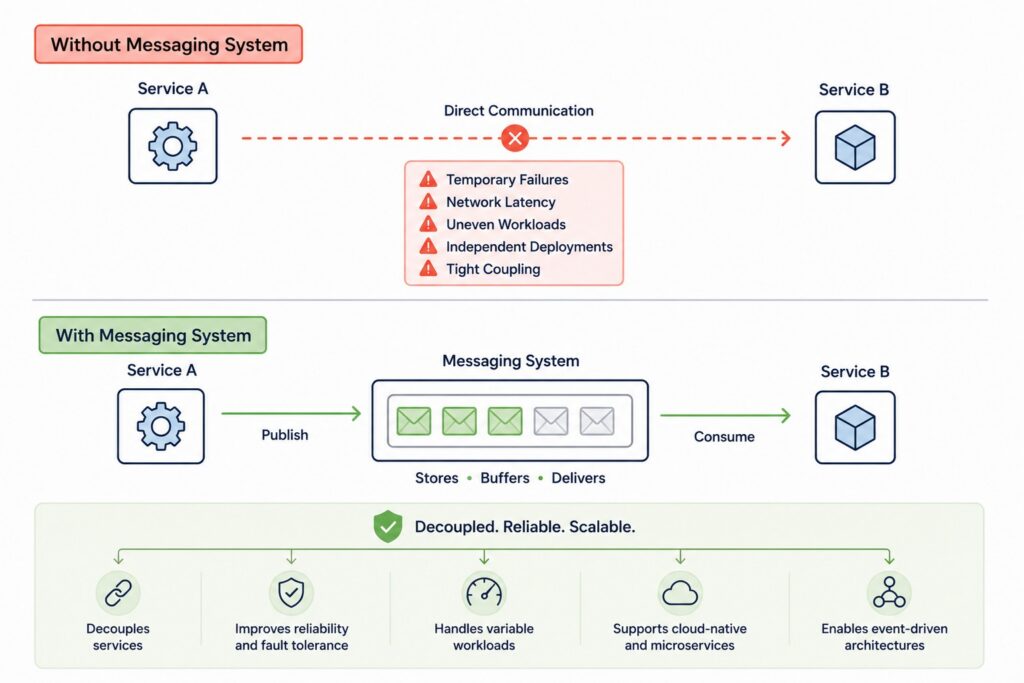
As applications grow into distributed systems, direct communication between services becomes increasingly difficult to manage. Temporary failures, network latency, uneven workloads, and independently deployed services all introduce challenges that tightly coupled architectures struggle to handle. Messaging systems solve these problems by separating message production from message consumption, allowing services to communicate reliably without depending on one another’s immediate availability.
These characteristics make messaging systems a fundamental component of modern cloud applications, microservices, and event-driven architectures.
Asynchronous Communication
Many business operations do not require immediate processing. Tasks such as sending emails, generating reports, processing images, or updating analytics can occur after the user receives a response.
Messaging systems allow these background activities to execute asynchronously without increasing user-facing latency.
Scalability
Application traffic rarely remains constant. During busy periods, producers may generate messages much faster than consumers can process them.
Messaging systems buffer these workloads while allowing additional consumers to be deployed whenever processing capacity needs to increase.
Reliability
Unexpected failures should not immediately result in lost work. Messaging systems store messages safely until they are successfully delivered or processed according to the configured delivery guarantees.
This improves application resilience during temporary outages.
Loose Coupling
Independent services should evolve without requiring coordinated deployments. Messaging systems isolate producers from consumers, allowing each service to change implementation details, deployment schedules, or programming languages independently.
Loose coupling greatly simplifies large-scale software development.
| Distributed System Challenge | Messaging System Solution |
|---|---|
| Long-running tasks | Asynchronous processing |
| Traffic spikes | Message buffering |
| Service failures | Reliable delivery |
| Tight dependencies | Loose coupling |
Core Components of a Messaging System
Although messaging platforms vary in implementation, most share a common set of architectural components. Producers generate messages, brokers coordinate communication, queues and topics organize message delivery, consumers perform processing, and delivery mechanisms ensure reliable communication. Together, these components enable scalable asynchronous messaging across distributed applications.
Understanding these building blocks makes it much easier to compare different messaging technologies and communication patterns.
Producers
Producers are applications or services that generate messages whenever important business events or background tasks occur. Examples include order services publishing purchase events, authentication systems generating login notifications, or applications scheduling asynchronous jobs.
After publishing a message, producers typically continue processing without waiting for downstream services.
Message Broker
The message broker serves as the central communication hub. It receives incoming messages, determines where they should be delivered, temporarily stores messages when necessary, and coordinates communication between producers and consumers.
The broker also manages acknowledgments, retries, routing rules, and delivery guarantees.
Queues and Topics
Messaging systems commonly organize communication using queues or topics. Queues distribute work among consumers, while topics broadcast events to multiple independent subscribers.
Different messaging technologies may support one or both communication models.
Consumers and Subscribers
Consumers retrieve messages from queues, while subscribers receive events published to topics. Both execute application-specific business logic after receiving messages.
Multiple consumers or subscribers can often operate simultaneously to improve scalability.
Delivery Guarantees
Messaging systems define how reliably messages are delivered through mechanisms such as acknowledgments, retries, persistence, and redelivery policies.
These guarantees determine what happens when failures interrupt normal message processing.
| Component | Responsibility |
|---|---|
| Producer | Publish messages |
| Broker | Route and manage communication |
| Queue or Topic | Organize message delivery |
| Consumer or Subscriber | Process messages |
| Delivery Guarantees | Ensure reliable communication |
How Messaging Systems Work
Every message follows a structured lifecycle as it moves through the messaging infrastructure. Rather than communicating directly with downstream services, producers publish messages to a broker, which determines how those messages should be routed and delivered. Consumers then process the messages independently according to the messaging pattern being used.
This workflow allows applications to remain responsive while supporting scalable asynchronous communication.
Producer Publishes a Message
The messaging process begins when an application creates a message describing either a task or an event. This message may represent a customer order, payment confirmation, notification request, or any other business operation.
The producer sends the message to the broker instead of contacting downstream services directly.
Broker Receives the Message
The broker validates the incoming message and applies routing rules to determine its destination. Depending on the messaging model, the broker may place the message into a queue or publish it to a topic.
The producer’s responsibility ends once the broker accepts the message.
Queue or Topic Stores the Message
The broker temporarily stores the message until consumers or subscribers retrieve it. Some messaging systems also persist messages to durable storage for improved reliability.
Retention behavior depends on the messaging technology and delivery configuration.
Consumer or Subscriber Processes the Message
Consumers retrieve queued work items, while subscribers receive published events. Each recipient executes the business logic associated with the message.
Multiple recipients may process different messages simultaneously to improve throughput.
Acknowledgment and Completion
Once processing completes successfully, the consumer or subscriber acknowledges the message. Depending on the communication model, the broker either removes the message or records successful delivery.
Failures during processing may trigger retries or redelivery according to configured policies.
| Message Stage | Responsibility |
|---|---|
| Publish | Producer creates message |
| Receive | Broker accepts message |
| Store | Queue or topic retains message |
| Process | Consumer executes work |
| Acknowledge | Confirm successful completion |
Types of Messaging Systems
Messaging systems support several communication patterns because different workloads require different delivery behaviors. Some applications distribute background work among competing consumers, while others broadcast business events across multiple services or maintain persistent event logs for analytics. Understanding these messaging models helps architects select the appropriate communication pattern for each application.
Many enterprise systems combine multiple messaging patterns within the same overall architecture.
Message Queues
Message queues distribute work among multiple consumers. Each message is processed by one consumer before being removed from the queue.
This model is ideal for background jobs, asynchronous workflows, and task execution.
Publish-Subscribe (Pub/Sub)
The publish-subscribe (Pub/Sub) model broadcasts each published event to every interested subscriber. Multiple services can therefore react independently to the same business event.
Pub/Sub forms the foundation of many event-driven architectures.
Event Streaming
Event streaming platforms maintain persistent ordered logs of events that consumers can replay whenever necessary. Rather than removing events after processing, streams often retain them for extended periods.
This model is widely used for analytics, monitoring, and real-time data processing.
Request-Reply Messaging
Some messaging systems support synchronous communication through brokers by allowing producers to publish requests while waiting for corresponding replies.
Although less common than asynchronous messaging, this pattern can simplify communication in certain distributed environments.
Hybrid Messaging
Many modern messaging platforms combine queues, Pub/Sub, and event streaming into one integrated system. Different application components can therefore use the communication model that best matches their specific workload.
Hybrid messaging provides significant architectural flexibility.
| Messaging Pattern | Primary Purpose |
|---|---|
| Message Queue | Work distribution |
| Publish-Subscribe | Event broadcasting |
| Event Streaming | Persistent event logs |
| Request-Reply | Broker-mediated request-response |
| Hybrid Messaging | Multiple communication models |
Popular Messaging Technologies
Numerous messaging platforms exist today, each optimized for different workloads and architectural styles. Some focus on traditional enterprise messaging, others specialize in high-throughput event streaming, while several provide fully managed cloud messaging services. Choosing the appropriate technology depends on scalability requirements, operational complexity, latency expectations, and communication patterns.
Although these technologies differ internally, they all provide reliable message-based communication between distributed applications.
RabbitMQ
RabbitMQ is one of the most widely used traditional message brokers. It supports queues, routing exchanges, acknowledgments, priorities, delayed delivery, and flexible messaging patterns.
Its mature ecosystem makes it popular for background processing and enterprise applications.
Apache Kafka
Kafka is designed primarily for high-throughput event streaming rather than traditional message queuing. It stores persistent ordered event logs that multiple consumer groups can process independently.
Kafka excels in analytics pipelines, event-driven architectures, and real-time data platforms.
Amazon SQS and SNS
Amazon SQS provides fully managed message queues, while Amazon SNS offers managed publish-subscribe messaging. Together they support scalable asynchronous communication within AWS environments.
Their managed nature eliminates much of the operational overhead associated with self-hosted messaging infrastructure.
Google Pub/Sub
Google Cloud Pub/Sub provides globally scalable managed messaging for distributed cloud applications. It automatically scales while supporting reliable event distribution across services.
Its cloud-native design simplifies messaging in Google Cloud deployments.
Apache ActiveMQ
Apache ActiveMQ is a mature enterprise messaging platform supporting numerous messaging protocols and integration patterns. It remains widely used in organizations requiring compatibility with existing enterprise systems.
Its flexibility makes it suitable for many business-critical applications.
NATS
NATS is a lightweight, cloud-native messaging platform emphasizing simplicity, low latency, and high performance. It integrates naturally with microservices and containerized environments.
Its minimal operational footprint makes it attractive for modern distributed systems.
| Technology | Primary Strength |
|---|---|
| RabbitMQ | Traditional message queuing |
| Apache Kafka | Event streaming |
| Amazon SQS/SNS | Managed cloud messaging |
| Google Pub/Sub | Cloud-native messaging |
| Apache ActiveMQ | Enterprise integration |
| NATS | Lightweight cloud-native messaging |
Performance and Scalability
One of the primary reasons organizations adopt messaging systems is their ability to scale communication independently of application processing. Instead of forcing services to process every request immediately, messaging systems buffer workloads, distribute messages efficiently, and allow producers and consumers to scale independently. This decoupling enables applications to handle millions of messages while maintaining responsiveness under highly variable workloads.
Different messaging platforms use different scalability strategies, but all aim to maximize throughput while minimizing latency and operational bottlenecks.
Horizontal Scaling
Messaging systems scale horizontally by allowing additional brokers, producers, and consumers to be deployed as workloads increase. Rather than relying on a single server, communication is distributed across multiple nodes.
This approach enables messaging infrastructure to grow alongside application demand.
Partitioning
High-volume messaging platforms often divide messages into partitions or shards. Multiple consumers can process different partitions simultaneously, significantly increasing throughput while preserving ordering within individual partitions when required.
Partitioning is particularly important for event streaming platforms handling massive workloads.
Consumer Groups
Many messaging systems organize consumers into consumer groups. Messages are distributed automatically among consumers within a group, allowing work to be processed in parallel without duplication.
Consumer groups make scaling message processing straightforward.
High Throughput
Modern messaging platforms optimize throughput through batching, efficient network protocols, asynchronous I/O, and sequential disk writes where appropriate. These optimizations allow brokers to process millions of messages per second in large production environments.
Performance improvements come from both software architecture and efficient hardware utilization.
| Scalability Technique | Benefit |
|---|---|
| Horizontal Scaling | Add brokers and consumers |
| Partitioning | Parallel message processing |
| Consumer Groups | Automatic workload sharing |
| High Throughput | Efficient large-scale messaging |
Reliability and Fault Tolerance
Distributed systems must continue exchanging messages even when servers fail, networks become unreliable, or applications crash unexpectedly. Messaging systems improve reliability by storing messages safely, retrying failed deliveries, replicating critical data, and isolating problematic messages that repeatedly fail processing.
These reliability mechanisms allow applications to recover gracefully from failures without losing important business events or background tasks.
Message Persistence
Many messaging systems persist messages to durable storage before acknowledging successful publication. If a broker restarts unexpectedly, persisted messages remain available for later delivery.
Persistence significantly improves durability for business-critical communication.
Replication
Enterprise messaging platforms commonly replicate messages across multiple broker nodes. If one broker becomes unavailable, another replica can continue serving producers and consumers with minimal interruption.
Replication improves both availability and disaster recovery.
Retry Policies
Temporary failures should not permanently lose messages. Messaging systems automatically retry failed deliveries according to configurable retry policies, allowing consumers additional opportunities to process messages successfully.
Retries reduce manual intervention during transient failures.
Dead Letter Queues
Messages that repeatedly fail processing can be moved into Dead Letter Queues (DLQs) instead of blocking normal message flow. Administrators can later inspect, correct, or replay these problematic messages.
Dead letter queues improve operational visibility while protecting overall system throughput.
Disaster Recovery
Large-scale deployments frequently replicate messaging infrastructure across multiple availability zones or geographic regions. Multi-region replication helps maintain communication even during major infrastructure outages.
Disaster recovery planning is especially important for mission-critical applications.
| Reliability Feature | Purpose |
|---|---|
| Message Persistence | Protect messages from failures |
| Replication | Broker redundancy |
| Retry Policies | Recover from temporary failures |
| Dead Letter Queues | Isolate failed messages |
| Disaster Recovery | Multi-region resilience |
Common Use Cases
Messaging systems support a wide variety of distributed application architectures because they enable reliable asynchronous communication between independent services. From processing customer orders to distributing real-time events, messaging systems simplify application scaling while reducing dependencies between components.
Although every organization uses messaging differently, several common architectural patterns appear repeatedly across modern software systems.
Microservices
Microservices frequently communicate through messaging systems rather than direct API calls. Services publish events or tasks while downstream services process them independently.
This loose coupling simplifies deployments while improving system resilience.
Order Processing
E-commerce platforms commonly use messaging systems to coordinate inventory updates, payment processing, shipping, invoice generation, and customer notifications after an order is placed.
Breaking these workflows into asynchronous messages improves scalability and fault tolerance.
Event-Driven Architectures
Many applications generate business events whenever important state changes occur. Messaging systems distribute these events to interested services such as analytics, auditing, notifications, and recommendation engines.
This architecture allows new services to consume existing events without modifying the original application.
Data Pipelines
Analytics platforms, monitoring systems, and machine learning pipelines continuously consume large streams of application events. Messaging systems transport these events reliably between data producers and downstream processing systems.
Streaming architectures frequently depend on messaging infrastructure.
Notifications
Applications commonly use messaging systems to deliver email, SMS, push notifications, and webhook events asynchronously. Background workers process notification requests independently of the original user interaction.
Users receive immediate responses while notifications are delivered separately.
| Use Case | Messaging Benefit |
|---|---|
| Microservices | Loose service communication |
| Order Processing | Asynchronous workflows |
| Event-Driven Systems | Business event propagation |
| Data Pipelines | Reliable event transport |
| Notifications | Background message delivery |
Common Misconceptions About Messaging Systems
Because messaging systems are widely used across cloud-native architectures, developers sometimes assume they solve every distributed systems challenge automatically. In reality, messaging systems introduce their own architectural tradeoffs and should be selected based on specific application requirements.
Understanding these misconceptions helps engineers build messaging architectures that remain both scalable and maintainable.
Messaging Systems Replace APIs
Messaging systems complement synchronous APIs rather than replacing them. Many applications continue using REST or gRPC for immediate request-response communication while using messaging for asynchronous workflows.
Most production systems rely on both communication models.
All Messaging Systems Are the Same
Different messaging platforms optimize different workloads. RabbitMQ focuses on traditional queuing, Kafka specializes in event streaming, while cloud-native services emphasize managed scalability.
Selecting the appropriate platform depends on communication requirements rather than popularity.
Messaging Guarantees Exactly-Once Delivery
Many messaging systems provide at-least-once delivery rather than true exactly-once processing. Applications often need idempotent consumers to safely handle duplicate messages.
Delivery guarantees vary considerably between technologies.
Messaging Eliminates Failures
Messaging systems improve resilience but cannot prevent hardware failures, network partitions, software bugs, or operational mistakes. Monitoring, retries, replication, and operational practices remain essential.
Messaging reduces failure impact rather than eliminating failures completely.
Every Distributed System Needs a Broker
Small applications with straightforward request-response communication may not benefit from introducing messaging infrastructure. Adding brokers unnecessarily increases operational complexity.
Messaging should solve a genuine architectural problem rather than being introduced by default.
| Misconception | Reality |
|---|---|
| Messaging replaces APIs | Both communication models are valuable |
| All brokers are identical | Different platforms target different workloads |
| Exactly-once is guaranteed | Often only at-least-once delivery |
| Messaging prevents failures | It improves recovery and resilience |
| Every system needs messaging | Simpler systems may not |
Messaging Systems in System Design Interviews
Messaging systems are one of the most frequently discussed topics in backend and distributed systems interviews because they solve many of the scalability and reliability challenges encountered in modern software architectures. Interviewers expect candidates to understand not only how messaging systems work but also when they should be introduced and which communication pattern best fits a particular workload.
Strong candidates explain messaging decisions in terms of architectural requirements rather than simply recommending a particular technology.
When to Recommend Messaging Systems
Messaging systems become appropriate whenever applications require asynchronous processing, loose coupling, workload buffering, event-driven communication, or background task execution.
Examples include notification services, payment processing, analytics pipelines, order workflows, and microservice communication.
What Interviewers Evaluate
Interviewers commonly evaluate understanding of asynchronous communication, message durability, ordering guarantees, delivery semantics, scalability, retries, acknowledgments, persistence, and failure recovery.
Candidates should explain both the benefits and operational costs of introducing messaging infrastructure.
Common Candidate Mistakes
Many candidates confuse message queues with event streaming platforms or assume every distributed system automatically requires Kafka or RabbitMQ. Others ignore retries, dead letter queues, monitoring, or operational complexity when discussing messaging architectures.
Strong interview answers distinguish communication patterns while balancing scalability, reliability, and simplicity.
| Interview Topic | What Interviewers Evaluate |
|---|---|
| Asynchronous Communication | Appropriate workload selection |
| Messaging Patterns | Queue, Pub/Sub, and streaming |
| Reliability | Persistence, retries, acknowledgments |
| Scalability | Partitioning and consumer groups |
| Architectural Tradeoffs | Simplicity versus flexibility |
Frequently Asked Questions About Messaging Systems
Messaging systems are one of the foundational technologies behind modern distributed applications because they enable scalable, reliable, and loosely coupled communication between independent services. Although every messaging platform implements these concepts differently, the underlying architectural principles remain remarkably consistent across technologies.
The following questions address several concepts commonly encountered when learning messaging architectures.
What is a messaging system?
A messaging system is middleware that enables applications to exchange messages asynchronously through brokers rather than communicating directly.
It improves scalability, reliability, and service independence.
What is the difference between a message queue and a messaging system?
A message queue is one communication pattern supported by many messaging systems. A messaging system is the broader platform that may support queues, publish-subscribe messaging, event streaming, and additional communication models.
Queues represent one capability within a larger messaging ecosystem.
What is the difference between messaging systems and event streaming?
Messaging systems encompass multiple communication patterns, including traditional message queues and event streaming. Event streaming specifically focuses on persistent ordered event logs that multiple consumers can replay independently.
Not every messaging system supports full event streaming.
Which messaging system should you choose?
RabbitMQ is well-suited for traditional messaging, Kafka excels at high-throughput event streaming, Amazon SQS and SNS simplify AWS deployments, Google Pub/Sub provides managed cloud messaging, ActiveMQ supports enterprise integration, and NATS emphasizes lightweight cloud-native communication.
Technology selection should reflect workload requirements.
How do messaging systems improve scalability?
Messaging systems buffer workloads, distribute processing across multiple consumers, decouple services, and allow producers and consumers to scale independently.
This significantly improves resource utilization during traffic spikes.
Do messaging systems guarantee message delivery?
Delivery guarantees vary between platforms. Many provide at-least-once delivery with retries and acknowledgments, while stronger guarantees often require additional coordination and application support.
Applications should understand their messaging platform’s delivery semantics.
Can messaging systems work across cloud environments?
Yes. Many messaging platforms support hybrid cloud, multi-cloud, and on-premises deployments, allowing applications running in different environments to exchange messages reliably.
Cloud-native managed services are also widely available.
When should you avoid using a messaging system?
Simple applications with straightforward synchronous workflows often do not benefit from introducing messaging infrastructure. If asynchronous processing, loose coupling, or workload buffering are unnecessary, direct communication may be simpler and easier to maintain.
Messaging should address real architectural needs rather than increasing complexity.
| Question | Short Answer |
|---|---|
| What is a messaging system? | Middleware for asynchronous communication |
| Queue vs messaging system? | Queue is one messaging pattern |
| Messaging vs event streaming? | Streaming is one messaging model |
| How does messaging scale? | Independent producers and consumers |
| Does it guarantee delivery? | Depends on the platform |
| When avoid messaging? | Simple synchronous applications |
Final Thoughts
Messaging systems provide the foundation for asynchronous communication in modern distributed applications by connecting producers and consumers through brokers, queues, topics, and well-defined delivery guarantees. Rather than requiring services to communicate directly, messaging systems buffer workloads, route messages intelligently, and allow applications to continue operating even when downstream services are temporarily unavailable. Communication patterns such as message queues, publish-subscribe, and event streaming each address different architectural challenges while improving scalability, reliability, and fault tolerance.
Understanding messaging systems is essential for backend engineering, cloud infrastructure, microservices, and event-driven architecture because nearly every large-scale distributed application depends on reliable message-based communication. Whether building background processing pipelines, coordinating business workflows, streaming real-time events, or integrating independent services, selecting the appropriate messaging pattern requires balancing throughput, durability, latency, operational complexity, and delivery guarantees. These tradeoffs also make messaging systems one of the most important topics encountered in modern System Design interviews.