
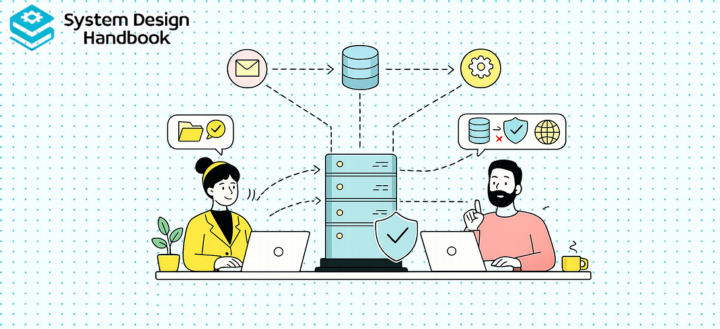
Nearly every modern application you use follows the client-server model. Opening a website, checking your email, streaming a video, sending a message, or using a mobile banking app all involve a client communicating with one or more servers across a network. Although users typically see only the interface on their device, most of the actual processing, data storage, and business logic occur on backend servers. Client-server architecture provides the structure that makes this interaction possible.
At its core, client-server architecture is a computing model in which one component, known as the client, requests a service or resource, while another component, known as the server, processes the request and returns an appropriate response. This separation of responsibilities allows applications to remain scalable, maintainable, and accessible from many different devices.
Understanding the Roles of Clients and Servers
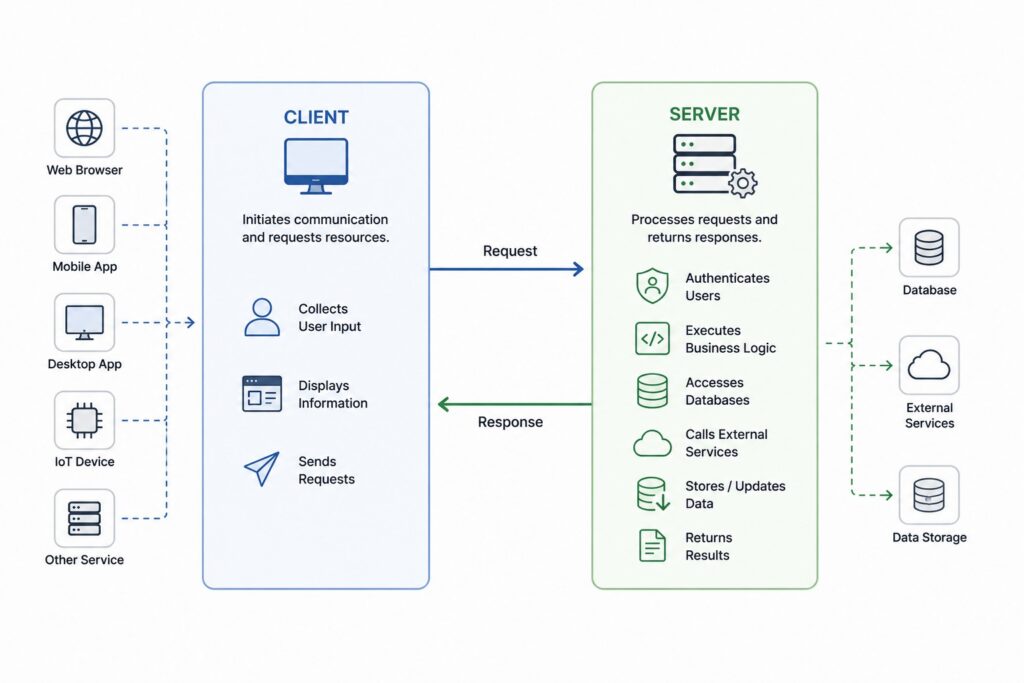
The client is responsible for initiating communication with the server. This client may be a web browser, a mobile application, a desktop program, an IoT device, or another software service. Its primary responsibilities include collecting user input, displaying information, and sending requests for resources or operations.
The server receives those requests, performs the necessary work, and generates responses. Depending on the application, the server may authenticate users, execute business logic, retrieve information from databases, communicate with external services, or store new data before returning results to the client.
Requests and Responses
Communication between clients and servers follows a request-response model. A client sends a request describing what it needs, and the server processes that request before returning a response. The response may contain data, confirmation that an operation succeeded, an error message, or instructions for additional interactions.
Although this exchange appears simple, modern systems often involve multiple servers, databases, caches, and supporting services working together before a single response reaches the client.
Client-Server Architecture Is Everywhere
The client-server model forms the foundation of countless computing systems. Websites, SaaS applications, cloud platforms, APIs, email systems, multiplayer games, and streaming services all depend on this architectural pattern because it separates user interaction from backend processing while supporting large numbers of simultaneous users.
Understanding this model is essential because many advanced System Design concepts build directly upon its principles.
| Component | Primary Responsibility |
|---|---|
| Client | Initiate requests and present information |
| Server | Process requests and generate responses |
| Request | Ask for a resource or operation |
| Response | Return data or execution results |
| Network | Carry communication between client and server |
Why Client-Server Architecture Matters
Separating clients from servers has become one of the most important design principles in modern software engineering. Rather than placing all application logic on individual devices, backend servers centralize processing, storage, and security while allowing many different clients to access the same functionality. This separation simplifies development, improves maintainability, and allows applications to grow without fundamentally changing how users interact with them.
As systems become larger and more complex, client-server architecture provides the organizational structure needed to support millions of users across a wide variety of devices and platforms.
Separation of Responsibilities
One of the greatest strengths of client-server architecture is that each side focuses on a different set of responsibilities. Clients concentrate on presenting information, collecting user input, and providing responsive user experiences. Servers handle business logic, authentication, data storage, and communication with other backend systems.
This separation allows frontend and backend teams to work independently while reducing the amount of duplicated logic across different client applications. Changes to business rules often require only backend updates rather than modifications to every client.
Centralized Data and Control
Keeping business logic and data on centralized servers improves consistency across the application. Every client interacts with the same backend services, ensuring that calculations, security policies, permissions, and business workflows remain identical regardless of whether requests originate from browsers, mobile apps, or third-party integrations.
Centralization also improves security because sensitive information remains inside trusted backend infrastructure instead of being distributed across user devices.
Supporting Multiple Clients
Modern applications rarely support only a single type of client. The same backend may simultaneously serve web browsers, Android applications, iOS applications, desktop software, smart TVs, and public APIs. Because the server provides a consistent interface, new client platforms can often be added without redesigning the underlying business logic.
This flexibility has made client-server architecture the dominant model for modern software systems.
| Without Client-Server Separation | With Client-Server Architecture |
|---|---|
| Logic duplicated across devices | Centralized business logic |
| Difficult maintenance | Easier updates and evolution |
| Data scattered across clients | Centralized data management |
| Limited platform support | Multiple clients share one backend |
| Weaker security | Better control over sensitive data |
How Client-Server Communication Works
Although client-server communication appears instantaneous to users, several coordinated steps occur before a response is displayed on the screen. Requests travel across networks, pass through infrastructure components, reach application servers, interact with databases, and eventually return to the client. Understanding this lifecycle provides the foundation for learning APIs, networking, distributed systems, and backend architecture.
Regardless of whether the client is a browser, mobile application, or another backend service, the overall communication process follows the same sequence of operations.
Client Request
The communication process begins when the client initiates a request. This may happen because a user clicks a button, submits a form, refreshes a page, opens an application, or performs another action that requires backend processing. The client packages this information into a network request that identifies the desired resource or operation.
Along with the requested data, clients often include authentication credentials, cookies, headers, or additional metadata needed by the server to process the request correctly.
Network Transport
After leaving the client, the request travels across one or more networks before reaching the server. Depending on the application, communication may occur using HTTP, HTTPS, TCP, WebSockets, or other protocols designed for different communication patterns.
During this journey, requests may pass through DNS servers, routers, load balancers, reverse proxies, firewalls, or API gateways before arriving at the destination application.
Server Processing
Once the request reaches the server, it passes through several processing stages. The server validates the request, authenticates the user when necessary, executes business logic, retrieves or updates data, communicates with external services, and prepares an appropriate response.
Modern backend applications frequently interact with databases, caches, message queues, and other microservices before completing a single request.
Client Response Handling
After the server generates a response, the client receives it and updates the user interface accordingly. A browser may render new HTML, a mobile application may display updated information, or another service may continue processing based on the returned data.
Clients also handle errors, retries, caching, and local state management to improve overall user experience.
| Communication Stage | What Happens |
|---|---|
| Client Request | User action generates a request |
| Network Transport | Request travels across the network |
| Server Processing | Business logic and data operations execute |
| Response Generation | Server prepares results |
| Client Handling | Interface updates based on the response |
Core Components of Client-Server Systems
Although client-server systems vary significantly in size and complexity, most contain the same fundamental building blocks. Each component performs a specific role within the overall architecture, allowing requests to move efficiently from users to backend services and back again. Understanding these components makes it easier to reason about larger distributed systems built on top of the same principles.
Rather than viewing applications as a single program, client-server architecture organizes functionality across several cooperating components.
Client
The client represents the user’s entry point into the system. Web browsers, mobile applications, desktop software, smart devices, and API consumers all act as clients because they initiate requests and present information returned by servers.
Modern clients are often responsible for rendering interfaces, validating simple user input, maintaining local state, and communicating efficiently with backend services. However, they generally avoid storing sensitive business logic that must remain under server control.
Server
The server performs the computational work requested by clients. Depending on the application, servers may authenticate users, execute business workflows, access databases, generate reports, process payments, or communicate with other backend services.
Large applications often consist of multiple specialized servers rather than one centralized application. Authentication servers, API servers, file servers, database servers, and caching servers each perform distinct responsibilities within the architecture.
Network
The network connects clients and servers, making communication possible across local networks or the internet. Reliability, bandwidth, latency, encryption, and routing all influence how quickly and securely requests move between components.
Because network communication is inherently less reliable than local computation, backend engineers design applications assuming that delays and failures will occasionally occur.
Protocols
Protocols define the rules governing communication between clients and servers. HTTP and HTTPS dominate web applications, while TCP provides reliable transport, TLS secures communication, and WebSockets enable long-lived bidirectional connections for real-time applications.
Following standardized protocols allows independent systems built by different organizations to communicate successfully.
| Component | Purpose |
|---|---|
| Client | Initiates requests and presents results |
| Server | Executes business logic |
| Network | Transfers requests and responses |
| Protocols | Define communication rules |
| Database (Supporting Component) | Stores application data |
Types of Client-Server Architecture
Not every client-server application distributes responsibilities in the same way. As applications grow in size and complexity, additional architectural layers are often introduced to improve scalability, maintainability, and security. Understanding these variations helps explain why simple applications and enterprise platforms can both follow the client-server model while looking very different internally.
Each architecture represents a different balance between simplicity, flexibility, and operational complexity.
Two-Tier Architecture
In a two-tier architecture, clients communicate directly with the server responsible for processing requests and managing data. Small business applications and internal enterprise systems commonly use this approach because it is relatively easy to develop and deploy.
As traffic and functionality increase, however, combining business logic and data access within a single server can make scaling and maintenance more challenging.
Three-Tier Architecture
Three-tier architecture separates the presentation layer, application layer, and data layer into distinct components. Clients interact with the application server, which contains business logic and communicates with the database independently.
This separation improves maintainability because presentation, business logic, and data management evolve independently without tightly coupling different parts of the application.
N-Tier Architecture
Large-scale applications frequently introduce additional layers beyond the traditional three-tier model. API gateways, authentication services, caches, message queues, search systems, content delivery networks, and background workers all become specialized components that support different aspects of the application.
N-tier architecture improves scalability and flexibility while introducing additional operational complexity that must be managed carefully.
Thin Clients vs Thick Clients
Another way to classify client-server systems is by where most application logic executes. Thin clients rely heavily on backend servers for processing, making them easier to update and maintain. Thick clients perform more work locally, improving offline capabilities and responsiveness while increasing the complexity of client applications.
The appropriate choice depends on the application’s requirements, available hardware, and expected user experience.
| Architecture | Characteristics |
|---|---|
| Two-Tier | Direct client-to-server communication |
| Three-Tier | Separate presentation, business, and data layers |
| N-Tier | Multiple specialized infrastructure layers |
| Thin Client | Most logic executes on the server |
| Thick Client | More processing occurs on the client |
Client-Server Architecture vs Peer-to-Peer Architecture
Although client-server architecture dominates modern software systems, it is not the only way computers communicate. Another widely used model is peer-to-peer (P2P) architecture, where participating nodes communicate directly with one another instead of relying on centralized servers. Both approaches solve different problems, and understanding their tradeoffs helps engineers choose the most appropriate architecture for a particular application.
The distinction ultimately comes down to how responsibilities are distributed across participating systems.
Client-Server Model
In the client-server model, servers provide centralized control over data, authentication, business logic, and resource management. Clients request services, while servers remain responsible for processing those requests consistently for every user.
This centralized design simplifies security, monitoring, backups, updates, and operational management because important application logic remains under the control of trusted infrastructure rather than user devices.
Peer-to-Peer Model
Peer-to-peer systems distribute responsibility among participating nodes. Instead of relying on one central server, each node may both request and provide resources to other participants. File-sharing networks, blockchain platforms, multiplayer gaming systems, and some communication platforms commonly adopt this model.
While decentralization improves resilience and removes certain single points of failure, coordinating many independent nodes introduces additional complexity around consistency, discovery, and security.
Choosing Between the Two
Most business applications use client-server architecture because organizations require centralized control over customer data, security policies, billing, compliance, and business logic. Peer-to-peer systems become attractive when decentralization, fault tolerance, or direct node-to-node communication is more important than centralized management.
Many modern systems actually combine both models, using centralized servers for authentication and coordination while allowing direct peer communication where appropriate.
| Client-Server | Peer-to-Peer |
|---|---|
| Centralized control | Decentralized communication |
| Easier security management | Greater coordination complexity |
| Simpler maintenance | No single central authority |
| Common in web and mobile applications | Common in blockchain, file sharing, and gaming |
| Scales through backend infrastructure | Scales through participating peers |
Client-Server Architecture in Web Applications
The client-server model forms the foundation of modern web development. Every time a user opens a website, submits a form, watches a video, or interacts with an online service, a client communicates with one or more backend servers to retrieve data or perform operations. Although modern frontend frameworks have made client applications far more sophisticated, the underlying architectural model remains the same: clients request services, and servers process those requests.
As web applications have evolved, client-server communication has become increasingly efficient. Instead of reloading entire pages for every interaction, modern clients exchange small amounts of data with backend APIs while maintaining responsive user experiences.
Browser as the Client
A web browser acts as the client by rendering HTML, CSS, and JavaScript while responding to user interactions. When users click buttons, submit forms, or navigate through an application, the browser generates requests that are sent to backend services for processing.
Modern browsers also handle responsibilities such as caching, cookie management, local storage, session management, and rendering dynamic user interfaces. These capabilities allow applications to provide interactive experiences while leaving sensitive business logic on the server.
Backend as the Server
The backend receives requests from browsers and performs the work required to satisfy them. This includes authenticating users, validating requests, executing business logic, querying databases, communicating with external services, and generating responses.
Separating frontend presentation from backend processing allows each component to evolve independently. Frontend teams can improve user interfaces while backend teams optimize APIs, databases, and infrastructure without disrupting one another.
Static and Dynamic Content
Not every response generated by a server is created in the same way. Static resources such as images, JavaScript files, and stylesheets are often served directly from content delivery networks, while dynamic content is generated based on user identity, application state, or database queries.
Modern architectures frequently combine both approaches to maximize performance. Static assets are distributed globally through CDNs, while dynamic requests are processed by backend services close to the application’s core infrastructure.
Single-Page Applications
Single-page applications (SPAs) have changed how clients interact with servers. Instead of requesting a new HTML page after every navigation event, the browser loads the application once and then communicates with backend APIs using asynchronous requests.
This approach reduces unnecessary page reloads and creates a smoother user experience while preserving the client-server relationship. The browser remains the client, and the backend continues providing data and executing business logic.
| Web Architecture Component | Primary Responsibility |
|---|---|
| Browser | Render interface and initiate requests |
| Backend API | Process requests and execute business logic |
| Database | Store persistent application data |
| CDN | Deliver static assets efficiently |
| Authentication Service | Verify user identity |
Client-Server Architecture in APIs and Microservices
Although client-server architecture is commonly associated with browsers communicating with websites, the same principles apply throughout modern backend systems. In microservices architectures, services frequently act as both clients and servers simultaneously. One service receives requests from upstream components while acting as a client when communicating with downstream dependencies.
This layered communication demonstrates that client-server architecture is not limited to user-facing applications. It serves as the communication model for virtually every distributed system.
APIs as Server Interfaces
APIs provide standardized interfaces that expose server functionality to clients. Whether implemented using REST, GraphQL, or gRPC, APIs define how clients request information and how servers respond.
Well-designed APIs separate implementation details from external consumers. Clients interact with stable interfaces while backend implementations evolve independently, allowing applications to change internally without disrupting consumers.
Service-to-Service Communication
In microservices environments, backend services communicate continuously with one another. An order service may call inventory, payment, notification, and shipping services before completing a transaction. During these interactions, the order service acts as a client while the downstream services behave as servers.
This demonstrates that the client-server model is determined by communication roles rather than by whether a component is considered part of the frontend or backend.
API Gateways and Load Balancers
Production systems often place API gateways and load balancers between clients and backend services. Load balancers distribute traffic across multiple application instances, while API gateways provide centralized routing, authentication, rate limiting, logging, and request transformation.
These infrastructure components simplify backend architectures by presenting clients with a consistent entry point regardless of how many services exist behind the scenes.
Internal and External Clients
Not every client is a human user. External clients may include mobile applications, browsers, desktop software, and partner integrations, while internal clients include scheduled jobs, background workers, AI services, and other backend applications.
Designing APIs that support both internal and external consumers improves reuse and encourages consistent communication patterns throughout the system.
| Communication Pattern | Example |
|---|---|
| Browser → API | User requests application data |
| Mobile App → Backend | Retrieve account information |
| Service → Service | Order service calls payment service |
| API Gateway → Backend | Route client requests |
| Background Job → API | Scheduled synchronization task |
Scalability and Performance in Client-Server Systems
One of the greatest strengths of client-server architecture is its ability to scale independently. Clients and servers can often evolve separately, allowing organizations to add more backend capacity without requiring users to upgrade their devices or fundamentally change how applications operate. As traffic grows, engineers focus on optimizing the individual components responsible for performance rather than redesigning the entire system.
Scalability becomes a matter of identifying bottlenecks and distributing work efficiently across the architecture.
Scaling the Server
Backend servers typically become the first scaling concern because they perform most application processing. Horizontal scaling adds additional application instances behind load balancers, allowing requests to be distributed across multiple servers instead of relying on increasingly powerful hardware.
Backend performance can also be improved through caching, database replication, asynchronous processing, and background workers. These techniques reduce the amount of work performed during each request while improving overall system responsiveness.
Optimizing the Client
Clients also contribute significantly to application performance. Browsers cache previously downloaded resources, compress network requests, lazily load content, and batch API calls to reduce unnecessary communication with backend servers.
Modern client applications also perform local rendering and maintain application state efficiently, minimizing the number of network requests required to provide responsive user experiences.
Improving Network Performance
Even highly optimized clients and servers remain dependent on network communication. Latency, bandwidth limitations, geographic distance, and connection overhead all influence application performance. Technologies such as CDNs, HTTP compression, connection reuse, and geographically distributed infrastructure reduce these network costs.
Understanding network behavior is therefore essential for building high-performance client-server applications.
Identifying Bottlenecks
Performance problems rarely originate from a single source. Slow user experiences may result from inefficient frontend rendering, network latency, overloaded application servers, poorly optimized database queries, or external service dependencies.
Effective optimization begins by measuring where delays actually occur rather than assuming every problem originates within the backend.
| Optimization Technique | Primary Benefit |
|---|---|
| Horizontal Scaling | Increase backend capacity |
| Load Balancing | Distribute incoming traffic |
| Caching | Reduce repeated computations |
| CDN | Accelerate static content delivery |
| Compression | Reduce network transfer size |
| Lazy Loading | Improve perceived responsiveness |
Security in Client-Server Architecture
Security is a shared responsibility between clients and servers, but the two components play very different roles. Clients collect user input and present information, while servers enforce authentication, authorization, validation, and business rules. Because client devices operate outside trusted infrastructure, backend systems must assume that every incoming request could potentially be modified or malicious.
Designing secure client-server systems involves protecting communication channels while ensuring servers remain the final authority for all security decisions.
Authentication and Authorization
Authentication establishes the identity of the client before access is granted to protected resources. Once identity has been verified, authorization determines which operations that client is permitted to perform.
Keeping these decisions on the server prevents attackers from bypassing security controls simply by modifying client-side code. Even trusted client applications should never determine access permissions independently.
Secure Communication
Data exchanged between clients and servers often includes passwords, personal information, payment details, and authentication credentials. HTTPS and TLS encrypt this communication, preventing attackers from reading or modifying requests while they travel across untrusted networks.
Certificate validation further ensures that clients communicate with legitimate servers rather than impersonated infrastructure.
Trust Boundaries and Input Validation
A common security principle in client-server systems is that servers should never fully trust client input. Browsers, mobile applications, and desktop software can all be modified by attackers, making client-side validation insufficient for protecting backend systems.
Servers must independently validate every request before processing it. This includes checking input formats, enforcing business rules, and rejecting malformed or unauthorized operations.
Session Management and Common Mistakes
Modern applications maintain authenticated sessions using cookies, bearer tokens, or other authentication mechanisms. Proper session expiration, secure logout, CSRF protection, and token validation all contribute to protecting authenticated users.
Common security mistakes include exposing secrets inside client applications, relying exclusively on frontend validation, transmitting sensitive data over unencrypted connections, or assuming trusted clients cannot be compromised.
| Security Mechanism | Purpose |
|---|---|
| Authentication | Verify client identity |
| Authorization | Control access to resources |
| HTTPS/TLS | Protect communication |
| Input Validation | Reject malicious requests |
| Session Management | Maintain authenticated users securely |
| Logging and Monitoring | Detect suspicious activity |
Client-Server Architecture in System Design Interviews
Client-server architecture appears in nearly every System Design interview because it provides the foundation upon which most software systems are built. Whether candidates are asked to design a messaging platform, e-commerce website, streaming service, or AI application, interviewers expect them to explain how clients interact with backend services, where responsibilities belong, and how requests move through the system.
Strong candidates naturally incorporate client-server principles into their designs rather than treating them as separate concepts. Explaining request flow clearly often establishes the framework for the remainder of the discussion.
When to Discuss Client-Server Architecture
Any interview involving web applications, APIs, mobile platforms, SaaS products, or cloud services implicitly relies on the client-server model. Before discussing databases, caching, or distributed systems, candidates should establish how clients communicate with backend infrastructure and where major processing responsibilities reside.
Beginning with this high-level architecture helps interviewers follow the remainder of the design discussion more easily.
What Interviewers Evaluate
Interviewers look for an understanding of request flow, API design, scalability, security, latency, and data ownership. They want to see whether candidates appreciate the separation between client responsibilities and server responsibilities rather than placing excessive logic on either side.
Clear explanations of communication patterns often demonstrate stronger architectural thinking than immediately introducing advanced infrastructure components.
Common Candidate Mistakes
A common mistake is focusing exclusively on backend infrastructure while largely ignoring client behavior. Others place sensitive business logic inside client applications, overlook network latency, or assume communication between clients and servers is always reliable.
Strong candidates acknowledge these constraints and explain how architectural decisions improve reliability, maintainability, and user experience.
| Interview Topic | What Interviewers Evaluate |
|---|---|
| Request Flow | Understanding client-server communication |
| API Design | Well-defined service interfaces |
| Scalability | Ability to grow backend infrastructure |
| Security | Appropriate trust boundaries |
| Communication | Clear architectural reasoning |
Frequently Asked Questions About Client-Server Architecture
Client-server architecture has remained the dominant computing model for decades because it provides a clear separation between user-facing applications and backend services. Although technologies continue evolving, the underlying communication model remains remarkably consistent across websites, mobile applications, enterprise software, and cloud platforms. Understanding these common questions helps clarify why the model continues to serve as the foundation for modern software systems.
Many advanced architectural concepts simply build upon the principles established by client-server communication.
What is a client in client-server architecture?
A client is any application or device that initiates requests to another system. Browsers, mobile applications, desktop software, IoT devices, and backend services can all function as clients depending on the direction of communication.
The client is primarily responsible for interacting with users, collecting input, and presenting responses received from the server.
What is a server in client-server architecture?
A server is a system that receives requests, processes them, and returns responses. Servers execute business logic, manage databases, authenticate users, communicate with external services, and maintain centralized application behavior.
A single application may consist of many specialized servers working together to provide different capabilities.
Is the web based on client-server architecture?
Yes. Every website operates using the client-server model. Browsers request web pages, APIs, images, and other resources from backend servers, which process those requests before returning appropriate responses.
Even highly interactive web applications continue following the same communication pattern despite using modern frontend frameworks.
What is the difference between client-server and peer-to-peer?
Client-server systems rely on centralized servers to provide services for clients. Peer-to-peer systems distribute responsibilities among participating nodes, allowing them to communicate directly without depending on a central authority.
Both models have advantages, but most commercial applications prefer client-server architecture because centralized control simplifies security, maintenance, and business operations.
Can a server also act as a client?
Yes. In distributed systems, servers frequently communicate with other servers. For example, an order service may call payment, inventory, and shipping services while processing a customer request. During these interactions, the order service acts as a client even though it also serves incoming requests.
Communication roles depend on who initiates the interaction rather than the type of component involved.
What are the advantages of client-server architecture?
Client-server architecture provides centralized control over data, security, and business logic while supporting multiple client platforms through shared backend services. It also simplifies maintenance because application updates often occur on servers rather than on every individual client device.
These advantages have made the model highly scalable and adaptable across many industries.
What are the disadvantages of client-server architecture?
Centralized servers can become performance bottlenecks or single points of failure if they are not designed with sufficient redundancy and scalability. Applications also depend on reliable network communication, meaning latency and connectivity problems directly affect user experience.
Modern architectures address these challenges through load balancing, replication, caching, and distributed infrastructure.
Is client-server architecture still used in modern systems?
Absolutely. Although cloud computing, microservices, and serverless platforms have changed backend implementation details, they continue relying on the client-server model. Browsers, mobile applications, APIs, and backend services all communicate using the same fundamental request-response principles.
The architecture remains one of the most important concepts in software engineering.
| Question | Short Answer |
|---|---|
| What is a client? | A component that initiates requests. |
| What is a server? | A component that processes requests. |
| Is the web client-server? | Yes, it is fundamentally client-server based. |
| Can servers be clients? | Yes, during service-to-service communication. |
| Main advantage? | Clear separation of responsibilities. |
| Is it still relevant? | Yes, it underpins modern software systems. |
Final Thoughts
Client-server architecture remains one of the most fundamental concepts in software engineering because it defines how applications communicate, share responsibilities, and deliver services across networks. By separating user interaction from backend processing, the model enables organizations to centralize business logic, secure sensitive data, support multiple client platforms, and scale infrastructure independently as applications grow. Nearly every modern software system, from web applications and mobile apps to cloud services and APIs, builds upon these principles.
Understanding client-server architecture provides the foundation for learning more advanced topics such as API design, authentication, distributed systems, microservices, cloud computing, and System Design. Once you understand how clients and servers communicate, how requests flow through an application, and where different responsibilities belong, it becomes much easier to reason about scalability, reliability, security, and performance in production systems. This knowledge not only strengthens your backend engineering skills but also prepares you for the architectural discussions that frequently appear in System Design interviews.