

Modern AI applications are expected to serve millions of users, process enormous amounts of data, and generate responses within seconds, all while remaining reliable and cost-effective. Achieving these goals requires much more than choosing the right machine learning model. You also need a collection of proven architectural approaches that solve common engineering challenges, which is where scalable AI System Design patterns become invaluable. These patterns provide reusable solutions that help you design systems capable of handling increasing workloads without sacrificing performance or maintainability.
Whether you are building an AI chatbot, recommendation engine, autonomous agent, or enterprise search platform, you will encounter many of the same scalability challenges. Learning these patterns allows you to recognize proven solutions instead of reinventing architectures for every new project.
Why design patterns matter
Design patterns have long been an important part of software engineering because they capture solutions that have been tested across many production systems. Scalable AI System Design patterns follow the same philosophy, but they address challenges that are unique to artificial intelligence, including distributed model serving, GPU resource management, vector search, prompt orchestration, and continuous model improvement.
Rather than focusing on individual technologies, these patterns teach you how to combine multiple services into a cohesive architecture. This architectural mindset helps you build systems that remain flexible as user traffic, model complexity, and business requirements continue to evolve.
| Design Pattern Benefit | Why It Matters |
|---|---|
| Reusability | Apply proven architectural solutions repeatedly |
| Scalability | Support increasing users and workloads |
| Reliability | Reduce failures through well-tested designs |
| Maintainability | Simplify future development and upgrades |
| Interview Readiness | Demonstrate structured architectural thinking |
Why traditional System Design patterns are not enough for AI
Traditional distributed systems were designed to serve deterministic applications where the same request almost always produces the same response. Modern AI applications operate very differently because they depend on probabilistic models, enormous datasets, specialized hardware, and continuously evolving machine learning pipelines. As a result, scalable AI System Design patterns introduce architectural components that rarely appear in conventional web applications.
Although many traditional principles such as caching, load balancing, and horizontal scaling remain essential, AI systems add entirely new engineering challenges that require different architectural approaches. Understanding these differences helps you design platforms that perform reliably under real-world AI workloads.
AI introduces new architectural challenges
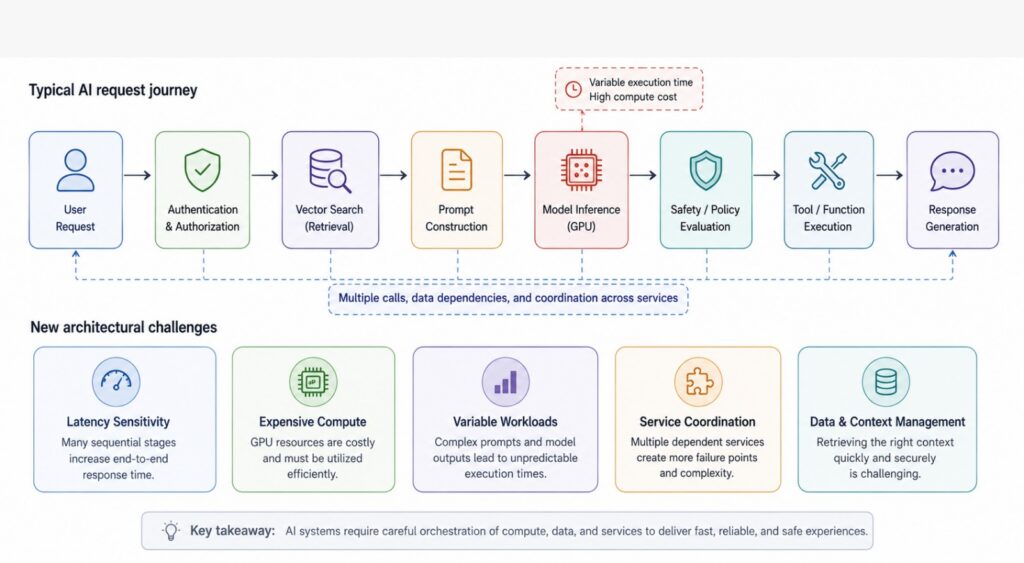
Unlike conventional APIs, AI inference often requires expensive GPU resources, variable execution times, and dynamic context retrieval. A single user request may involve authentication, vector search, prompt construction, multiple model calls, safety evaluation, and tool execution before a response is generated.
These additional stages increase architectural complexity while creating new opportunities for bottlenecks. Engineers must carefully manage latency, hardware utilization, and service coordination to deliver responsive AI applications.
Comparing traditional and AI architectures
| Traditional Systems | AI Systems |
|---|---|
| Deterministic logic | Probabilistic predictions |
| CPU-centric workloads | GPU-intensive inference |
| Database lookups | Vector search and embeddings |
| Static business rules | Continuously evolving models |
| Simple APIs | Multi-stage orchestration pipelines |
Thinking differently about scalability
One of the biggest mindset shifts is recognizing that the AI model is only one service within the overall platform. Scalable AI System Design patterns focus on coordinating data pipelines, inference infrastructure, retrieval systems, orchestration engines, and monitoring platforms rather than optimizing a single component.
This broader systems perspective is exactly what distinguishes experienced engineers during System Design interviews. Instead of discussing only the model, you demonstrate how every architectural layer contributes to scalability, reliability, and operational efficiency.
The building blocks of scalable AI architectures
Although AI applications solve a wide variety of business problems, most production systems share a common architectural foundation. Whether you are designing an AI coding assistant, recommendation engine, enterprise chatbot, or autonomous agent, the same infrastructure components appear repeatedly because they address challenges that nearly every intelligent application encounters. These reusable components form the basis of most scalable AI System Design patterns.
Understanding these building blocks helps you recognize recurring architectural patterns across different products. Instead of viewing each AI application as unique, you begin identifying common services that can be combined in different ways depending on the workload.
Core architectural components
Every scalable AI architecture begins with data collection and processing before progressing through model training, deployment, inference, monitoring, and continuous feedback. Around these core stages, engineers add supporting services such as caching, orchestration frameworks, authentication systems, and messaging platforms to improve performance and reliability.
As AI systems become more sophisticated, additional components such as vector databases, memory services, and workflow engines become increasingly common. Together, these services allow applications to retrieve external knowledge, coordinate multiple models, and support complex user interactions.
| Component | Primary Responsibility |
|---|---|
| Data Pipeline | Collect and prepare data |
| Model Training | Build machine learning models |
| Inference Service | Serve predictions |
| Vector Database | Retrieve semantic information |
| Orchestration Layer | Coordinate AI workflows |
| Cache | Reduce latency and repeated computation |
| Monitoring | Observe health and performance |
| Feedback Loop | Improve future model versions |
Recognizing reusable patterns
The value of scalable AI System Design patterns lies in understanding how these building blocks interact rather than studying each component independently. Once you understand the role of every layer, you can quickly assemble architectures for new AI applications while making informed trade-offs around scalability, latency, reliability, and cost.
Pattern 1: Microservices architecture for AI systems
As AI applications continue growing in complexity, monolithic architectures become increasingly difficult to maintain and scale. A single application may include user authentication, inference services, retrieval pipelines, billing systems, monitoring platforms, and orchestration engines, each with very different performance requirements. This is why microservices have become one of the most widely adopted scalable AI System Design patterns.
By separating responsibilities into independent services, teams can develop, deploy, and scale individual components without affecting the rest of the platform. This modular approach also allows different engineering teams to work independently while supporting continuous deployment and faster feature development.
Breaking AI applications into services
Rather than placing every function inside one application, each major capability becomes its own service. The inference service focuses exclusively on serving models, while retrieval services manage vector databases, authentication services handle user identity, and orchestration services coordinate complex workflows.
This separation improves fault isolation because failures within one service are less likely to impact the entire application. It also enables infrastructure to scale selectively based on workload instead of allocating identical resources across every component.
| Microservice | Responsibility |
|---|---|
| Authentication | User identity and authorization |
| Inference | Model prediction requests |
| Retrieval | Semantic search and vector queries |
| Orchestration | Coordinate AI workflows |
| Monitoring | Collect operational metrics |
| Billing | Track usage and costs |
Benefits and trade-offs
Although microservices improve flexibility and scalability, they also introduce operational complexity through service discovery, network communication, distributed tracing, and deployment management. Successful scalable AI System Design patterns balance these trade-offs by keeping service boundaries clear while investing in strong observability and automation.
For System Design interviews, explaining why you would separate AI workloads into independent services demonstrates that you understand how modern production systems evolve as applications and engineering teams grow.
Pattern 2: Retrieval-Augmented Generation (RAG)
Retrieval-Augmented Generation has become one of the most important scalable AI System Design patterns because it allows language models to generate responses using external knowledge instead of relying entirely on information stored during training. This approach significantly improves accuracy while reducing the need for expensive model retraining whenever underlying information changes.
Today, RAG powers enterprise chatbots, document assistants, customer support platforms, legal research tools, and countless other AI applications that require access to current or organization-specific information. As a result, understanding this pattern has become essential for both production engineering and AI-focused System Design interviews.
How Retrieval-Augmented Generation works
When a user submits a query, the application converts it into an embedding and searches a vector database for semantically similar documents. The retrieved information is then combined with the original prompt before being sent to the language model, allowing the model to generate responses using relevant external context.
This retrieval process enables organizations to keep knowledge up to date without modifying the underlying model. As documents change, only the vector database requires updating rather than retraining an expensive foundation model.
| RAG Component | Purpose |
|---|---|
| Embedding Model | Convert text into vectors |
| Vector Database | Store semantic representations |
| Retriever | Find relevant documents |
| Prompt Builder | Combine context with user query |
| Large Language Model | Generate the final response |
Why RAG scales so well
One of the greatest strengths of scalable AI System Design patterns like RAG is the separation of knowledge from reasoning. The language model focuses on generating coherent responses while retrieval systems manage continuously changing information, resulting in architectures that are easier to maintain, more accurate, and significantly more scalable than repeated fine-tuning.
Pattern 3: Event-driven AI architectures
Many AI workloads involve operations that take several seconds or even minutes to complete, making synchronous request processing inefficient and difficult to scale. Event-driven architecture solves this problem by allowing services to communicate asynchronously through messages rather than waiting for each task to finish before continuing. This makes it one of the most effective scalable AI System Design patterns for high-throughput AI platforms.
Instead of tightly coupling services together, event-driven systems allow each component to process work independently. This decoupling improves scalability, fault tolerance, and resource utilization while making the overall architecture significantly more resilient.
Asynchronous AI workflows
In an event-driven AI application, user requests are published as events that downstream services consume whenever resources become available. One service may generate embeddings, another performs document retrieval, another executes inference, while additional services handle logging, notifications, or analytics independently.
Because these services operate asynchronously, temporary slowdowns in one component do not immediately block the rest of the system. Message queues also provide buffering during traffic spikes, allowing workloads to be processed gradually without overwhelming infrastructure.
| Event-Driven Component | Responsibility |
|---|---|
| Message Queue | Store pending tasks |
| Event Bus | Route events between services |
| Worker Service | Process asynchronous jobs |
| Notification Service | Deliver updates |
| Monitoring Platform | Observe event processing |
Why event-driven architectures improve scalability
One of the biggest advantages of scalable AI System Design patterns built around events is their ability to absorb unpredictable workloads. AI inference, document indexing, embedding generation, and model retraining often occur at different speeds, and asynchronous communication allows each service to scale independently based on demand.
For System Design interviews, event-driven architectures frequently demonstrate engineering maturity because they show that you understand how production AI systems coordinate complex workflows without relying on tightly coupled synchronous communication.
Pattern 4: Distributed inference and model serving
Training a powerful AI model is only half the challenge. Once the model reaches production, it must serve predictions for thousands or even millions of users while maintaining low latency and high availability. This is why distributed inference has become one of the most important scalable AI System Design patterns. Instead of relying on a single inference server, production systems distribute requests across multiple model-serving instances to improve throughput, resilience, and resource utilization.
As AI models continue growing in size, serving infrastructure often becomes more expensive than training infrastructure. Designing an efficient inference layer therefore has a direct impact on both user experience and operational costs.
Building a scalable inference layer
A typical inference architecture begins with an API gateway and load balancer that distribute incoming requests across multiple model servers. Autoscaling policies add or remove inference instances based on GPU utilization, request queues, or latency metrics, ensuring that the platform can adapt to changing traffic patterns without manual intervention.
Modern AI platforms also use request batching, model sharding, and intelligent scheduling to maximize GPU utilization. These optimizations reduce idle hardware while increasing the number of requests that can be processed simultaneously.
| Inference Component | Purpose |
|---|---|
| API Gateway | Receive and authenticate requests |
| Load Balancer | Distribute traffic |
| Model Server | Execute inference |
| GPU Scheduler | Allocate compute resources |
| Autoscaler | Scale infrastructure dynamically |
| Cache | Reduce repeated computation |
Trade-offs in model serving
Although distributed inference significantly improves scalability, it also introduces additional complexity around networking, synchronization, and deployment. Engineers must balance latency, throughput, infrastructure costs, and hardware utilization when designing production AI systems.
For System Design interviews, explaining these trade-offs demonstrates that you understand scalable AI System Design patterns beyond the machine learning model itself. Interviewers are often more interested in how you design reliable serving infrastructure than in the specific model you choose.
Pattern 5: AI orchestration and agent workflows
Modern AI applications rarely rely on a single model call to complete a task. Instead, they coordinate multiple services that retrieve information, execute tools, reason through complex problems, and communicate with external systems before generating a final response. This coordination layer is known as orchestration, and it has become one of the defining scalable AI System Design patterns for building intelligent applications.
As AI systems become more autonomous, orchestration enables applications to break complex tasks into smaller steps while allowing specialized services to handle each stage independently. This modular approach improves maintainability and makes it easier to extend the platform as new capabilities are added.
Coordinating multiple AI services
An orchestration engine manages the overall workflow by determining which services should execute, in what order, and under what conditions. Depending on the request, it may retrieve documents, call external APIs, invoke multiple language models, execute business logic, and validate outputs before returning the final result.
Many AI agent frameworks also include planning modules, memory systems, and tool-calling capabilities that allow applications to solve increasingly sophisticated problems. These services work together to create flexible workflows without tightly coupling every component.
| Orchestration Component | Purpose |
|---|---|
| Workflow Engine | Coordinate execution steps |
| Planner | Determine task sequence |
| Tool Calling | Execute external APIs |
| Memory Service | Store conversational context |
| Agent Manager | Coordinate multiple agents |
| Validator | Verify outputs |
Why orchestration matters
One of the greatest strengths of scalable AI System Design patterns built around orchestration is flexibility. Instead of embedding business logic inside a single model, engineers create modular workflows that are easier to debug, extend, and optimize over time.
This architectural pattern is becoming increasingly common during System Design interviews because it demonstrates how production AI systems coordinate multiple services while remaining scalable and maintainable.
Pattern 6: Caching and memory optimization
AI inference is computationally expensive, making caching one of the simplest and most effective scalable AI System Design patterns for improving performance. Rather than repeatedly performing identical computations, production systems reuse previously generated results whenever possible, reducing both latency and infrastructure costs.
Although caching has always been an important part of distributed systems, AI introduces several new opportunities for optimization. Engineers can cache embeddings, prompt templates, model responses, retrieved documents, and intermediate computations depending on the application’s workload.
Different types of AI caching
Response caching stores complete answers for repeated requests, while embedding caching avoids recomputing vector representations for frequently used documents. Semantic caching goes a step further by identifying requests that are similar rather than identical, allowing systems to reuse previous responses even when prompts are phrased differently.
Session memory also plays an important role in conversational AI by preserving context across multiple interactions. Instead of repeatedly processing the same information, the application can reference previous exchanges to improve efficiency and maintain coherent conversations.
| Cache Type | Primary Benefit |
|---|---|
| Response Cache | Faster repeated responses |
| Embedding Cache | Reduce vector computation |
| Semantic Cache | Reuse similar queries |
| Feature Cache | Accelerate ML pipelines |
| Session Memory | Preserve conversation context |
Balancing performance and freshness
Although caching improves scalability, stale information can reduce response quality if cached data is not updated appropriately. Successful scalable AI System Design patterns therefore include cache invalidation policies that balance performance improvements with the need to deliver current and accurate information.
For interview preparation, understanding when to cache and when to recompute demonstrates practical engineering judgment. Interviewers often value thoughtful trade-off discussions more than simply mentioning caching as an optimization technique.
Pattern 7: Observability, resilience, and fault tolerance
Building a scalable AI application is not just about handling increasing traffic. It also requires designing systems that continue operating when individual components fail, workloads spike unexpectedly, or model performance degrades over time. This is why observability and resilience have become essential scalable AI System Design patterns for production environments.
Without comprehensive monitoring, engineers have little visibility into why an AI application becomes slower, more expensive, or less accurate. Modern AI platforms therefore invest heavily in operational tooling that continuously measures system health and detects problems before users notice them.
Monitoring production AI systems
Unlike traditional applications, AI systems must monitor both infrastructure metrics and model-specific behavior. Engineers track latency, throughput, GPU utilization, request failures, and resource consumption alongside model accuracy, hallucination rates, retrieval quality, and model drift.
Distributed tracing provides end-to-end visibility into every request, allowing teams to identify bottlenecks across inference services, retrieval pipelines, orchestration engines, and external APIs. This holistic view makes troubleshooting significantly faster.
| Operational Pattern | Purpose |
|---|---|
| Monitoring | Track system health |
| Distributed Tracing | Follow request execution |
| Circuit Breakers | Prevent cascading failures |
| Retries | Recover from transient errors |
| Graceful Degradation | Maintain service during failures |
| Rate Limiting | Protect infrastructure |
Designing for failure
Every production system experiences failures eventually, so resilient architectures assume that components will occasionally become unavailable. Successful scalable AI System Design patterns include redundancy, fallback models, retry policies, and graceful degradation strategies that keep applications functional even during partial outages.
This operational mindset is highly valued during System Design interviews because it demonstrates that you understand how production systems behave under real-world conditions rather than ideal scenarios.
Real-world scalable AI System Design patterns
The best way to understand scalable AI System Design patterns is by examining how successful AI companies solve similar engineering problems. While implementation details differ between organizations, the underlying architectural principles remain remarkably consistent across production systems serving millions of users every day.
Whether you study conversational AI platforms, coding assistants, AI search engines, or recommendation systems, you will repeatedly encounter the same design patterns. Distributed inference, retrieval pipelines, caching, orchestration, event-driven processing, and comprehensive monitoring form the foundation of nearly every large-scale AI application.
Common patterns across leading AI platforms
OpenAI, Anthropic, Microsoft, Google, GitHub, Netflix, and Perplexity all combine multiple architectural patterns rather than relying on a single solution. Their platforms coordinate APIs, model-serving infrastructure, retrieval services, orchestration engines, observability platforms, and scalable storage systems to deliver reliable user experiences.
Although each organization optimizes for different business goals, the reusable architectural building blocks remain largely the same.
| Company Type | Common Design Patterns |
|---|---|
| Conversational AI | Distributed inference, RAG, orchestration |
| AI Search | Retrieval pipelines, vector databases, caching |
| Coding Assistants | Context retrieval, tool calling, inference |
| Enterprise AI | RAG, workflow orchestration, observability |
| Recommendation Systems | Event-driven processing, feature stores, caching |
Learning from production architectures
Studying real-world architectures helps you recognize reusable engineering principles rather than memorizing company-specific implementations. This understanding allows you to adapt scalable AI System Design patterns to new applications while explaining your architectural decisions with greater confidence.
For System Design interviews, this broader perspective enables you to justify design choices using proven industry practices instead of relying on theoretical knowledge alone.
Mastering scalable AI System Design patterns for interviews
Learning scalable AI System Design patterns is one of the most effective ways to prepare for the next generation of software engineering interviews. As organizations increasingly build AI-powered products, interview questions are shifting from traditional distributed systems toward architectures that incorporate language models, retrieval systems, orchestration frameworks, and AI-specific infrastructure.
Rather than memorizing complete system diagrams, you should focus on understanding why each architectural pattern exists, when it should be applied, and what trade-offs it introduces. This approach prepares you to solve unfamiliar design problems with confidence.
A practical learning roadmap
Begin with distributed systems fundamentals before exploring AI-specific infrastructure. Once concepts such as caching, load balancing, messaging systems, databases, and observability become familiar, gradually expand into vector databases, Retrieval-Augmented Generation (RAG), distributed inference, orchestration frameworks, and AI security.
The most effective preparation combines theory with practice. Designing multiple AI systems and comparing alternative architectures helps reinforce reusable design patterns that appear repeatedly during interviews.
Final interview advice
Strong candidates communicate their reasoning as clearly as their architecture. During interviews, explain assumptions, identify bottlenecks, discuss scaling strategies, and justify every major design decision instead of jumping directly to implementation details.
As AI continues reshaping software engineering, scalable AI System Design patterns will become increasingly valuable knowledge for backend engineers, platform engineers, machine learning engineers, and software architects. Mastering these patterns will help you design production-ready AI systems while giving you a significant advantage in modern System Design interviews.
Free Resources Worth Bookmarking
If you’re looking to continue learning, the following free resources are excellent additions to your System Design study plan.
| Free Resource | Best For |
|---|---|
| System Design Primer | Reviewing interview fundamentals and core distributed systems concepts |
| Complete Guide to System Design | Following a structured learning roadmap from beginner to advanced topics |
| System Design Guide | Comprehensive guides covering distributed systems, architecture patterns, and modern System Design concepts |
| System Design Interview Guide | Preparing specifically for System Design interviews with interview-focused guides and examples |
| Grokking the System Design Interview | Exploring advanced architecture, large-scale distributed systems, and senior engineering design decisions |
Final thoughts
Scalable AI applications are built on much more than powerful machine learning models. Behind every successful AI product is a carefully designed architecture that combines distributed systems, data engineering, inference infrastructure, orchestration, observability, caching, and security into a cohesive platform capable of serving millions of users reliably.
The technologies used to build AI systems will continue evolving rapidly, but the underlying architectural principles remain remarkably consistent. By mastering scalable AI System Design patterns, you develop a reusable engineering toolkit that applies across conversational AI, recommendation systems, AI search, autonomous agents, enterprise assistants, and countless future applications. This systems-level thinking will not only make you a stronger software engineer but will also prepare you for the increasingly AI-focused System Design interviews that define today’s technology landscape.